Clear Sky Science · en
Bee swimming is adaptive but disrupted by insecticide
Why Bees on Water Matter
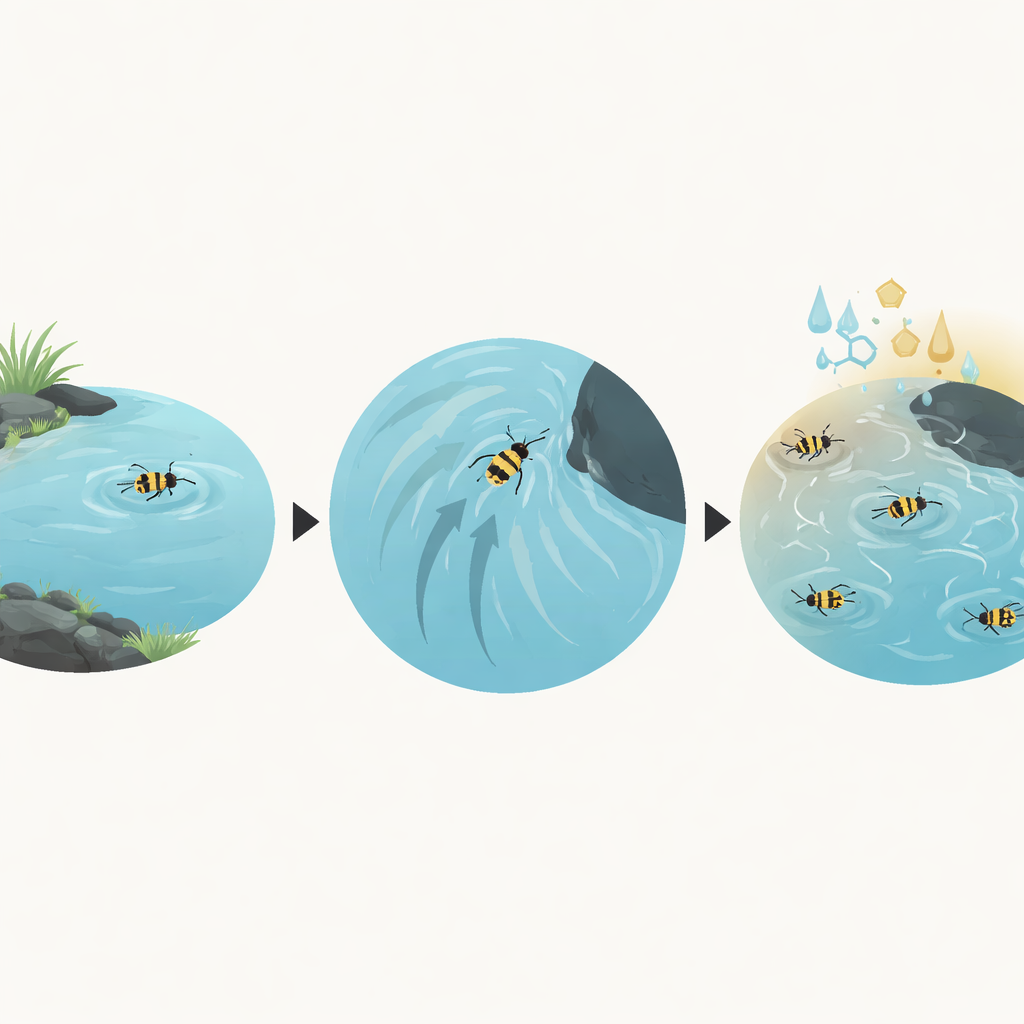
If you picture a honey bee in trouble, you might imagine it caught in a spider’s web or trapped in a storm. But bees face another, less obvious danger: drowning. When they fall onto ponds, puddles, or farm irrigation water, their chances of survival depend on what they do next. This study reveals that bees are not helpless in this situation—they can "swim" across the water surface in a surprisingly purposeful way—and shows how a common insecticide can quietly undermine that lifesaving behavior.
Bees That Paddle to Safety
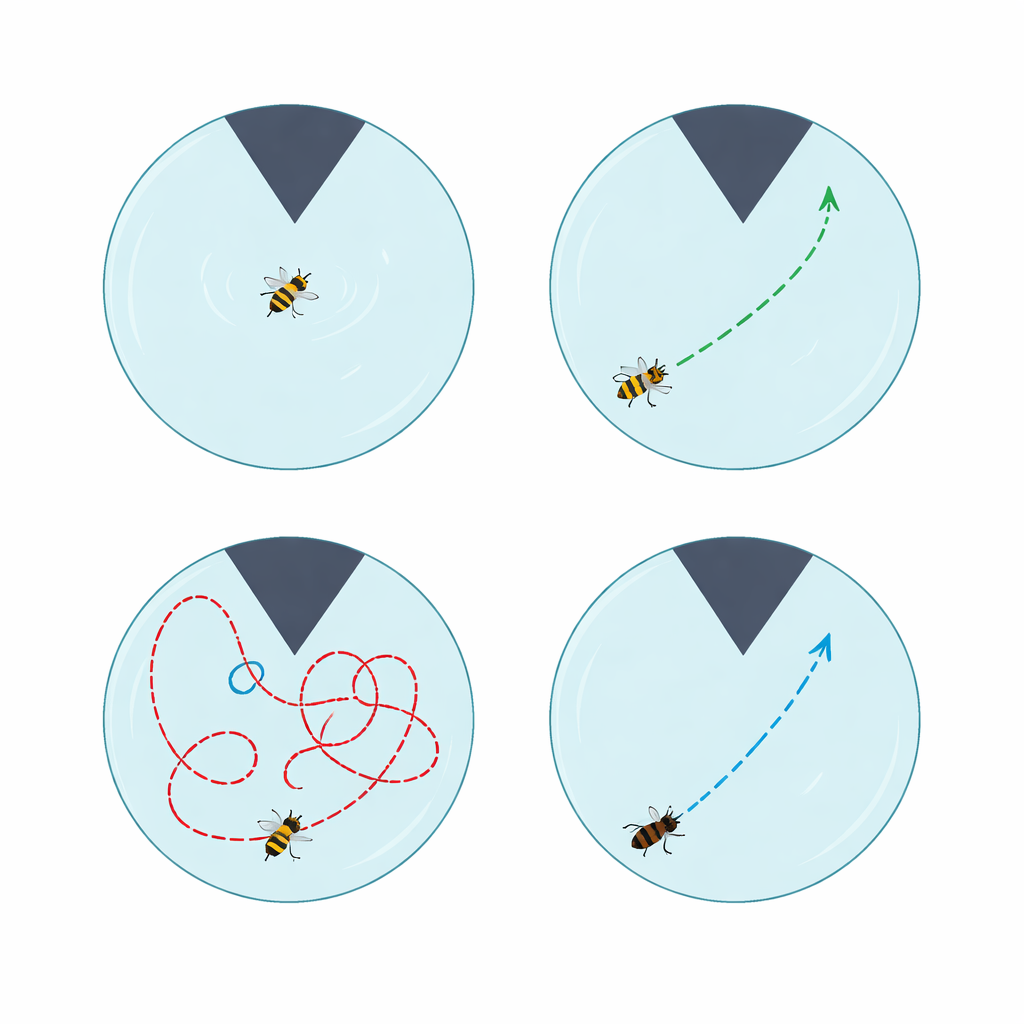
Recent work showed that honey bees can move across the water surface by beating their wings while keeping the tops of those wings dry, allowing them to push against the water without sinking. The new research set out to ask a deeper question: is this just an odd trick that occasionally works, or is it an evolved escape strategy? To find out, the scientists placed individual bees in a circular bowl of water where one fifth of the rim was covered by a dark strip, mimicking natural features like tree bark or soil. They then watched where each bee finally reached the edge.
Drawn Toward the Dark
Honey bees consistently headed for the darker side of the arena instead of landing at random points around the rim. This preference for dark objects—a behavior called skototaxis—likely helps a stranded bee find solid ground in nature, where darker shapes often mark land or vegetation rising above the water. The pattern was seen in bees tested in both the United States and China, suggesting that this is a robust, purposeful response rather than a fluke of one group or location. The result supports the idea that bee swimming is an adaptive behavior shaped by natural selection to cut the risk of drowning.
When Chemicals Confuse the Escape
The researchers then asked what happens when bees are exposed to thiamethoxam, a widely used neonicotinoid insecticide that can contaminate nectar and pollen. Bees were fed sugar syrup containing a field-realistic concentration of the chemical for several days before being tested in the water arena. After this exposure, their behavior changed strikingly. Instead of favoring the dark sector, treated bees landed at random around the rim. They also took longer to reach the edge, swam farther overall, and traced out more tangled, looping paths with extra turns. Their average speed did not change, suggesting that their muscles still produced force, but their fine control or coordination was impaired.
Lessons from a Solitary Cousin
To understand how ancient or widespread this escape strategy might be, the team also tested mason bees, a solitary species that does not live in large social colonies. Both male and female mason bees showed an even stronger pull toward the dark area than honey bees did. Females, which in nature are responsible for nest building and food gathering, proved the most efficient swimmers: they reached the edge faster, covered shorter distances, and moved at higher speeds than males. Compared with honey bees, female mason bees needed less time and distance to escape, hinting that strong swimming ability may have been especially important before social living evolved in bee lineages.
What This Means for Bees and People
Together, the experiments show that bee "swimming" on water is not random thrashing but a directed, useful behavior that helps them find safety by homing in on dark visual cues. The fact that a common insecticide disrupts this finely tuned response underscores how human-made chemicals can harm bees in subtle ways that go beyond the usual focus on foraging or navigation in the air. Because bees are vital pollinators for wild plants and crops alike, understanding and protecting even these rare, emergency behaviors—like escaping from water—adds another reason to limit pesticide exposure in their environment.
Citation: Liu, F., Li, W. & Huang, Z.Y. Bee swimming is adaptive but disrupted by insecticide. Commun Biol 9, 397 (2026). https://doi.org/10.1038/s42003-026-09669-w
Keywords: honey bee behavior, neonicotinoid insecticide, pollinator health, swimming and skototaxis, mason bees