Clear Sky Science · en
The core clock transcription factor TOC1 binds directly to defence gene promoters regulating immunity in Arabidopsis
Plants on a Daily Defense Schedule
Plants cannot run away from germs, so they rely on finely tuned defense systems. This study reveals that a part of the plant’s internal daily clock, a protein called TOC1, does more than just keep time. It also decides when plants are most vulnerable or most resistant to a common gray mold fungus, helping to explain why the time of day can change the outcome of an infection.
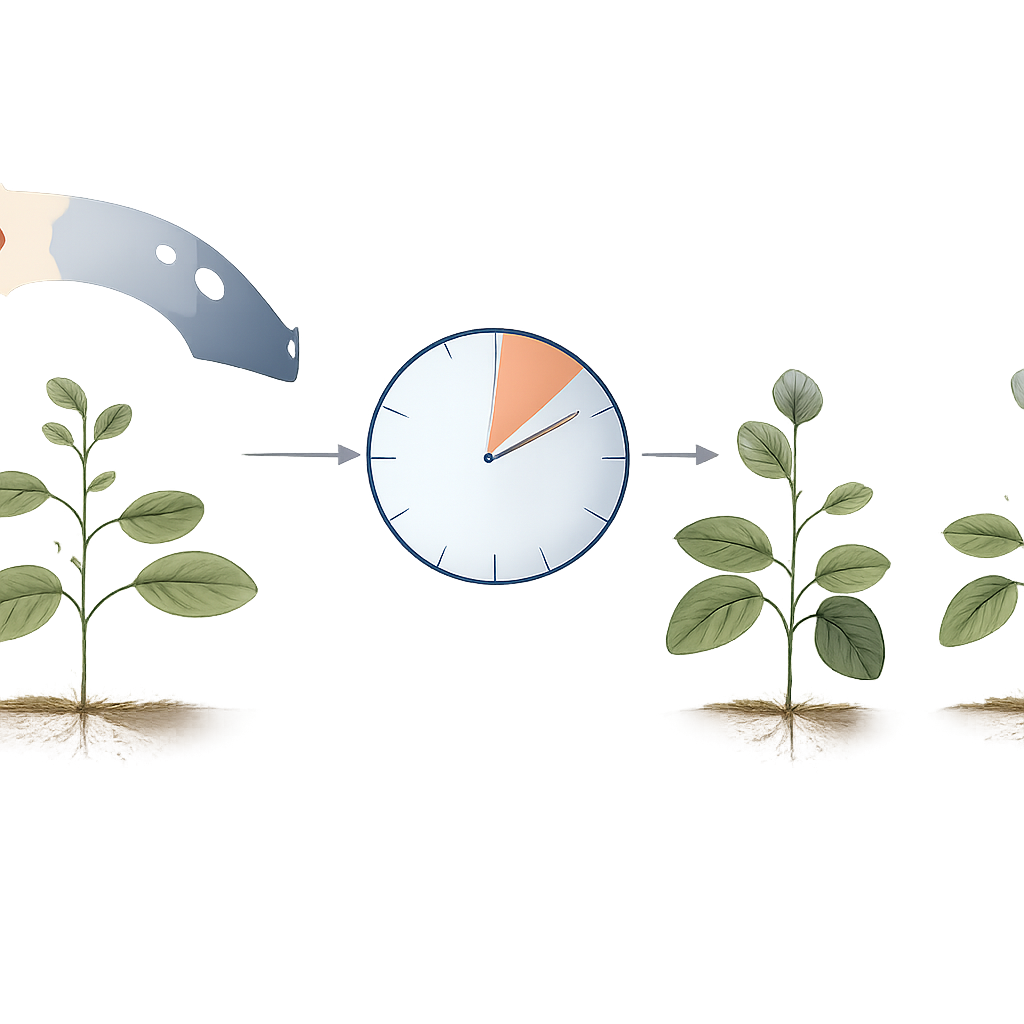
Why Time of Day Changes Infection Risk
The researchers worked with Arabidopsis, a small mustard plant widely used as a model organism, and the fungus Botrytis cinerea, which rots many crops. Earlier work showed that plants are generally more resistant to this fungus around dawn and more susceptible at night. Here, the team focused on TOC1, a key clock protein that normally peaks toward evening, to see if it directly controls this day–night swing in disease resistance.
Clock Protein That Weakens Plant Defenses
Using plants engineered to make too much TOC1, and mutants lacking TOC1, the authors infected leaves at either subjective dawn or night under both constant light and normal light–dark cycles. In normal plants, lesion size—dead tissue caused by the fungus—depended strongly on time of infection. In contrast, both TOC1-overexpressing and TOC1-lacking plants lost this daily variation. Plants with excess TOC1 were stuck in a highly susceptible state, while plants without TOC1 behaved as if locked in their most resistant state. This pattern shows that TOC1 acts as a brake on immunity: more TOC1 means weaker defense, especially when it is normally high in the evening.
Defense Genes Already Poised Before Attack
To understand what TOC1 was doing inside the cell, the team compared the activity of thousands of genes in normal and TOC1-lacking plants, with and without infection. Even before any fungus arrived, the mutant without TOC1 already mis-expressed hundreds of genes linked to stress and defense. Many of these genes carried short DNA motifs that TOC1 is known to recognize, suggesting it normally sits on their control regions and keeps them turned down. Key regulators of hormone pathways involved in defense, particularly those driven by jasmonic acid and ethylene, were more active when TOC1 was absent, providing a molecular explanation for the mutant’s heightened resistance.
How TOC1 and MYC2 Share the Same Switches
The story becomes more intricate at the level of individual defense switches in the genome. The authors zoomed in on several defense-related transcription factors—ERF4, ORA47, ORA59, and WRKY33—whose promoters contain a common DNA motif called a G-box. This same motif is recognized by another protein, MYC2, a central player in jasmonic acid signaling. Using chromatin immunoprecipitation, they showed that TOC1 physically occupies these G-box regions in healthy plants, consistent with it holding defense genes in check. After fungal infection, TOC1’s grip on these promoters largely disappeared, yet MYC2 remained bound. When MYC2 was removed genetically, TOC1 binding in healthy plants fell and, crucially, TOC1 was no longer released after infection. At the same time, expression of the downstream defense regulators dropped. Together, these results indicate that MYC2 helps recruit and then evict TOC1 from defense genes in an infection-dependent manner.
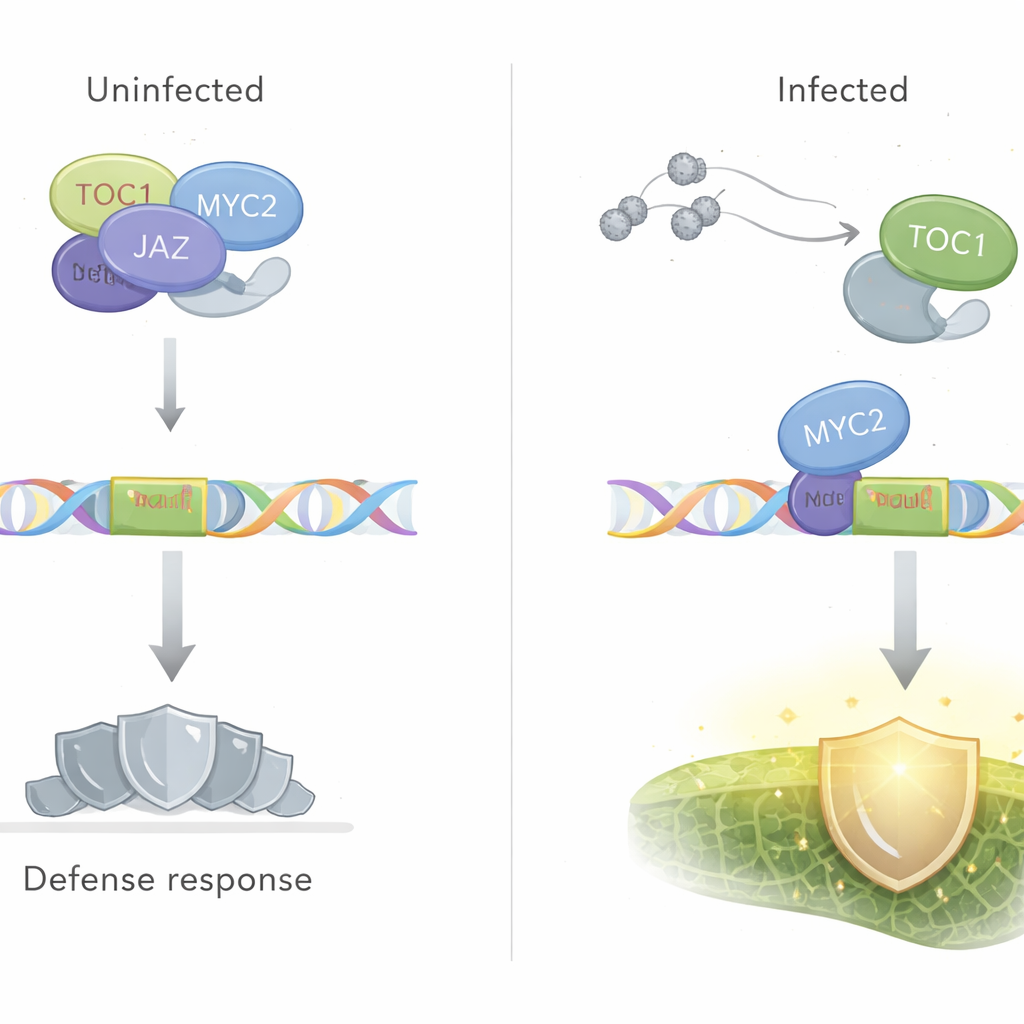
Clock-Gated Immunity in Everyday Life
Putting these pieces together, the authors propose that the plant clock and hormone signaling form a shared control panel for immunity. Over a 24-hour cycle, TOC1 levels rise toward evening, and with help from MYC2, TOC1 sits on G-box motifs in defense genes and dampens their activity, creating a daily “gate” that narrows the window of strong defense. When a pathogen is detected and jasmonic acid levels surge, MYC2 changes its behavior, TOC1 is released from these DNA sites, and the brake on defense is lifted so plants can mount an acute response, regardless of the time of day. For a lay reader, the key message is that plant immune strength is not constant: it is scheduled by the internal clock, and TOC1 is a central timing component that directly flips the switches on important defense genes.
Citation: Sparks, SL., Roden, L.C. & Ingle, R.A. The core clock transcription factor TOC1 binds directly to defence gene promoters regulating immunity in Arabidopsis. Commun Biol 9, 402 (2026). https://doi.org/10.1038/s42003-026-09667-y
Keywords: plant circadian clock, Arabidopsis immunity, Botrytis cinerea, jasmonate signaling, transcription factors