Clear Sky Science · en
Rocking-induced sleep enhancement promotes motor learning through transcriptional and synaptic remodelling
Why rocking mice matters for better sleep
Most of us know that gently rocking a baby can help them drift off to sleep. But is this soothing motion just comforting, or does it actually change the brain in ways that improve learning? This study explores that question in mice, showing that daily gentle rocking during sleep not only makes their rest longer and more stable, but also helps them master a demanding running task more quickly. The work begins to uncover how a simple, drug-free method of enhancing sleep may tune brain circuits involved in learning new movements.
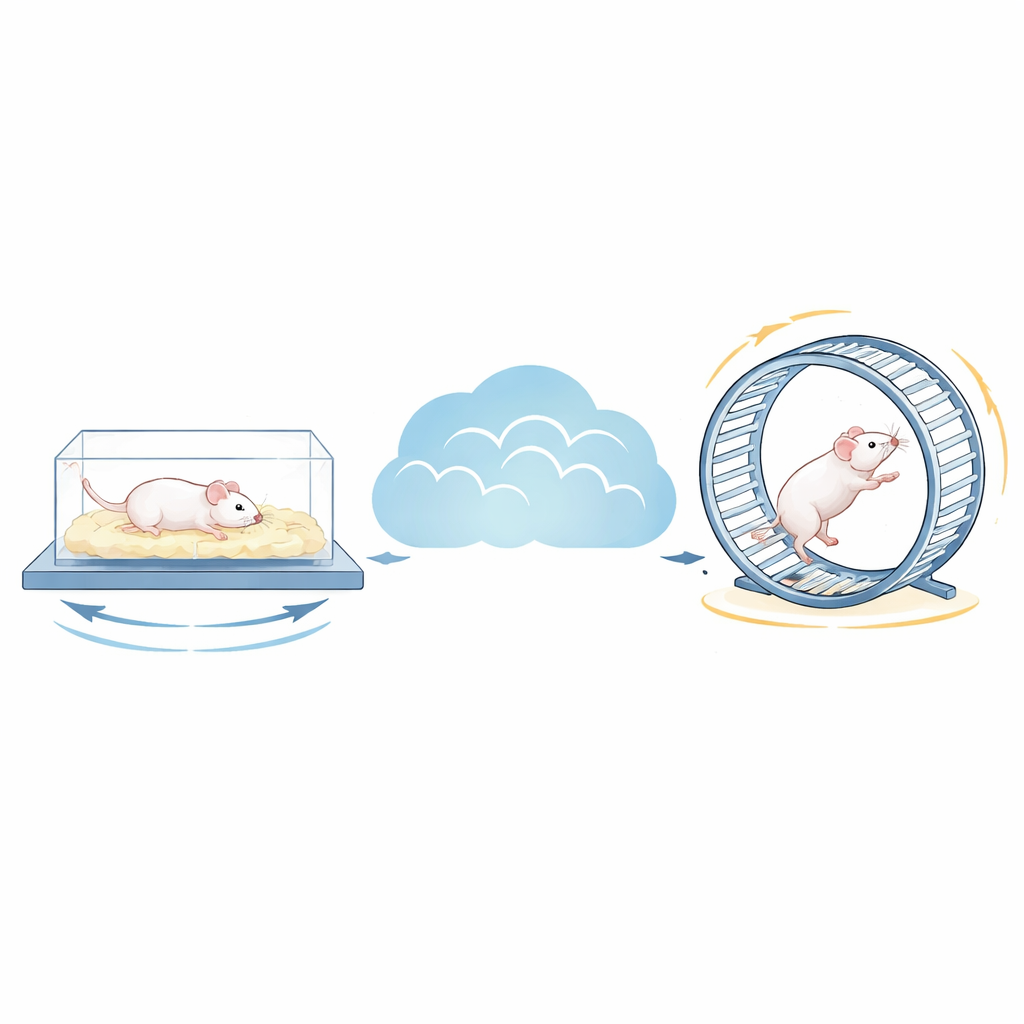
Gentle motion that deepens rest
The researchers used a platform that moved mouse cages back and forth at a slow, steady rhythm, similar to the sway of a hammock. When applied during the animals’ usual rest phase, this rocking reliably increased how long the mice slept and made their sleep less fragmented, without disturbing the balance of different sleep stages. Over eleven days, rocked mice consistently slept more than unrocked controls, and their sleep remained consolidated instead of breaking into short, shallow bouts. Rocking during the active, nighttime phase, by contrast, did not change sleep patterns, suggesting that timing the motion to the natural rest window is crucial.
Sleep that sharpens motor skills
To see whether this extra, more stable sleep had a functional payoff, the team tested the animals on a challenging motor task. Instead of a regular exercise wheel, they used a custom "complex" wheel with missing rungs arranged in an uneven pattern. Running smoothly on it requires practice and fine-tuned paw placement. Both rocked and unrocked mice improved over days, but those that had their sleep enhanced by daytime rocking learned faster: they reached higher top speeds and did so earlier in training. The better the individual mouse slept across the experiment, the greater its gain in performance, linking sleep amount to learning success. Importantly, total time spent running and distance covered were similar between groups, indicating that it was the quality of sleep, not extra exercise, that explained the advantage.
Changes inside the motor brain
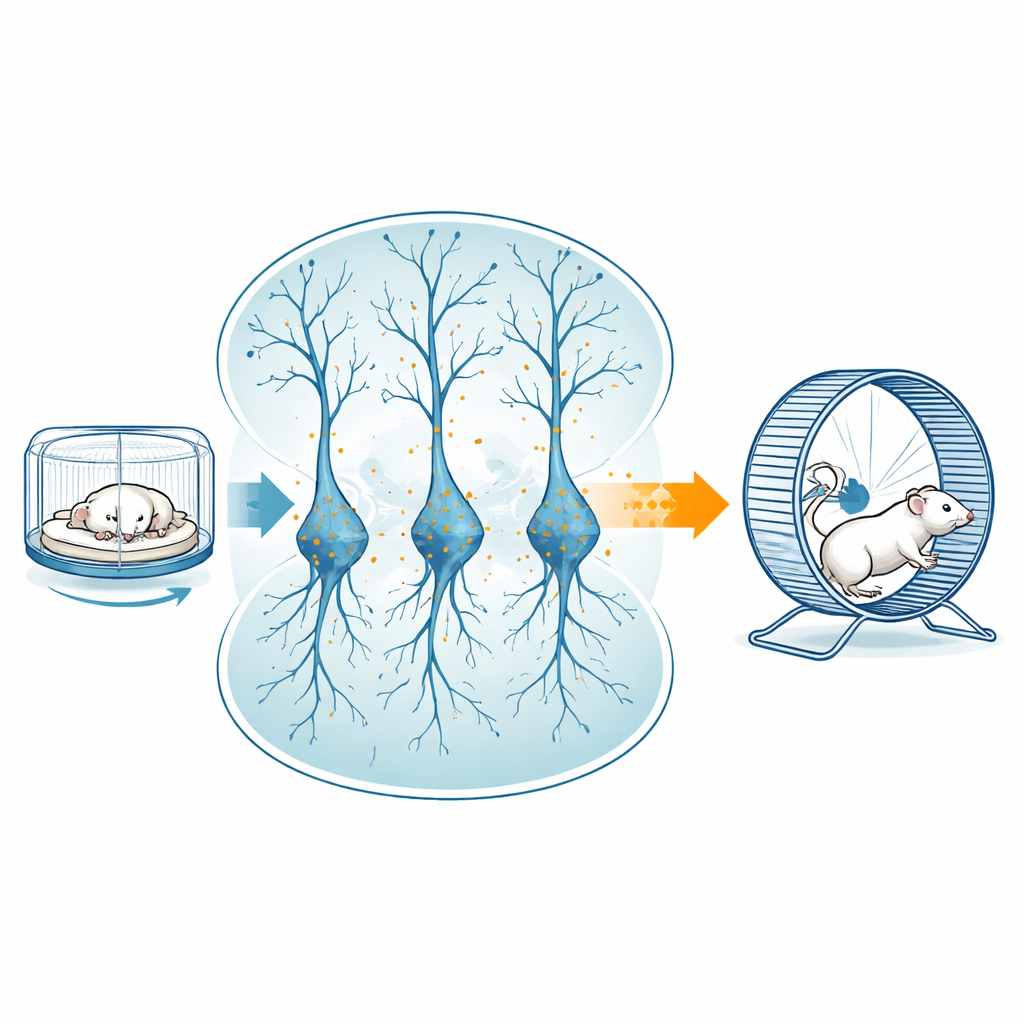
The scientists next asked what was happening in the brain’s motor cortex, the region that helps control movement. In mice that combined rocking-enhanced sleep with daily practice on the complex wheel, patterns of gene activity shifted toward those involved in communication between nerve cells and in reshaping connections. Many of the altered genes are tied to glutamate, the main excitatory chemical messenger, and to molecules known to support learning and memory. Using microscopic staining, the team then counted tiny contact points where nerve cells talk to each other. They found that excitatory synapses in the motor cortex were denser in rocked learners than in controls, while inhibitory synapses were unchanged. This suggests that better sleep helps the brain strengthen the specific pathways needed to refine a new motor skill.
When rocking is not enough
Crucially, rocking alone did not always remodel the brain. In a separate experiment, mice were rocked during their rest phase for the same eleven days but were not given access to the complex wheel. These animals still slept longer and more steadily, yet their motor cortex and a key memory area in the hippocampus showed no detectable change in synapse density. Similarly, when rocking was applied during wakefulness before training on the wheel, it failed to improve learning. Together, these tests argue that rocking helps by improving the sleep environment in which learning-related changes can occur, but actual practice of a skill is required to drive lasting structural rewiring.
What this means for our own sleep
In everyday terms, this study suggests that gentle, well-timed motion can make sleep more continuous and, in doing so, create better conditions for the brain to refine motor skills. Rocking does not magically boost performance on its own; instead, it appears to support the natural processes by which practice during wake is consolidated into more efficient brain circuits during sleep. While the work was done in mice and focused on a specific movement task, it hints that non-drug approaches like rhythmic motion could one day be tailored to help people with fragmented sleep or those undergoing rehabilitation learn physical skills more effectively.
Citation: Simayi, R., Santoni, L., Galizia, S. et al. Rocking-induced sleep enhancement promotes motor learning through transcriptional and synaptic remodelling. Commun Biol 9, 393 (2026). https://doi.org/10.1038/s42003-026-09666-z
Keywords: sleep enhancement, rocking stimulation, motor learning, synaptic plasticity, vestibular stimulation