Clear Sky Science · en
Molecular resilience of neurons to repetitive mechanical compression
How Our Nerves Survive Daily Wear and Tear
Every time you bend your back, turn your head, or take a step, the nerves running through your body are gently squeezed and stretched. Over a lifetime, this adds up to millions of tiny mechanical hits to the same cells. This study asks a surprisingly simple question with big implications: how much repeated squeezing can nerve cells tolerate before they break, and do they have built-in ways to repair themselves when the pressure is not too extreme?
Testing Nerves Under Repeated Squeezing
The researchers worked with sensory nerve cells taken from the dorsal root ganglia, clusters of neurons near the spine that carry touch, pain, and body-position signals. They grew these neurons in a tiny lab-made chamber sitting on a stretchable rubber-like sheet. By carefully moving this sheet with a screw-driven device, they could apply controlled cycles of compression to the axons—the long, cable-like extensions that carry nerve signals—without crushing the cell bodies themselves. They tested three levels of repeated compression, all delivered in 20 cycles: a low level (2.5% shortening), a middle level (5%), and a high level (10%).
When Pressure Becomes Destructive
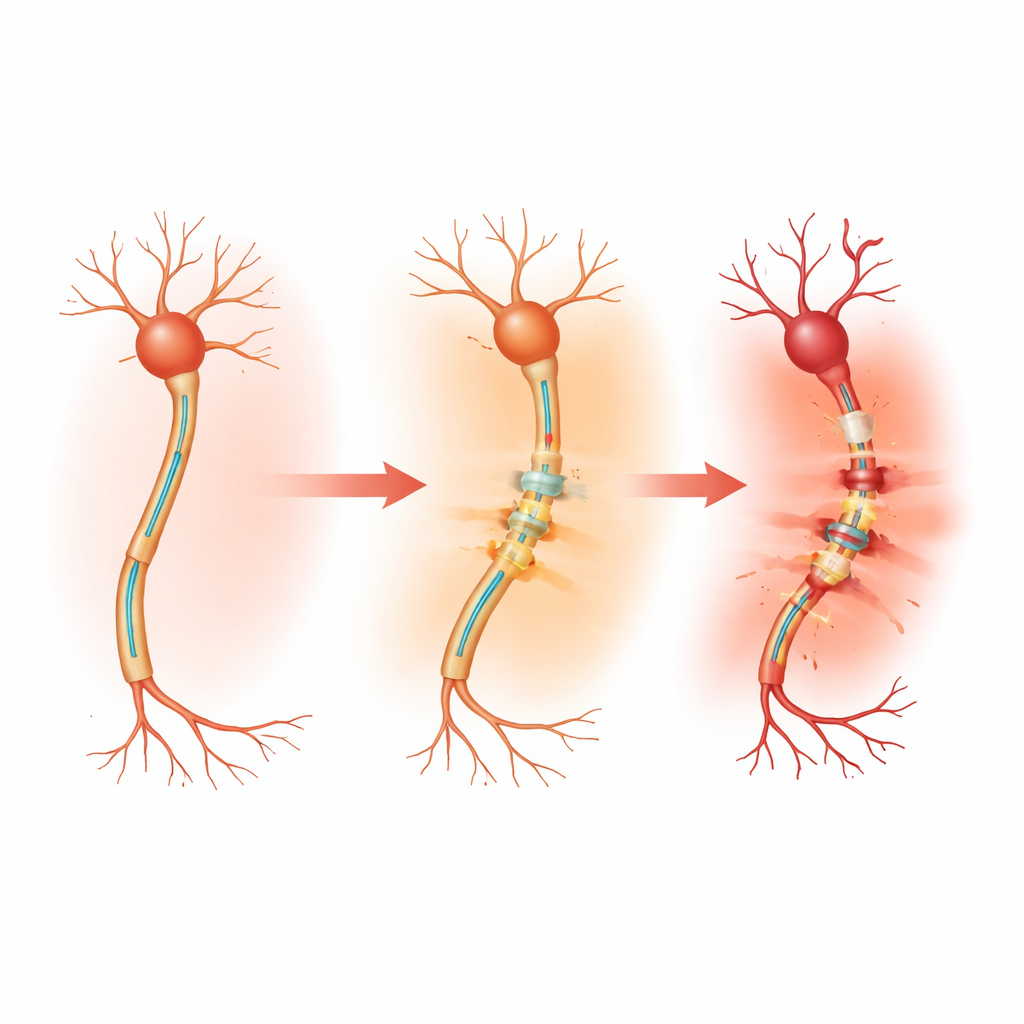
At the highest level of repeated compression, the neurons fared poorly. Electron microscope images showed severe internal damage: the DNA inside the nucleus clumped, membranes around internal structures broke, and the normally orderly scaffolding inside the axon dissolved into featureless dark material. Many axons appeared degenerated, and the rate of cell death jumped sharply. Under these conditions, the injury came on quickly and was so extensive that the cells did not seem able to mount effective repair responses. In other words, there is a range of repeated mechanical stress that simply overwhelms nerve cells and pushes them toward permanent damage and death.
Gentle Squeezes That Make Nerves Tougher
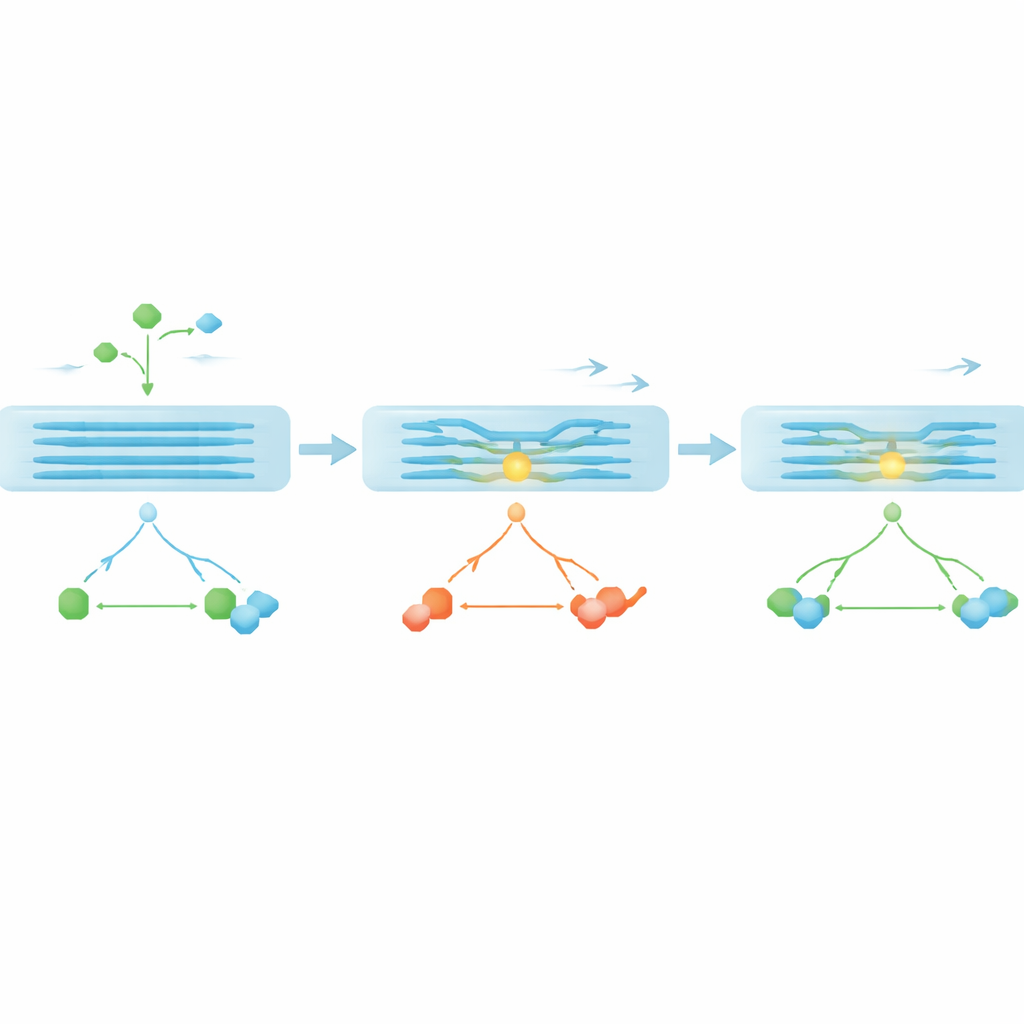
Low-level repeated compression told a different story. Here, the neurons remained alive and their internal fine structure looked normal. The axons did become shorter for a time, reflecting a kind of temporary retraction, but there were no signs of tearing or loss of key internal components. Instead, the researchers found a chemical signature of reinforcement inside the axons. The microtubules—stiff, tube-like filaments that form the main structural rails inside the axon—showed an increase in a modification associated with stability, and a decrease in a modification linked to rapid turnover. By 24 hours after the compression cycles, axon length and microtubule chemistry had returned to baseline. This suggests that mild mechanical stress can trigger a protective response that stabilizes the nerve’s internal skeleton and helps it bounce back.
The Middle Ground: Damage First, Recovery Later
The moderate compression level, 5%, landed between these two extremes and revealed how neurons cope with more serious but still survivable stress. Shortly after these cycles, axons were shorter, and their internal microtubule bundles looked disturbed: filaments were fewer, spaced farther apart, and often twisted or misaligned. Chemical markers indicated that the microtubules had become less stable. Yet most cells did not die, and within a day, both the architecture and the chemistry of the microtubules largely recovered. To probe how this rebound happens, the team analyzed which genes changed their activity after compression. They found strong signs that a well-known signaling route centered on Ras proteins—a family of molecular switches that control cell growth, survival, and the internal scaffold—was being engaged. Initially, the active form of Ras dropped, in line with reduced stability of the microtubules. Later, molecules that turn Ras back on became more abundant, Ras activity returned to normal, and the axon’s internal structure was restored.
Why These Findings Matter for Everyday Life
Taken together, the work shows that neurons respond to repeated mechanical squeezing in a dose-dependent way. Strong, repeated compression causes catastrophic breakdown and death. Gentle compression triggers a kind of “training effect,” prompting the cell to stiffen and protect its internal rails. Intermediate compression initially disrupts the axon’s scaffolding, but neurons can call on molecular pathways such as Ras signaling to reorganize their internal structure and regain their length. For a layperson, the message is that our nerves are not fragile glass fibers; they are living, adaptive tissues with built-in safety margins and repair systems that help them survive the continuous mechanical jostling of daily life—up to a point.
Citation: Coppini, A., Cappello, V., Nasrin, S.R. et al. Molecular resilience of neurons to repetitive mechanical compression. Commun Biol 9, 392 (2026). https://doi.org/10.1038/s42003-026-09661-4
Keywords: neuronal mechanobiology, axon compression, microtubule dynamics, Ras signaling, nerve resilience