Clear Sky Science · en
Species mixing promotes plant biomass accumulation and nutrient cycling in forest plantations
Why Mixing Tree Species Matters
As countries race to replant forests to store carbon, protect soils, and supply wood, most new plantations are still made of a single tree species grown like crops in rows. This study asks a simple but crucial question with big implications for climate and land restoration: do forests made of many tree species actually work better than single-species plantations at building wood, enriching the soil, and recycling nutrients? By pulling together thousands of comparisons from around the world, the authors provide one of the clearest answers yet—and it strongly favors diversity.
More Kinds of Trees, More Living Mass
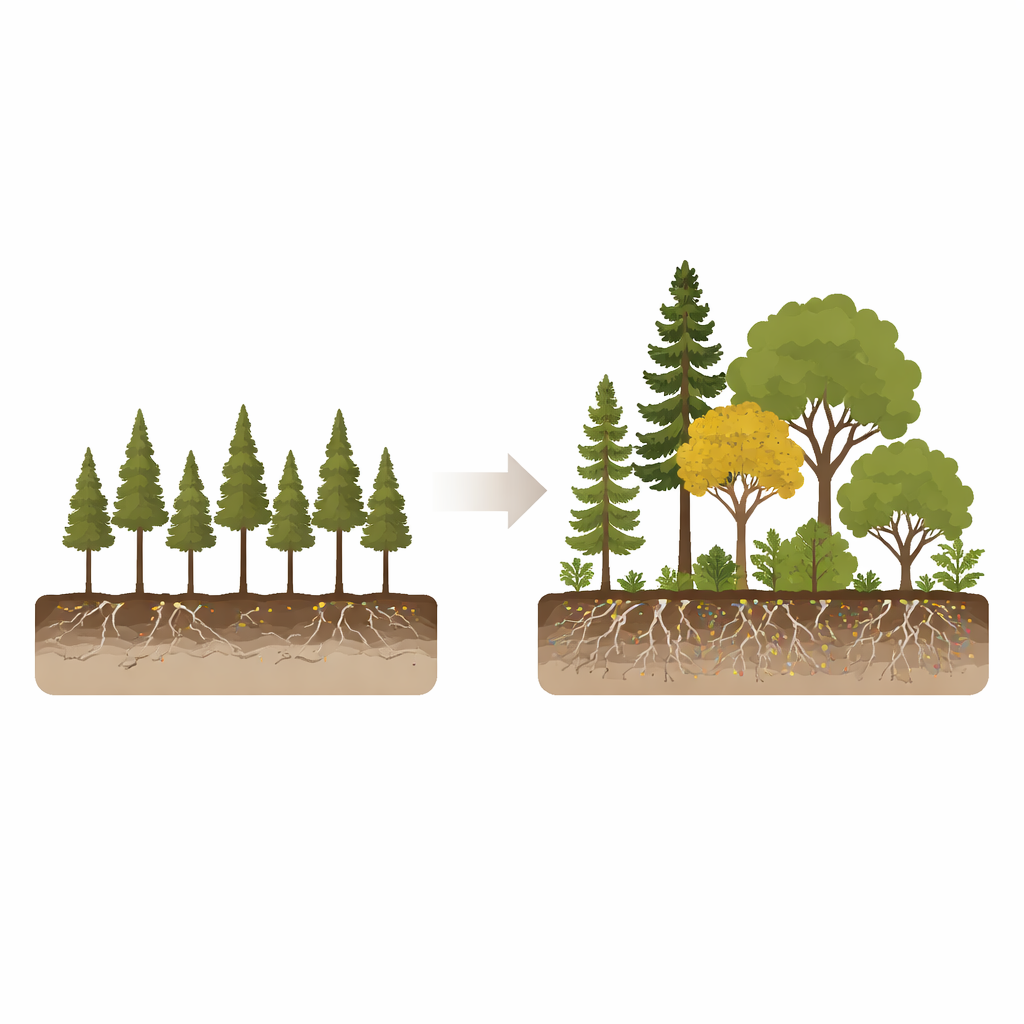
The researchers combined 8,450 paired measurements from 328 field studies that directly compared mixed-species plantations with nearby monocultures grown under the same conditions. Across regions, climates, and management styles, stands with several tree species grew more plant material—what scientists call biomass—than their single-species counterparts. On average, total plant biomass was about one sixth higher in mixed stands, with especially strong gains in the wood and leaves of trees. Tree crowns became longer and wider, trunks thicker, and overall tree height slightly greater, creating taller, fuller canopies. Shrubs in the middle layer of the forest also expanded, while herbs on the forest floor stayed roughly the same, suggesting that extra growth stacked vertically rather than simply replacing one layer with another.
Hidden Gains Below the Ground
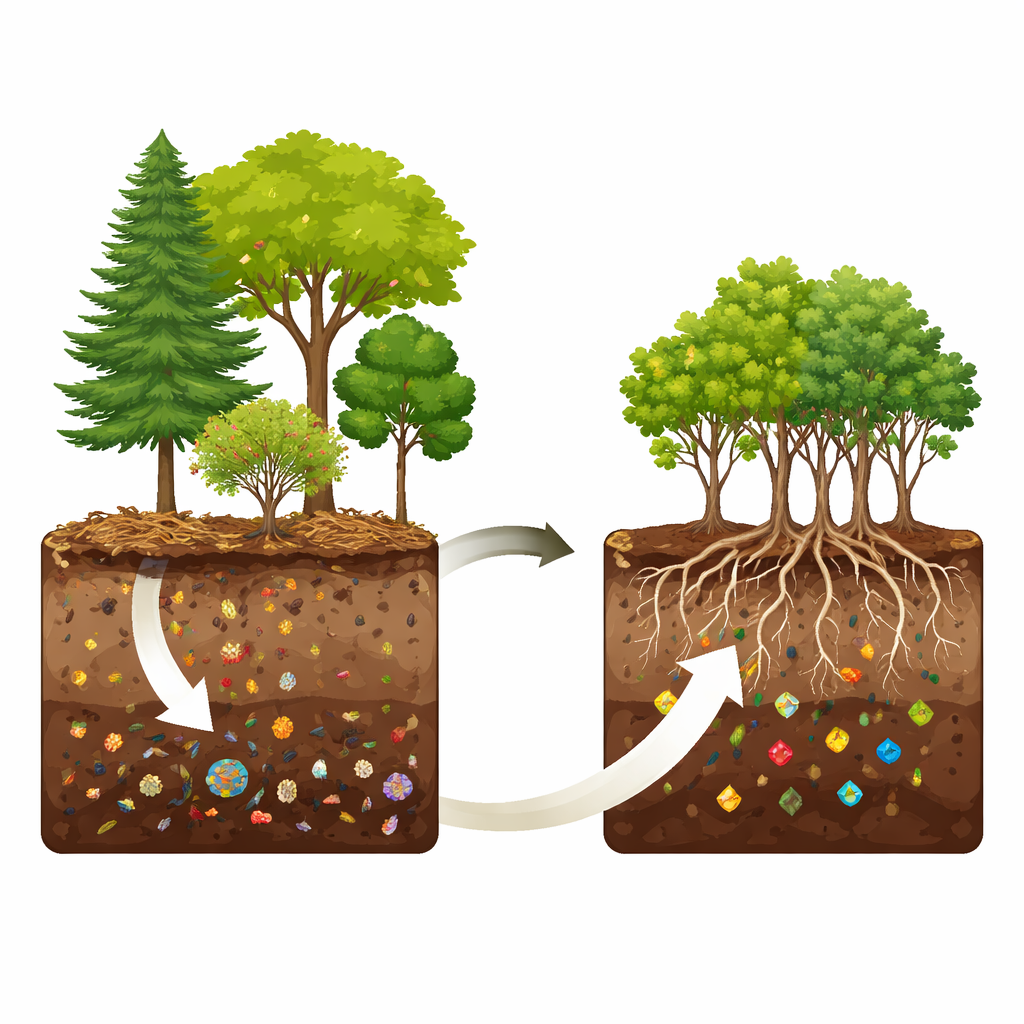
The benefits of species mixing extended into the soil. Trees in mixed plantations invested more in coarse roots and stumps, reinforcing support for their larger crowns and adding carbon below ground. At the stand level, soils under mixed forests held more organic carbon, more nitrogen, and more available phosphorus and potassium. Microbial biomass—representing the tiny organisms that power decomposition and nutrient recycling—also increased. Leaf litter and fallen material contained richer stores of nitrogen and potassium, feeding a cycle in which better-quality debris fuels more active microbes, which in turn release nutrients that plants can use. At the same time, the basic balance among elements like carbon, nitrogen, and phosphorus in the soil stayed stable, suggesting that fertility rose without throwing the system out of chemical balance.
Where and When Mixing Works Best
Not every mixed forest performed equally well. The analysis showed that gains from species mixing were strongest in warm, wet climates, where long growing seasons and ample moisture allow trees to take full advantage of their complementary traits. With increasing numbers of tree species, both biomass and nutrient improvements generally rose. Other factors followed more curved patterns. At low to moderate elevations, mixture benefits were positive but weakened and could even turn negative higher in the mountains, where cold limits growth. Similarly, positive effects on biomass peaked in middle-aged stands before declining in very old or overly dense plantations, where competition for light and soil resources becomes intense. This means that diversity helps most when climate, stand age, and planting density fall within ranges that allow species to share rather than fiercely fight over resources.
Guiding Smarter Forest Restoration
By synthesizing evidence across continents, this study shows that mixing tree species in plantations usually leads to forests that grow more wood, build healthier soils, and recycle nutrients more efficiently than monocultures. Importantly for practitioners, the work also clarifies that “more species” is not a magic bullet on its own: the biggest rewards come when functionally different species are combined in climates and stand structures that support their cooperation. For planners designing new plantations or restoring degraded lands, the message is clear in everyday terms: a thoughtfully mixed “team” of tree species can turn plantations into more self-sustaining, productive, and resilient forests, better able to lock away carbon and maintain fertile soils over the long haul.
Citation: Zhang, H., Feng, H., Qu, X. et al. Species mixing promotes plant biomass accumulation and nutrient cycling in forest plantations. Commun Biol 9, 348 (2026). https://doi.org/10.1038/s42003-026-09646-3
Keywords: mixed-species plantations, forest restoration, nutrient cycling, forest biodiversity, carbon storage