Clear Sky Science · en
Linking aerobic scope to fitness in the wild reveals potential opportunities to help recover imperiled salmon populations
Why this matters for salmon and people
Across the U.S. West Coast, Chinook salmon are shrinking in number, threatening ecosystems, fisheries, and Indigenous cultures that depend on them. This study asks a deceptively simple question with big consequences: how do river temperature and oxygen levels translate into real-world survival chances for young salmon? By tying lab measurements of salmon metabolism to years of field tracking and population data, the authors pinpoint when improving water conditions can actually boost survival—and when such efforts would do little good.
How much “breathing room” a fish has
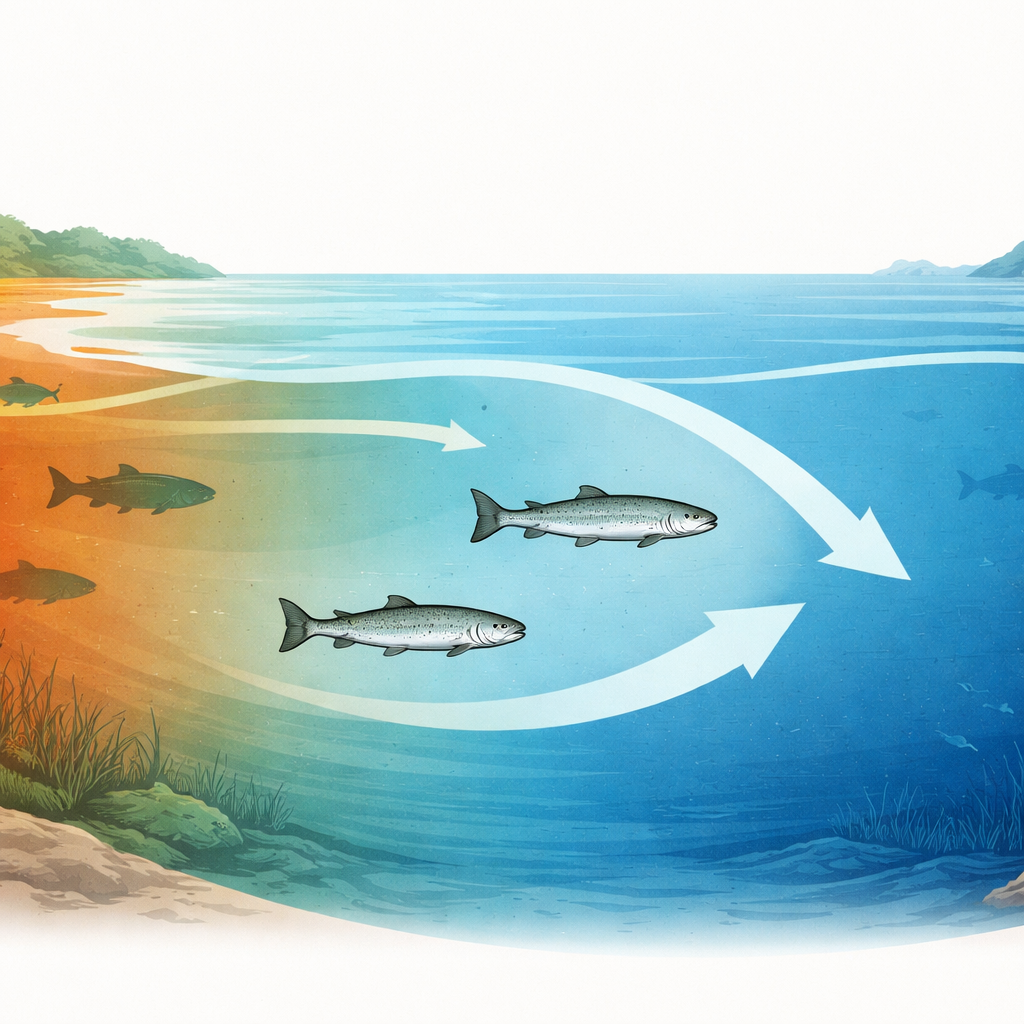
Like all animals, fish need energy to move, grow, and escape predators. That energy ultimately depends on how much oxygen they can take from the water beyond what is needed just to stay alive—a margin the authors call aerobic scope. They use a metric called the metabolic index, symbolized by the Greek letter phi, to summarize this “breathing room.” Phi combines water temperature and oxygen with measurements of how much oxygen juvenile Chinook salmon need at different life stages. Higher phi means more aerobic room to swim, feed, and recover from bursts of activity; lower phi means that even basic tasks become costly or impossible.
Tracking young salmon through a stressful river maze
The team studied Chinook salmon in California’s Sacramento–San Joaquin Delta, a warm, heavily modified river network that all juveniles must pass through on their way to the ocean. They focused on two critical stages: tiny fry that rear and grow in the Delta’s shallow habitats, and larger smolts that migrate downstream toward the sea. Using respirometry experiments on hundreds of hatchery fish, they estimated how temperature and oxygen shape phi for each life stage. They then linked these lab-based traits to massive field datasets: a decade of fish surveys showing where fry actually occur, thousands of acoustically tagged smolts whose survival through the Delta was tracked, and detailed records of flow, temperature, and dissolved oxygen throughout the system.
A narrow window where conditions really matter
When the researchers compared phi to real-world success—whether fry used certain habitats and whether smolts survived migration—they found a threshold pattern. Below a critical value (phicrit), successful rearing or migration was extremely unlikely no matter what else changed. Above a slightly higher “stable” value (phistable), further improvements in temperature or oxygen brought little extra survival benefit; other factors took over. Only in the narrow middle band between these two values did modest increases in phi translate into big gains in habitat use and migration success. River flow added another twist: higher flows could partially compensate for poorer water quality below phistable, boosting success when aerobic conditions were only marginal.
Predators thrive when salmon are pushed to their limits
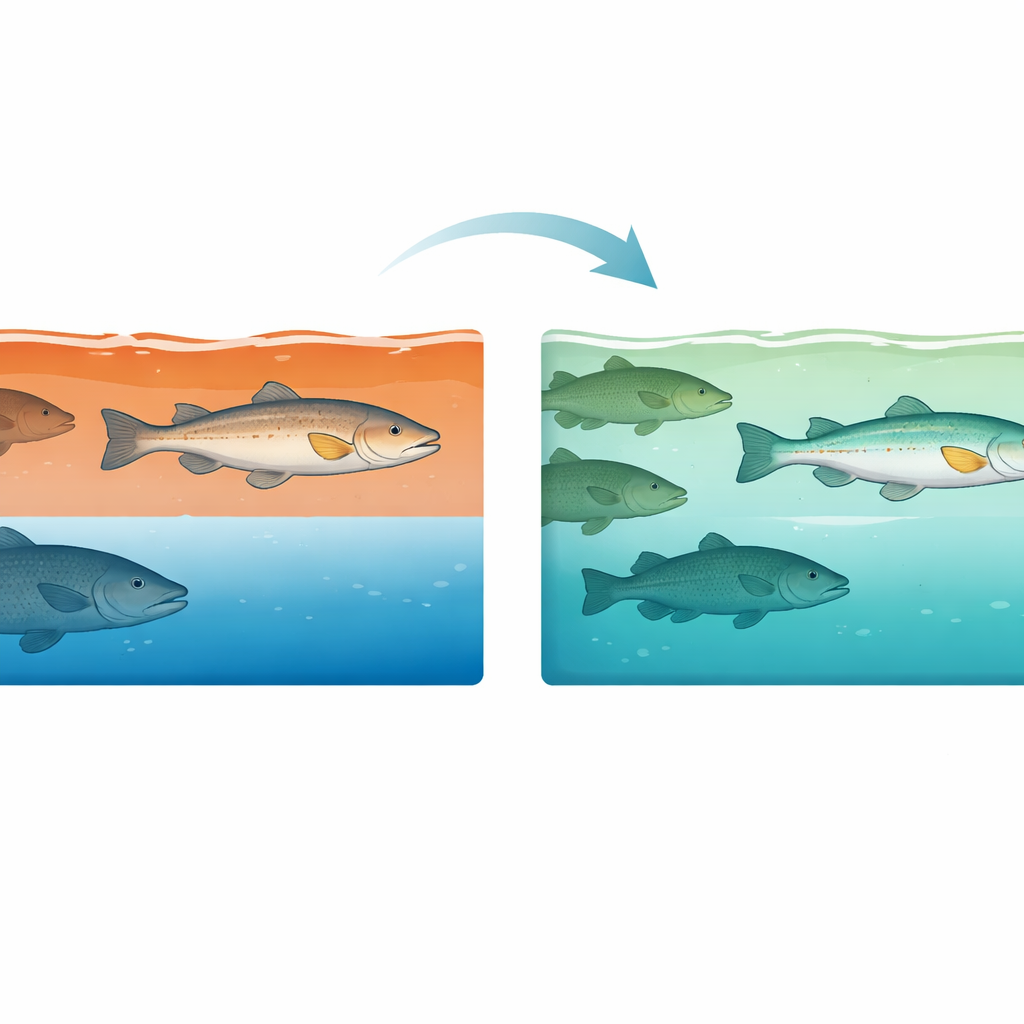
Young salmon in the Delta face heavy predation from non-native warmwater fish such as largemouth bass. The study shows that these predators generally enjoy a built-in aerobic advantage over salmon under the same conditions. Using experiments that filmed tethered juvenile salmon in the field, the researchers found that the likelihood of bass attacks rose when salmon aerobic capacity was limited but still above the point of total collapse—that is, in the same middle band of phi where small changes in water conditions matter most. In very cold water, predators were sluggish; in very poor conditions for salmon, attacks also dropped because overall activity was suppressed. This suggests that even slight reductions in salmon aerobic room can tip predator–prey encounters against them.
Turning science into smarter river management
Because phi directly reflects the combined effects of temperature and oxygen, it offers a more focused measure of water quality than temperature alone. The authors show that, for migrating smolts, models based on phi explain survival just as well as traditional temperature-based models, but point to oxygen shortages as a hidden driver. Their results imply that targeted actions—such as timed releases of cooler, well-oxygenated water from reservoirs, efforts to reduce oxygen-sapping plant growth, or increases in flow that expand usable habitat—could have outsized benefits when conditions are hovering between phicrit and phistable. Outside this window, the same interventions may yield little return, either because failure is almost certain or because fish are already operating with plenty of aerobic room.
What this means for saving salmon
The study concludes that aerobic capacity is neither a universal silver bullet nor an irrelevant detail. Instead, it can both limit and enhance salmon fitness depending on when and where fish encounter stressful conditions. For managers, this means that aiming simply to avoid the lowest viable levels of oxygen and the highest temperatures is not enough. A more protective benchmark is phistable, the point where further gains in aerobic room stop improving survival. By keeping conditions at or above this level—especially during key rearing and migration windows—water managers can make the most of limited cold water and restoration funds, and give imperiled salmon populations a better chance to recover in a warming, increasingly variable climate.
Citation: Burford, B.P., Lehman, B.M., Zillig, K.W. et al. Linking aerobic scope to fitness in the wild reveals potential opportunities to help recover imperiled salmon populations. Commun Biol 9, 359 (2026). https://doi.org/10.1038/s42003-026-09642-7
Keywords: Chinook salmon, aerobic scope, river temperature, dissolved oxygen, predation risk