Clear Sky Science · en
Organic periostracum preserved in Cretaceous ammonoids from the Andean Neuquén Basin
Ancient Shell Skin Frozen in Time
On the floor of a 135‑million‑year‑old sea in today’s Argentine Andes, scientists have found something almost impossibly delicate: the original outer “skin” of extinct coiled cephalopods called ammonoids. This whisper‑thin coating, normally the first part of a shell to vanish after death, has survived long enough to reveal how these animals built and protected their shells—and how fragile organic materials can endure for deep stretches of geological time. 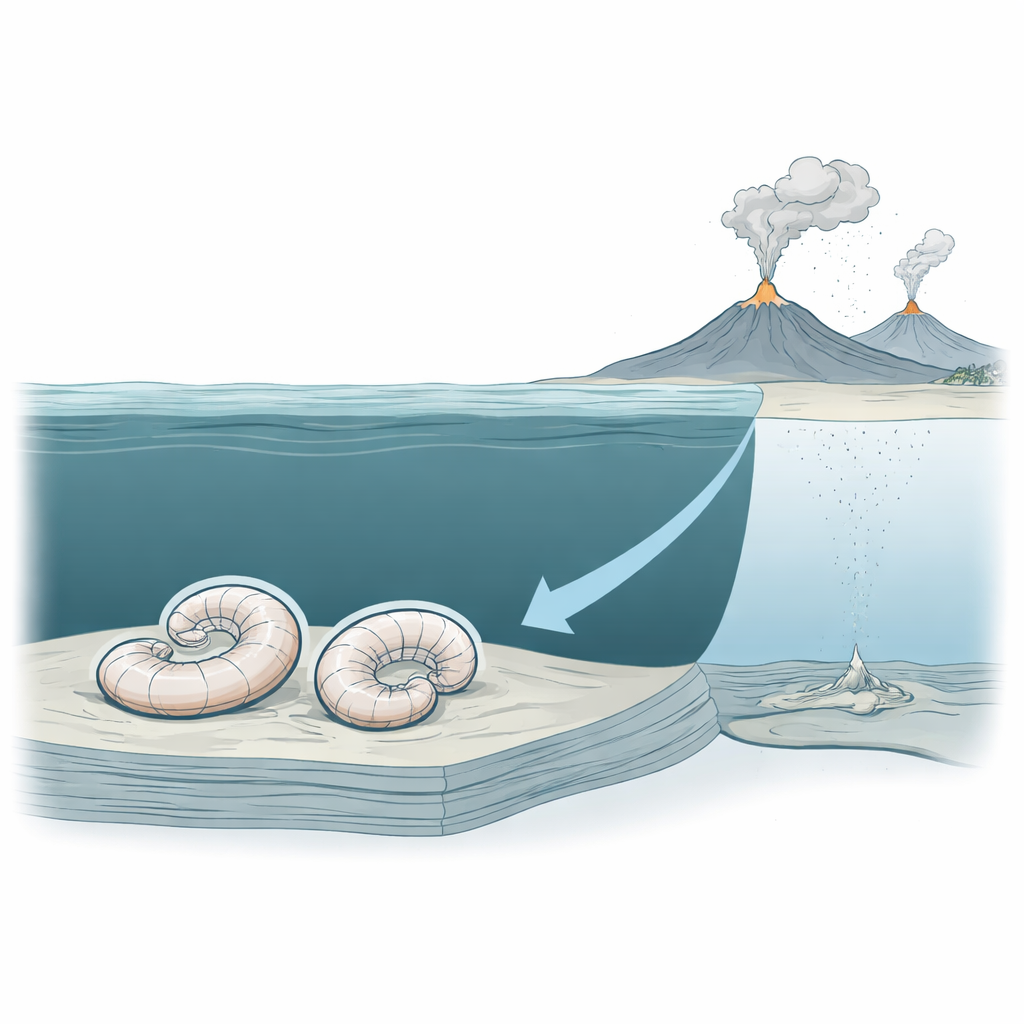
A Hidden Layer on Familiar Fossils
Ammonoid fossils are common in museums and rock outcrops, but what we usually see is only the mineral shell or, more often, its rocky mould. In living mollusks, that shell is wrapped in an outer organic film known as the periostracum, which helps start shell formation and shields it from wear and chemical attack. Until now, this film had almost never been convincingly documented in ammonoids. In rocks of the Vaca Muerta Formation in the Neuquén Basin—once a relatively deep marine setting at the foothills of the growing Andes—researchers studying two ammonoid species, Bochianites neocomiensis and Lissonia riveroi, discovered specimens where the original shell had dissolved away but a fragile, flexible film still clung to the fossil moulds.
What the Fossil Film Looks Like
Viewed under various types of microscopes, this fossil film behaves like a remarkably well‑kept ghost of the original surface. It is only about two micrometres thick—roughly one hundredth the thickness of a human hair—and can peel off the rock when exposed. Its outer face is mostly smooth, while the inner face shows a fine honeycomb pattern made of tiny polygonal pits and ridges where the now‑vanished mineral shell once pressed against it. The film sometimes splits along internal planes, hinting at an original internal layering. Both sides also record tiny imprints of planktonic organisms and mineral grains, showing that the film was still soft and slightly plastic when it was buried, able to take on impressions from its surroundings without breaking.
What It Is Made Of
To find out what this film consists of, the team used a suite of chemical tools, including electron microscopes, X‑ray–based imaging, and infrared and Raman spectroscopy. These methods detect the fingerprints of different chemical groups within a material. Even after being heated and compressed for tens of millions of years, the fossil film still shows signals from components typical of modern shell coatings: protein‑like amide groups, carbohydrate‑rich polysaccharides linked to chitin, and lipid‑related chemical bonds. Although the signals are weaker and blurrier than in fresh material—consistent with partial degradation—they closely match what is seen when modern mollusk periostraca are experimentally heated to mimic burial. This suggests that the basic recipe for this shell “skin” has changed little over hundreds of millions of years and across very different mollusk groups.
A Rare Window of Preservation
The survival of such a fragile organic layer demands very special conditions. Geological and microscopic evidence from the host rocks shows that, after death, the ammonoids settled into a quiet, fine‑grained, low‑oxygen seafloor. Layers of lime mud, organic matter, volcanic ash, and siliceous microfossils piled up gently, with little disturbance. Limited oxygen slowed decay, while early cementation of the surrounding sediment physically shielded the film from later disturbance and microbial attack. Volcanic input may have further shifted chemical conditions in the mud, aiding the preservation of organic matter and promoting the growth of pyrite grains that now stud the outer surface. Together, these factors created a brief but highly favorable “taphonomic window” that locked the periostracum in place before it could vanish. 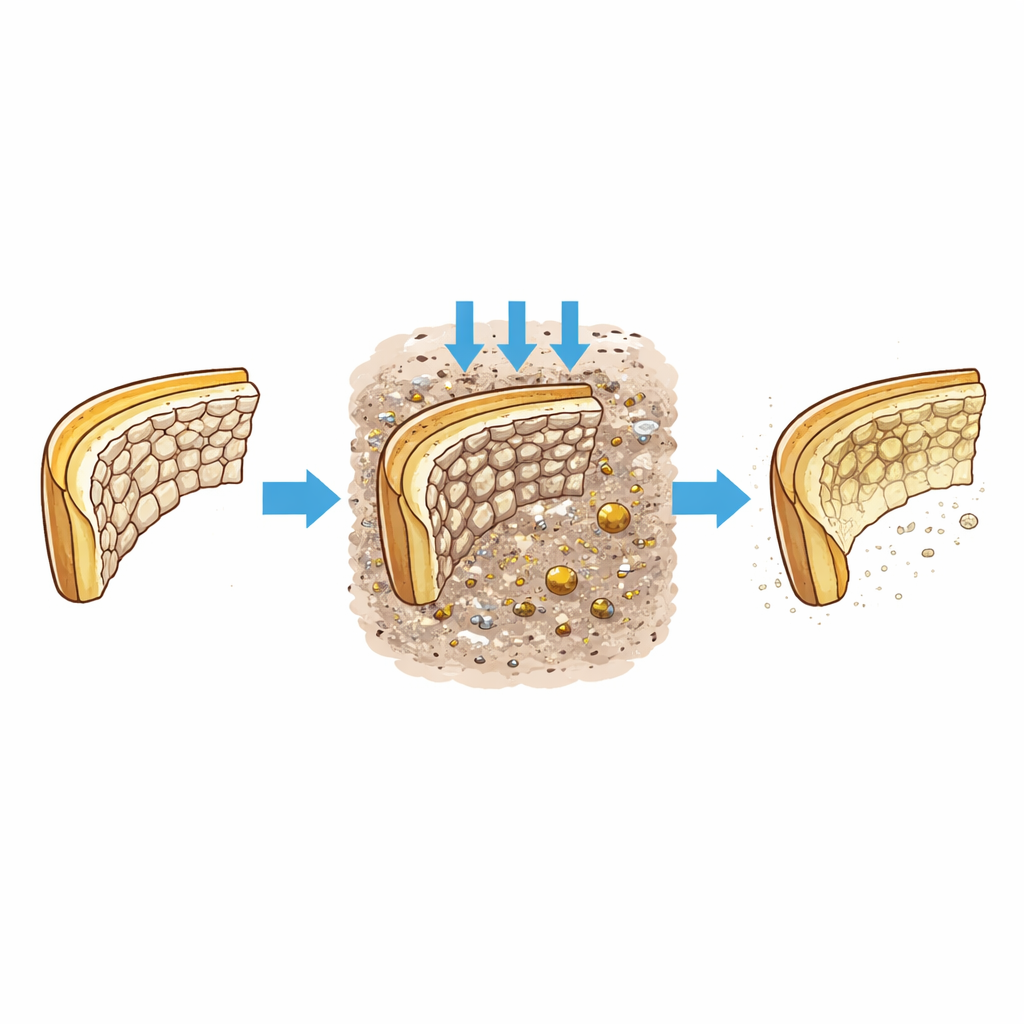
Why This Deep Time Shell Skin Matters
To a non‑specialist, the idea that a soft, nearly invisible coating can persist for 135 million years may be surprising, but it has big implications. It shows that the fine organic architecture of ancient animals can sometimes survive alongside or even in place of their mineral parts, if the burial setting is just right. It also indicates that ammonoids shared a shell skin strikingly similar to that of today’s squid, cuttlefish, snails, and clams, underscoring how conservative some biological designs can be over vast evolutionary spans. Most importantly, this work reveals that such delicate structures are not necessarily lost to time; in the right rocks and environments, more examples likely wait to be found, promising new insights into how ancient marine life grew, protected, and even colored its shells.
Citation: Aguirre-Urreta, B., Marin, L.S., Checa, A.G. et al. Organic periostracum preserved in Cretaceous ammonoids from the Andean Neuquén Basin. Commun Biol 9, 372 (2026). https://doi.org/10.1038/s42003-026-09635-6
Keywords: ammonoid fossils, shell periostracum, fossil preservation, Vaca Muerta Formation, ancient cephalopods