Clear Sky Science · en
Generating cisgenic sexing strains in insect pests
Why sorting tiny insects matters to us
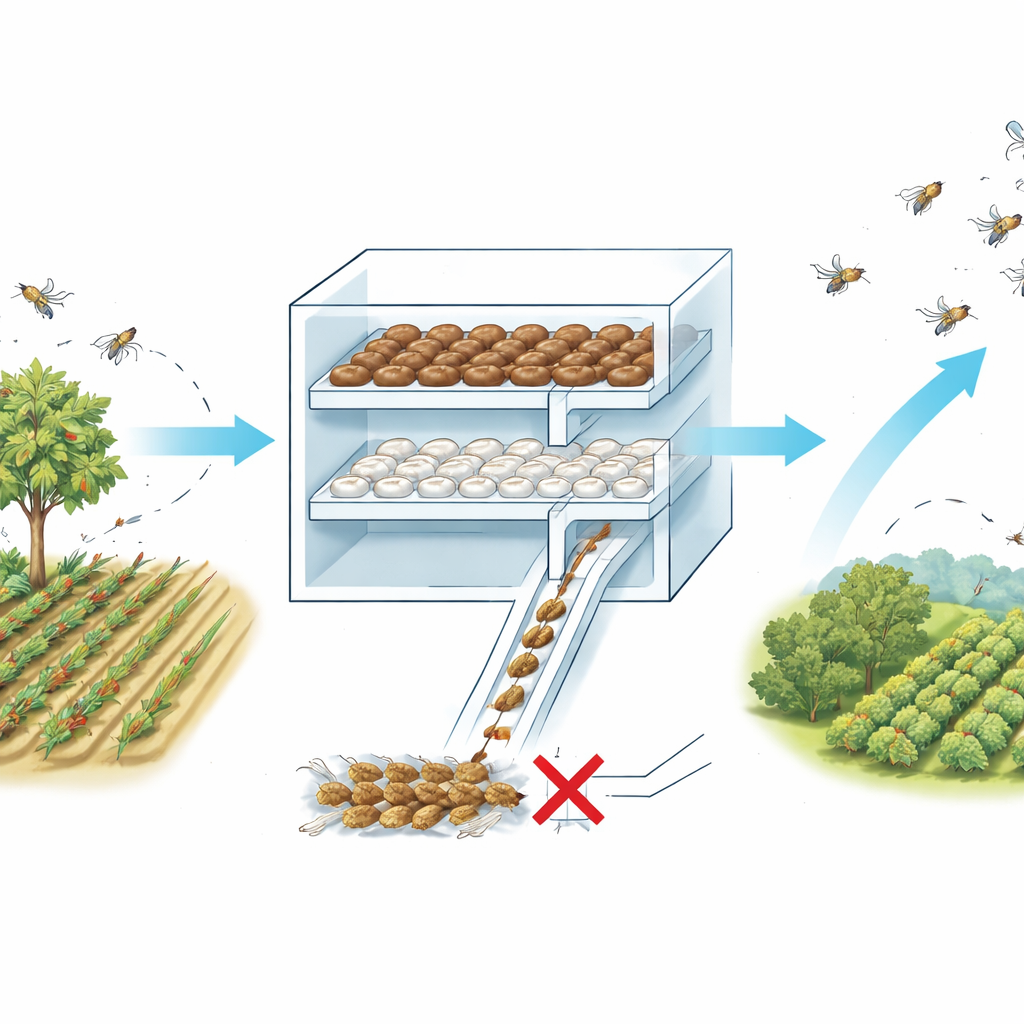
Every year, fruit‑eating flies damage crops and drive up the price of food. One of the most successful, environmentally friendly ways to control these pests is to release large numbers of sterile males, which compete with wild males and gradually shrink the population. But to do this efficiently, factories must separate male and female insects by the millions—a slow, error‑prone task. This study presents a new, precise way to build insect strains whose males and females can be told apart easily just by looking at them during the pupal stage, without adding any foreign DNA to their genomes.
A cleaner way to build sex-sorting strains
Past "genetic sexing strains" have been created in agricultural pests and disease‑carrying insects to make sex separation easier. The classic example in the Mediterranean fruit fly joins two useful traits—pupal color and heat sensitivity—to a region of the male chromosome using radiation. Males emerge from brown pupae and females from white ones, and embryos can be heat‑treated so that only males survive. However, this approach can reduce fitness, cause partial sterility in males, and sometimes lose its reliability through genetic reshuffling. It also relies on complex chromosome rearrangements that are hard to reproduce in other species.
Designing a cisgenic sexing system
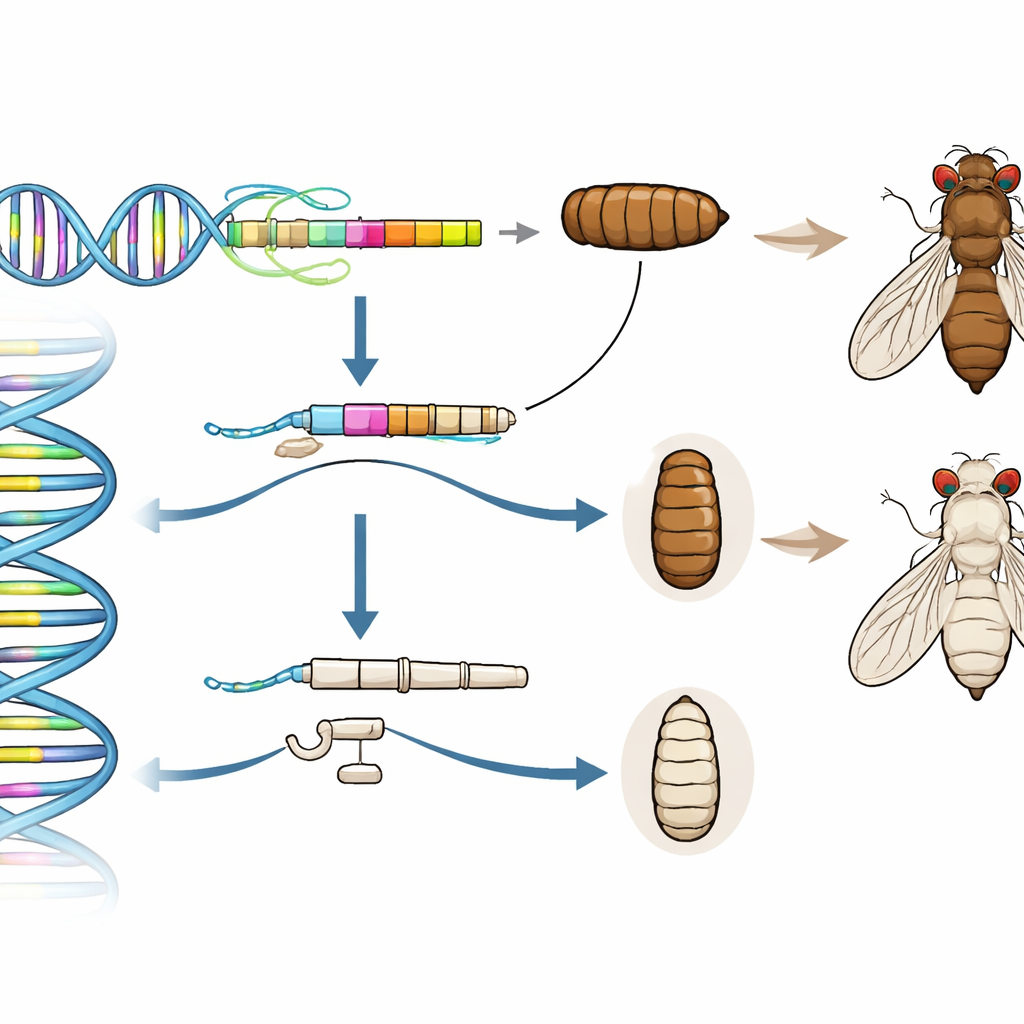
The authors set out to design a simpler, more stable, and potentially more acceptable system they call a cisgenic genetic sexing strain. "Cisgenic" means all genetic parts come from the same species, with no foreign genes added. Working in the Mediterranean fruit fly, they used CRISPR–based genome editing to insert a sex‑specific control segment, naturally found in a female‑determining gene called transformer, into a gene that controls pupal color known as white pupae. This inserted segment is handled differently in males and females when the gene is read, so the same edited gene behaves in opposite ways in the two sexes.
Turning color into a built-in sex tag
Because of this clever edit, male and female pupae now end up with different colors. In females, the inserted control segment is cut out when the gene is processed, allowing the white pupae gene to work normally and produce brown pupae. In males, the segment is left in place, interrupting the gene and blocking production of the normal protein, so males develop white pupae. The researchers bred this edited version to be present in two copies in all flies, creating a new strain they call IMPERIAL. In this line, every white pupa develops into a male and every brown pupa into a female, making sex sorting as simple as sorting by color.
Testing strength, stability, and behavior
To see whether IMPERIAL would be practical for large‑scale pest control, the authors compared it with both a standard wild‑type strain and the widely used VIENNA 8 genetic sexing strain. Over multiple generations, IMPERIAL maintained a perfect match between pupal color and sex and kept an even 1:1 ratio of males to females. In contrast, VIENNA 8 often produced fewer females, suggesting hidden female death or other costs. Survival from egg to adult and adult life span in IMPERIAL were similar to wild‑type and better than VIENNA 8 in several measures. Development from egg to adult also tended to be faster than in VIENNA 8, whose females in particular developed more slowly. When given a choice among males from all three strains, females from a tester strain mated with IMPERIAL males nearly as often as with VIENNA 8 males, though wild‑type males remained the most attractive.
What this means for future pest control
The IMPERIAL strain shows that a single, precise edit using only native DNA can create a reliable, eye‑visible marker that cleanly separates males and females in a major agricultural pest. Because no foreign genes are added, such cisgenic strains may be easier to regulate and more acceptable to the public than fully transgenic insects, though that will depend on local rules. The same strategy—borrowing a sex‑specific control segment from a species’ own sex‑determination system and inserting it into a visible marker gene—could in principle be applied to other fruit fly pests and mosquitoes. With further testing in real‑world rearing facilities, cisgenic sexing strains like IMPERIAL could make sterile‑male releases cheaper, more effective, and more widely usable, helping protect crops while reducing reliance on broad‑spectrum insecticides.
Citation: Davydova, S., Liu, J., Kandul, N.P. et al. Generating cisgenic sexing strains in insect pests. Commun Biol 9, 363 (2026). https://doi.org/10.1038/s42003-026-09624-9
Keywords: sterile insect technique, genetic sexing strain, Mediterranean fruit fly, CRISPR genome editing, cisgenic pest control