Clear Sky Science · en
Auditory cortex modulates call duration in rats
Why rat calls matter for understanding speech
When we talk, our brains constantly listen to our own voices and make tiny adjustments in real time. This self-monitoring is crucial for clear speech, yet how it works at the level of brain circuits is still being uncovered. In this study, researchers turned to rats and their ultrasonic calls to ask a simple but fundamental question: does the part of the brain that hears sound also help control how long calls last? By combining precise brain recordings, local drug injections, and background noise, they reveal that the auditory cortex does more than passively listen—it actively shapes vocal output.
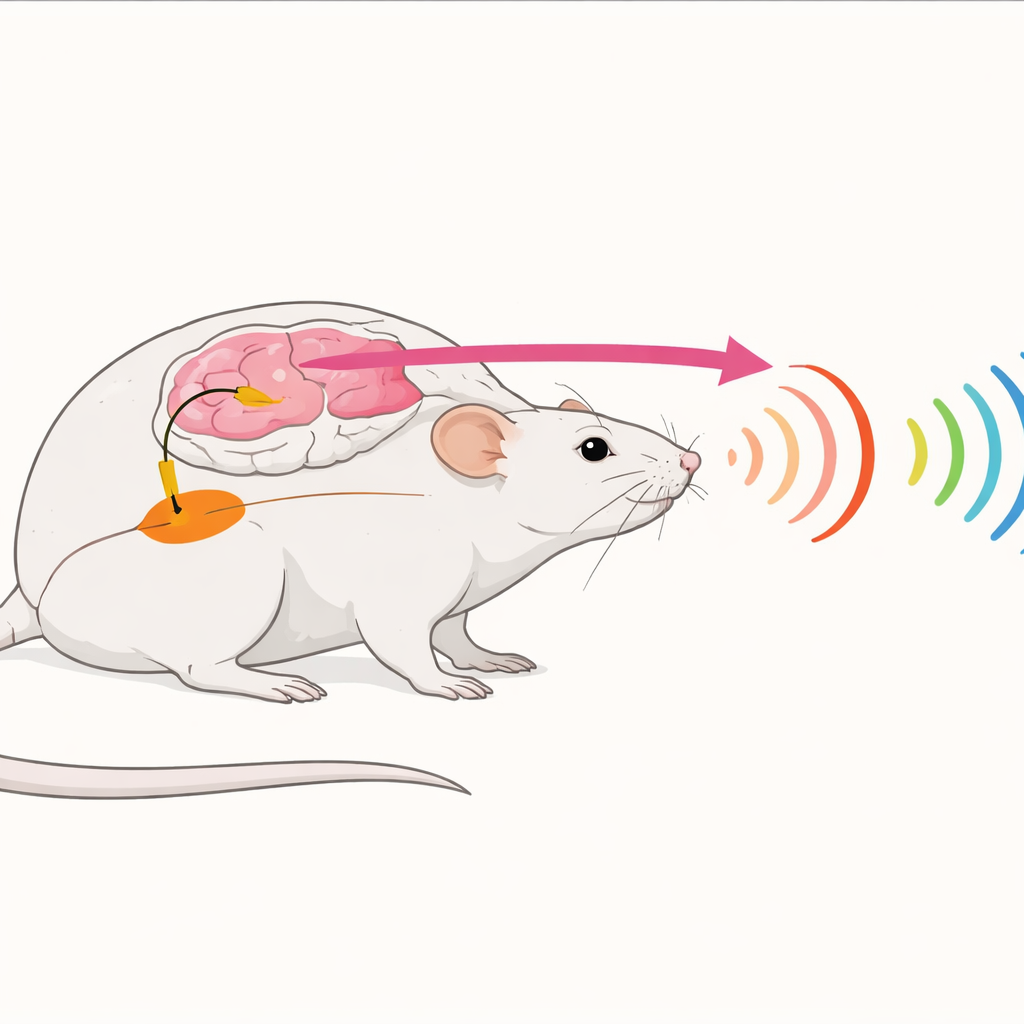
Listening while speaking
Rats use high‑frequency ultrasonic vocalizations to communicate emotion and social information. These calls depend on a network that spans cortex, midbrain, and brainstem. To probe how the auditory cortex participates, the team electrically stimulated a midbrain region known to trigger calls, the periaqueductal gray. While the anesthetized rats produced sequences of ultrasonic sounds, the researchers recorded from hundreds of neurons in the auditory cortex with high‑density Neuropixels probes. They also played back recordings of the same calls to the animals, allowing a direct comparison between brain activity during self‑generated calls and during passive listening.
Five ways brain cells respond to calls
The recordings revealed that auditory cortex neurons do not all behave alike. The authors grouped cells into five functional types based on how their firing changed around call onset and offset. Some cells fired just before calls (“pre‑call” cells), others jumped up in activity when a call began (“onset activated”), and some did the opposite, reducing their activity at onset (“onset suppressed”). Additional groups showed slow ramps of increasing or decreasing activity that peaked around call offset. Importantly, many neurons responded differently to the same sound when the rat produced it versus when it merely heard a playback. Response timing was also faster for self‑generated calls than for playback, even when baseline firing was similar, suggesting that internal motor‑related signals reach the auditory cortex and tune it specifically during vocal production.
Deep-layer cells that predict how long a call will last
Among the five groups, onset‑suppressed neurons—found mainly in deeper layers of the auditory cortex—stood out. Taken together as a population, their firing levels in the brief 100‑millisecond window before a call began reliably predicted how long that call would last. Higher or lower pre‑call activity corresponded to longer or shorter upcoming calls, and this relationship held across different animals and was not driven by a few outliers. The same population could also predict whether a call sequence would continue or stop. Using only activity in a short “predicting interval” after a call ended, a simple machine‑learning classifier could guess with high accuracy whether another call would follow or the sequence was over. These findings indicate that the auditory cortex contains neurons whose activity carries advance information about key vocal features, not just the sounds already produced.
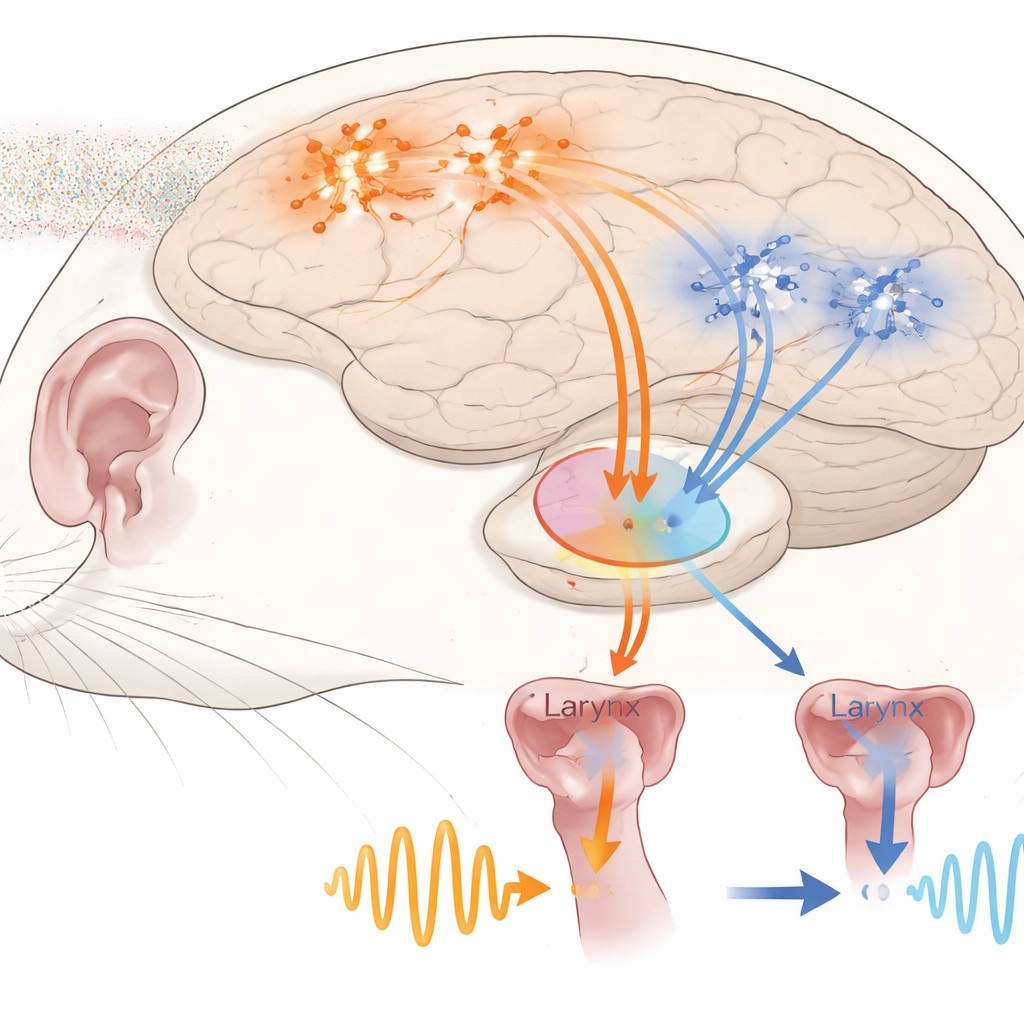
Turning the cortical knob to lengthen or shorten calls
To test whether the auditory cortex is not only informative but also causal, the researchers directly altered its activity. Silencing the auditory cortex with muscimol, a drug that boosts inhibition, made total call duration longer and slightly lowered call pitch, without being explained by saline control injections. In contrast, activating the cortex with gabazine, which blocks inhibitory input and thus excites local networks, shortened total call duration. Call pitch was largely unchanged in this case. These bidirectional effects suggest that stronger auditory cortical drive tends to curb ongoing vocalization, whereas reduced cortical activity lets the midbrain vocal machinery run longer. The team then asked whether natural stimulation—white noise delivered to the ears—would have similar consequences.
Noise as a natural brake on vocal output
When sequences of calls were triggered in a noisy environment, rats produced fewer and shorter calls overall, with higher pitch and somewhat greater loudness compared with quiet trials. Increasing noise intensity strengthened these changes in most animals, particularly the shortening of total call duration and the rise in pitch. Timing mattered: noise presented before a call tended to lengthen it, but noise overlapping the call itself shortened it and overrode the pre‑call effect. Because noise drives activity throughout the auditory pathway, these results imply that sound‑evoked activation of auditory cortex and related areas feeds back to vocal centers and reshapes call timing and acoustic properties in a graded, intensity‑dependent manner.
What this means for speech and vocal control
Together, the experiments show that the rat auditory cortex is not a passive microphone but an active participant in generating calls. Specific deep‑layer neurons carry advance information about how long calls will last and whether more calls are coming, while global changes in auditory cortex activity can lengthen or shorten total vocal output. Background noise produces similar adjustments, hinting at a general strategy whereby animals tweak call duration, pitch, and loudness to cope with noisy environments. These findings broaden our view of how sensory and motor systems interact and offer a tractable model for understanding the brain circuits that make flexible, feedback‑guided vocal behavior—and ultimately human speech—possible.
Citation: Tang, W., Concha-Miranda, M. & Brecht, M. Auditory cortex modulates call duration in rats. Commun Biol 9, 353 (2026). https://doi.org/10.1038/s42003-026-09608-9
Keywords: auditory cortex, vocalization control, ultrasonic calls, noise-induced vocal changes, rat communication