Clear Sky Science · en
Envelope destabilization by AcrAB2NodT overexpression links antibiotic resistance to metal sensitivity in Caulobacter vibrioides
When Fighting Antibiotics Has a Hidden Price
As antibiotic resistance spreads, we often imagine bacteria simply becoming tougher and harder to kill. This study reveals a surprising twist: in a common freshwater bacterium, one form of drug resistance actually makes the cells more vulnerable to certain metals like copper and zinc. Understanding this hidden trade-off may open new ways to tip the balance back in our favor by pairing antibiotics with other stresses that exploit bacterial weaknesses.
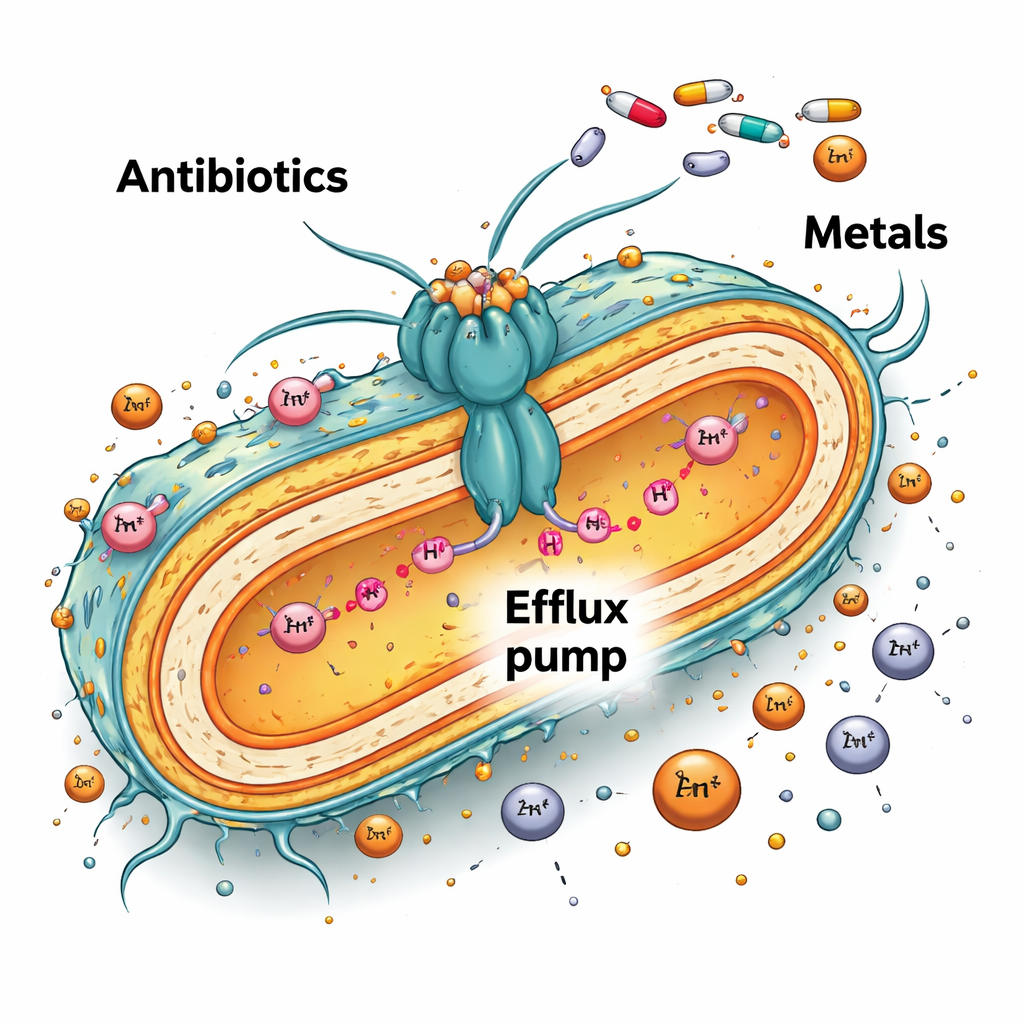
A Bacterial Pump with a Double Role
Many bacteria defend themselves by using powerful molecular pumps that sit in their outer layers and expel harmful compounds, including antibiotics. In Caulobacter vibrioides, a free-living microbe that thrives in nutrient-poor lakes and rivers, one such pump is called AcrAB2NodT. It spans the cell’s inner and outer membranes and is normally kept in check by a regulatory protein named TipR. When TipR is present, the pump is produced only when needed. The researchers examined what happens when tipR is deleted, creating a mutant that runs this pump at full throttle all the time.
Winning Against Drugs, Losing Against Metals
The tipR-lacking mutant was indeed better at withstanding certain beta-lactam antibiotics, confirming that the overactive pump helps the cells spit drugs out. But when the team exposed these cells to copper and other metals, including zinc, nickel, and cadmium, the picture flipped: the mutant became much more sensitive than normal cells. Careful measurements showed that this sensitivity was not because the cells were hoarding extra copper or producing more damaging reactive oxygen species. Instead, the total metal content inside the mutant stayed similar to that of normal cells, and standard indicators of oxidative stress did not increase. This meant the vulnerability had to come from changes in the cell’s structure or basic physiology, rather than from simple metal overload.
A Fragile Skin and a Leaky Barrier
Looking more closely at the cell surface, the scientists used electron microscopes and protein surveys to reveal that overexpressing AcrAB2NodT disrupts the bacterial “skin,” known as the cell envelope. Mutant cells showed bulges, abnormal shapes, and a wavy, uneven space between their inner and outer membranes. Proteins involved in building and remodeling the envelope were more abundant, indicating that the cells were mounting a constant repair effort. Additional tests revealed that the mutant’s envelope was leakier, allowing dyes to enter more easily once the pump’s ability to expel them was disabled experimentally. When the researchers disabled the pump altogether—either by deleting its genes or by introducing subtle mutations that kept it present but largely inactive—both the strange cell shapes and the metal sensitivity largely disappeared, even though some pump components were still there.
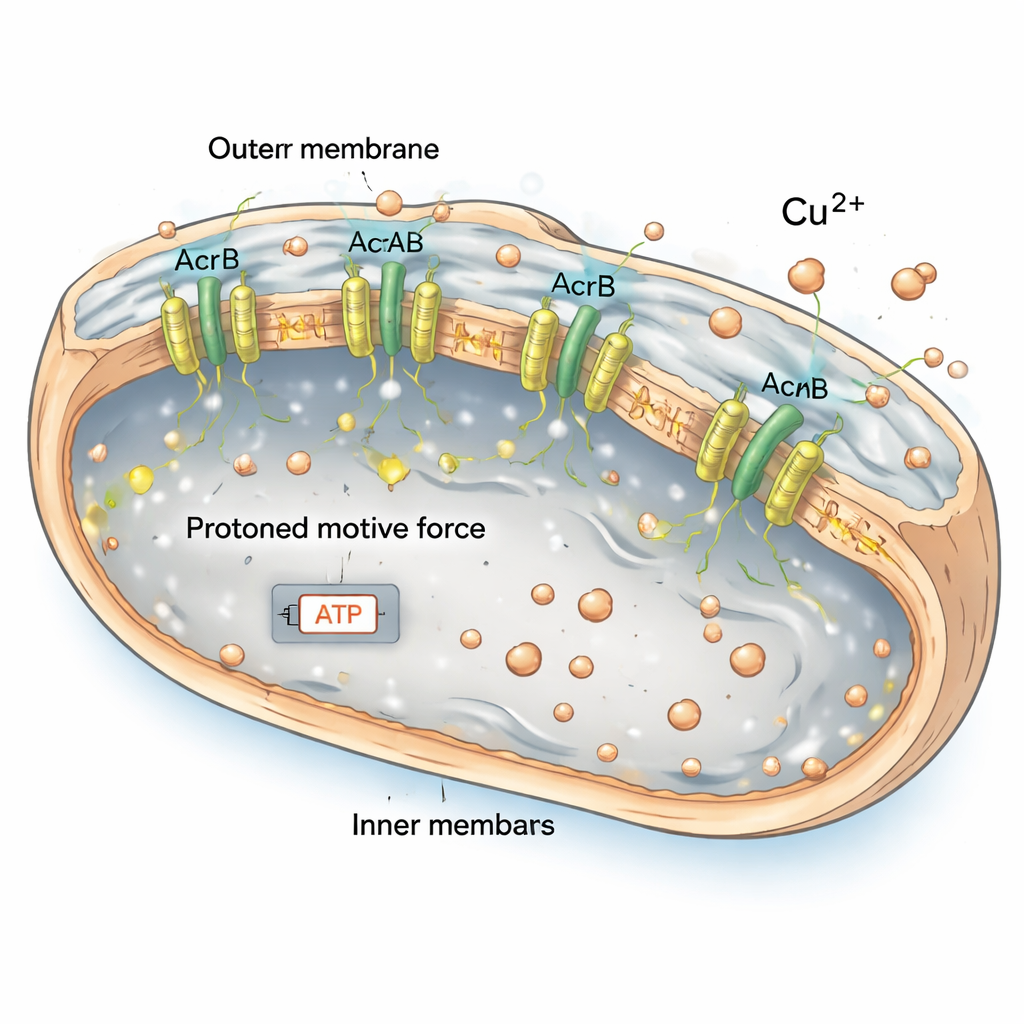
Drained Batteries and Energetic Strain
Efflux pumps like AcrAB2NodT are powered by the proton motive force, a kind of tiny battery formed by charged particles across the inner membrane. In the mutant that runs the pump nonstop, this battery was partly drained: a dye that reports on membrane voltage showed a weaker signal, and the cells had lower levels of ATP, their main energy currency. The bacteria tried to compensate by ramping up pathways that produce energy, such as those involved in breaking down fatty acids, but this was not enough to prevent an overall energy shortage. When the researchers chemically collapsed the proton gradient in otherwise normal cells, those cells started to resemble the mutant in how poorly they handled copper. This strongly suggests that the combination of a weakened envelope and chronically low energy makes the pump-overproducing bacteria especially easy targets for metal stress.
Turning a Weakness into a Treatment Strategy
For non-specialists, the key message is that antibiotic resistance can come with a cost: bacteria may survive drugs better but become more fragile in other ways. In Caulobacter, constantly running a powerful drug pump strains the cell’s outer layers and energy supply, leaving it less able to cope with metals such as copper. This trade-off hints at new treatment ideas. If similar weaknesses exist in disease-causing bacteria, doctors might boost the effectiveness of antibiotics by pairing them with metals or other agents that exploit the energetic and structural burden of resistance mechanisms, pushing resistant microbes past their breaking point.
Citation: Ote, M., Lardinois, L., Hendrickx, E. et al. Envelope destabilization by AcrAB2NodT overexpression links antibiotic resistance to metal sensitivity in Caulobacter vibrioides. Commun Biol 9, 313 (2026). https://doi.org/10.1038/s42003-026-09606-x
Keywords: antibiotic resistance, efflux pumps, copper sensitivity, bacterial envelope, energy metabolism