Clear Sky Science · en
Metabolite diversity of Microcystis strains shows tight correspondence to genotype and may contribute to ecotype specificities
Why freshwater blooms matter to us
Thick green scums on lakes and reservoirs are more than just an eyesore—they can poison pets, wildlife, and even threaten drinking water. These blooms are often caused by Microcystis, a tiny photosynthetic microbe that thrives in nutrient‑rich waters. The study summarized here asks a deceptively simple question with big implications: do different “kinds” of Microcystis make different chemical cocktails, and could that help explain why some blooms are more dangerous than others?
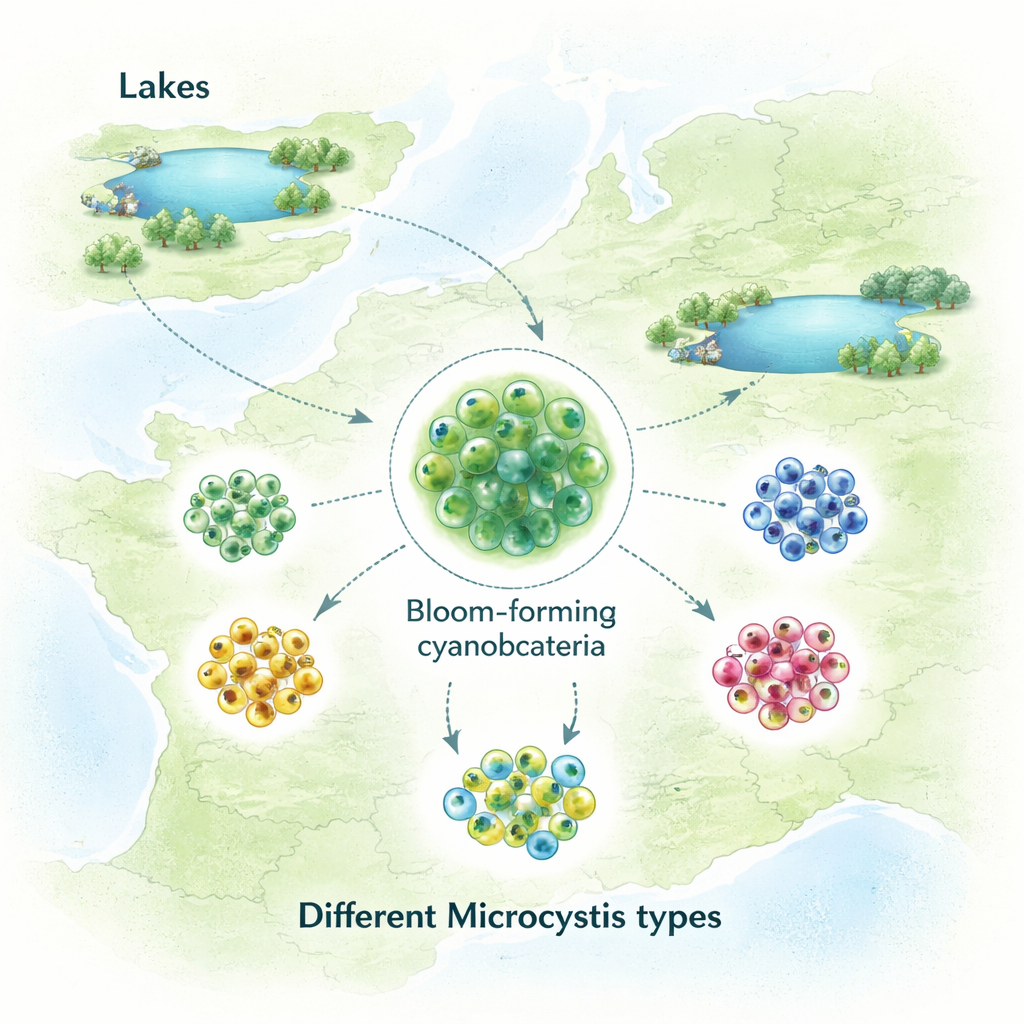
Many hidden kinds of the same microbe
Under the microscope, Microcystis cells look fairly similar, and for decades they were sorted mostly by colony shape. With modern DNA sequencing, however, scientists have discovered that what looked like a single species is actually a complex web of closely related lineages. In this work, researchers sequenced or analyzed 347 Microcystis genomes from around the world, including 65 strains from lakes in France and nearby countries. By comparing thousands of shared genes, they grouped these strains into genetic clusters, or “genotypes,” that are much finer than traditional species labels. Strikingly, multiple genotypes often co‑occurred in the same lake, meaning a single bloom can be a genetically mixed community rather than a uniform mass of identical cells.
Stable chemical fingerprints for each lineage
Microcystis is famous for producing microcystins, potent liver toxins, but it also makes many other small molecules whose roles are still mysterious. Using sensitive mass spectrometry, the team measured the full spectrum of metabolites produced by each of the 65 European strains grown under controlled laboratory conditions. Each strain turned out to have a remarkably stable chemical “fingerprint” that hardly changed across repeated cultures, growth phases, or modest shifts in culture conditions. When the researchers compared these fingerprints, they found that strains with nearly identical genomes consistently produced very similar sets of metabolites, while more distant genotypes made clearly different chemical mixtures. In effect, most genotypes could be matched one‑to‑one with a characteristic “chemotype.”
Genes, molecules, and toxins move in step
To understand how these chemical traits are encoded, the scientists looked for biosynthetic gene clusters—stretches of DNA that act as assembly lines for specialized molecules. These clusters made up about seven percent of the Microcystis genomes and varied greatly among genotypes, yet were well conserved within each genotype. Certain clusters, like those for aeruginosins, were widespread, while others, including the microcystin genes, appeared in scattered genetic branches. Importantly, the presence or absence of these clusters matched closely with the actual metabolites detected in culture. The team then tested extracts from selected strains on medaka fish embryos and larvae. Strains from the same genotype showed nearly identical toxicity profiles, whereas different genotypes within the same broader species group could be weakly or strongly toxic—even when they lacked microcystins but produced other bioactive compounds.
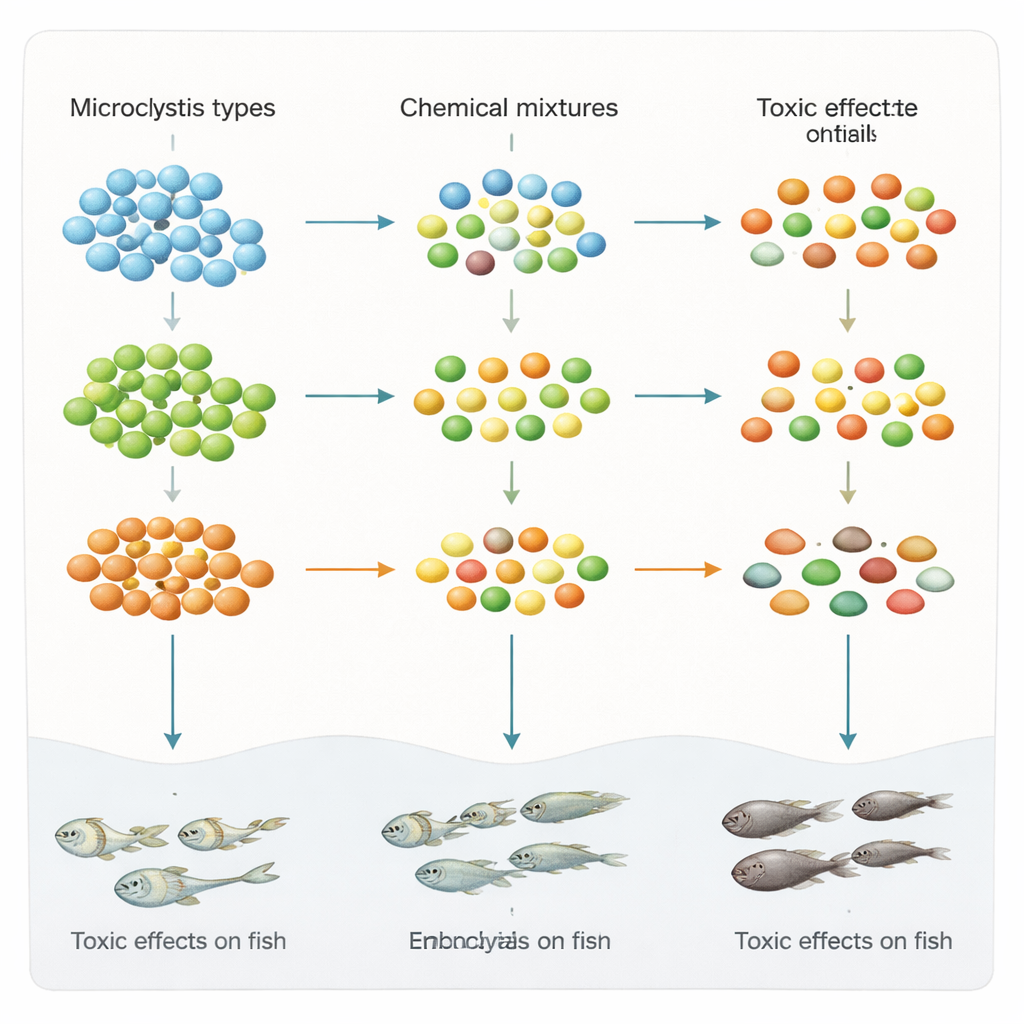
Clues to how blooms adapt and persist
Because genotypes, chemotypes, and toxicity patterns lined up so clearly, the authors propose that these chemical arsenals are not random extras but key traits shaped by evolution. Different Microcystis lineages seem to have settled on distinct strategies: some invest in high‑toxicity mixtures that kill fish larvae or deter grazers, others in molecules that may help them cope with light, nutrients, metals, or microbial competitors. Multiple genotypes often share a lake, forming a kind of “ecological toolbox” that may help the overall bloom survive shifting seasons and environmental conditions. This mirrors patterns seen in other freshwater microbes, where genetic micro‑diversity underpins flexible responses to a changing world.
What this means for people and lakes
For non‑specialists, the central message is that not all green scums are created equal. Two blooms that look the same can carry very different health risks, depending on which Microcystis genotypes are present and what chemical cocktails they make. By tying together genes, metabolites, and toxicity, this study shows that chemical profiles can serve as reliable fingerprints of hidden lineages—and likely of their ecological roles. In the long run, such insights could improve monitoring and prediction of harmful blooms by focusing less on total cyanobacterial biomass and more on which genetic and chemical types are in the water.
Citation: Huré, A., Le Meur, M., Duval, C. et al. Metabolite diversity of Microcystis strains shows tight correspondence to genotype and may contribute to ecotype specificities. Commun Biol 9, 305 (2026). https://doi.org/10.1038/s42003-026-09599-7
Keywords: Microcystis, cyanobacterial blooms, water toxins, freshwater ecology, metabolite diversity