Clear Sky Science · en
Uniparental analysis of Deep Maniot Greeks reveals genetic continuity from the pre-Medieval era
Ancient Roots in a Remote Greek Peninsula
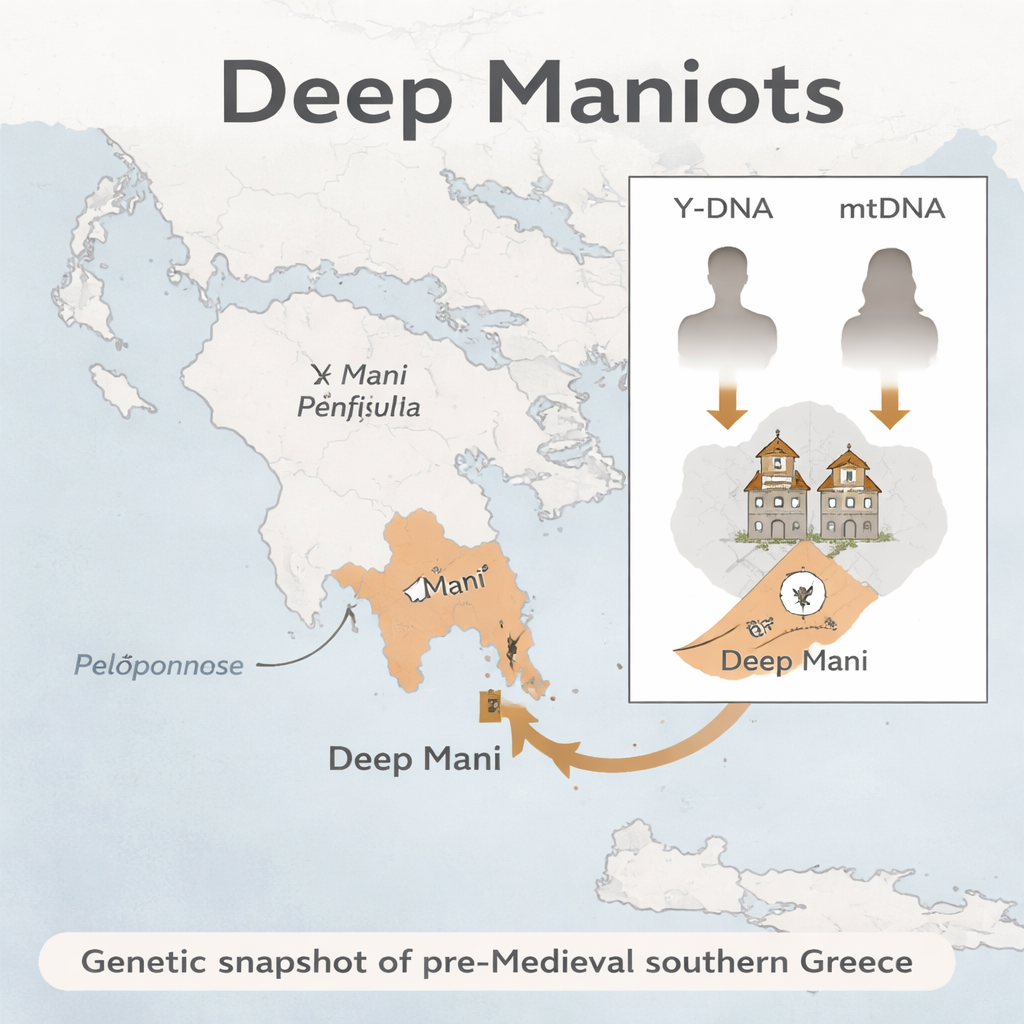
The rocky Mani Peninsula, jutting from the southern tip of mainland Greece, has long been famous for stone tower houses, fierce clans, and a stubborn sense of independence. This study asks a simple but far‑reaching question: are the people of Deep Mani living descendants of the Greeks who inhabited the region before the great upheavals of the Middle Ages, or were they largely replaced by later waves of migrants? By reading genetic clues in the Y chromosome (passed from fathers to sons) and mitochondrial DNA (passed from mothers to children), the authors explore how much of Mani’s past still lives in its present‑day inhabitants.
A Natural Refuge in Troubled Times
History sets the stage for this genetic detective story. During Late Antiquity and the early Middle Ages, the Balkans—and Greece in particular—underwent dramatic change. Slavic and other northern groups moved south, cities declined, and new languages and cultures appeared. Many Greek speakers fled into mountains and other hard‑to‑reach places. Deep Mani, a harsh, isolated corner of the Peloponnese with poor farmland but strong natural defenses, became one such refuge. Written sources and archaeology suggest that its people were less affected by outside settlers than other Greeks, but for several centuries there is almost no direct record of who actually lived there.
Reading Family Lines in DNA
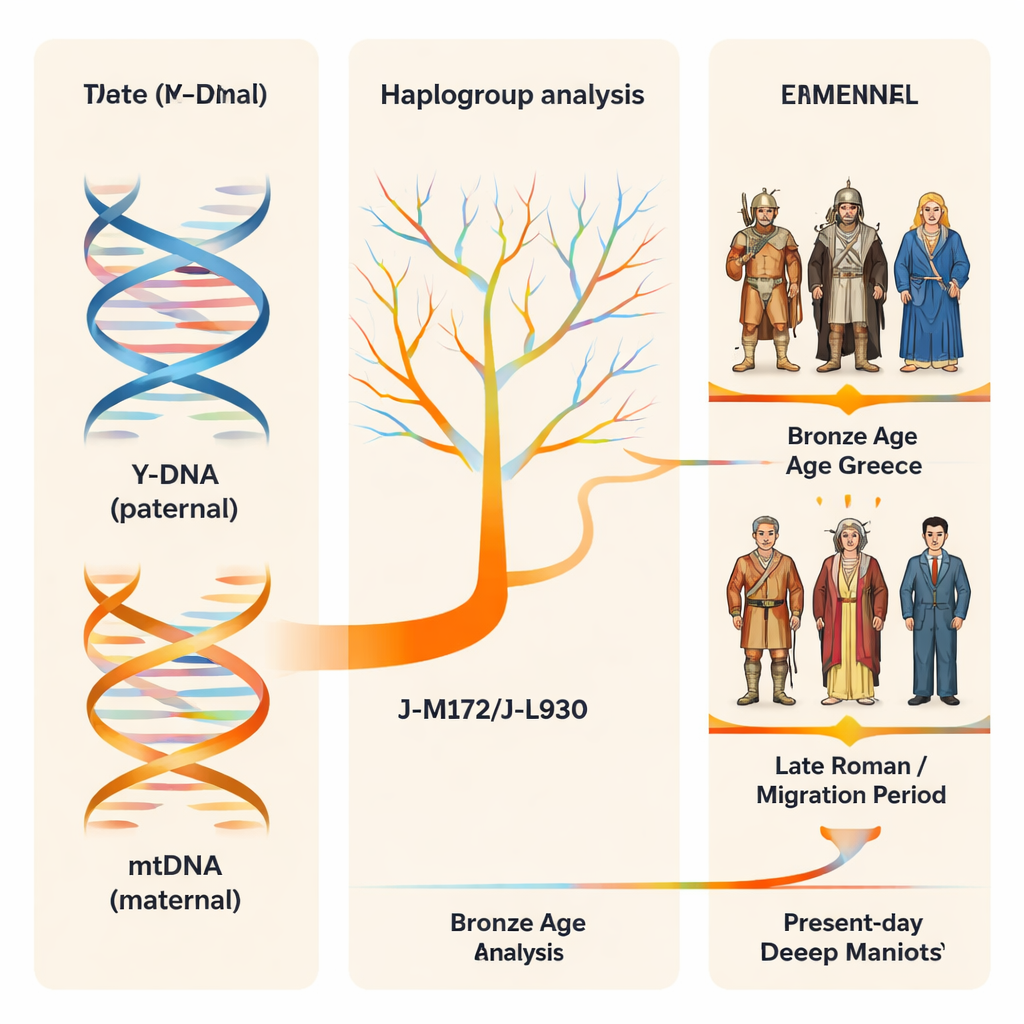
To fill this gap, the researchers analyzed Y‑DNA and mitochondrial DNA from 102 people with confirmed Deep Mani ancestry, representing major local clans and family groups. The Y‑chromosome data—reflecting male lines—turned out to be especially striking. About 80 percent of Deep Maniot men belong to a broader lineage called J‑M172, and roughly half to a very specific branch named J‑L930 that is almost unknown outside Mani. Other lineages that are now common in mainland Greece and are linked to Slavic, Germanic, Albanian, or other northern and western European ancestors are essentially absent. This combination of one extremely frequent, very local paternal line alongside a handful of rare others is a hallmark of a small, isolated population that has experienced “founder effects,” where a few ancestral fathers left most of today’s male descendants.
Echoes of Bronze Age and Roman Greeks
When the team compared these Y‑chromosome lineages with ancient DNA from archaeological sites, a clear pattern emerged. Several of the main Deep Maniot paternal branches closely match lineages found in Bronze Age and Iron Age Greeks, in Greek colonies in Sicily and Cyprus, and in people from Roman‑era Greece and nearby regions who had a distinctly eastern Mediterranean genetic profile. Crucially, the study finds that the most common Deep Maniot male lines began to diversify between about 380 and 670 CE—the very era when the Roman Empire was in crisis and new peoples were arriving in the Balkans. This timing suggests that today’s Deep Maniot men largely descend from a group that was already in or near Mani before those upheavals, then expanded in relative isolation while much of Greece was being reshaped by migration.
Women’s Stories Are More Mixed
Maternal lines tell a somewhat different story. The 50 individuals with Maniot mothers carried at least 30 distinct mitochondrial lineages, many tracing back to ancient populations in the Balkans, the Levant, the Caucasus, and other parts of western Eurasia. Some of these maternal lines also show signs of founder effects and long residence in Mani, but others point to modest outside contributions over time, including lineages associated with steppe herders, western Europeans, and even North African and Roma ancestors. In a society that was historically strongly patriarchal and organized around male‑led clans, such diversity makes sense: men may have stayed put within kin groups, while some women married into Mani from beyond the peninsula.
From Clans to Continuity
The genetic data also shed light on Mani’s famous clan system, with dominant families tracing their origin to heroic or noble founders. By estimating how long ago men from the same clan shared a common male ancestor, the study suggests that many major clans took shape between about 1350 and 1600 CE—several centuries earlier than some historians thought, but still long after the core Deep Maniot population had formed. Notably, the supposed foreign or imperial origins claimed in many clan legends find little support in the Y‑DNA, which instead points to deeply local roots.
A Living Window into Pre‑Medieval Greece
For non‑specialists, the key takeaway is that Deep Maniots appear to preserve a rare genetic snapshot of southern Greece as it looked before the great migrations of the early Middle Ages. Their paternal lines overwhelmingly descend from Bronze Age, Iron Age, and Roman‑era Greek populations, with remarkably little later input from Slavic, Germanic, or other newcomers who left strong marks elsewhere in the Balkans. Maternal lines are more varied, hinting at limited but real movement of women into Mani over many centuries. Together, these findings show how geography, local customs, and clan‑based society combined to create a community that is both culturally distinctive and genetically conservative—a living link to the deep past of the eastern Mediterranean.
Citation: Davranoglou, LR., Kofinakos, A.P., Mariolis, A.D. et al. Uniparental analysis of Deep Maniot Greeks reveals genetic continuity from the pre-Medieval era. Commun Biol 9, 157 (2026). https://doi.org/10.1038/s42003-026-09597-9
Keywords: Deep Maniots, ancient Greek ancestry, population genetics, Y-DNA haplogroups, Mediterranean history