Clear Sky Science · en
40 Hz flicker preconditioning protects nonarteritic anterior ischemic optic neuropathy via adenosine signaling
Why a flashing light could help protect aging eyes
Sudden, painless vision loss late in life is a terrifying prospect, and for many older adults it becomes reality because of a condition called nonarteritic anterior ischemic optic neuropathy, or NAION. This study explores an unexpected, non-invasive idea for protecting vulnerable eyes: exposing them to a gentle light that flickers 40 times per second. In mice, this simple “light training” before an injury helped their optic nerves better withstand damage that would normally kill vision-carrying nerve cells.
A silent stroke of the optic nerve
NAION is often described as a kind of “mini-stroke” of the front portion of the optic nerve, which carries visual information from the eye to the brain. It tends to strike people over 55 and is linked to crowded optic discs and common conditions such as high blood pressure, diabetes, high cholesterol, and sleep apnea. Once the blood flow problem occurs, many retinal ganglion cells—the nerve cells that form the optic nerve—die, leading to permanent visual loss. Clinical trials have shown that surgeries and steroid treatments do little to restore sight, and people who lose vision in one eye face a substantial risk of the same thing happening in the other. That has pushed scientists to search for ways to “pre-harden” the optic nerve so it can survive future blood flow crises.
Training the eye with rhythmic light
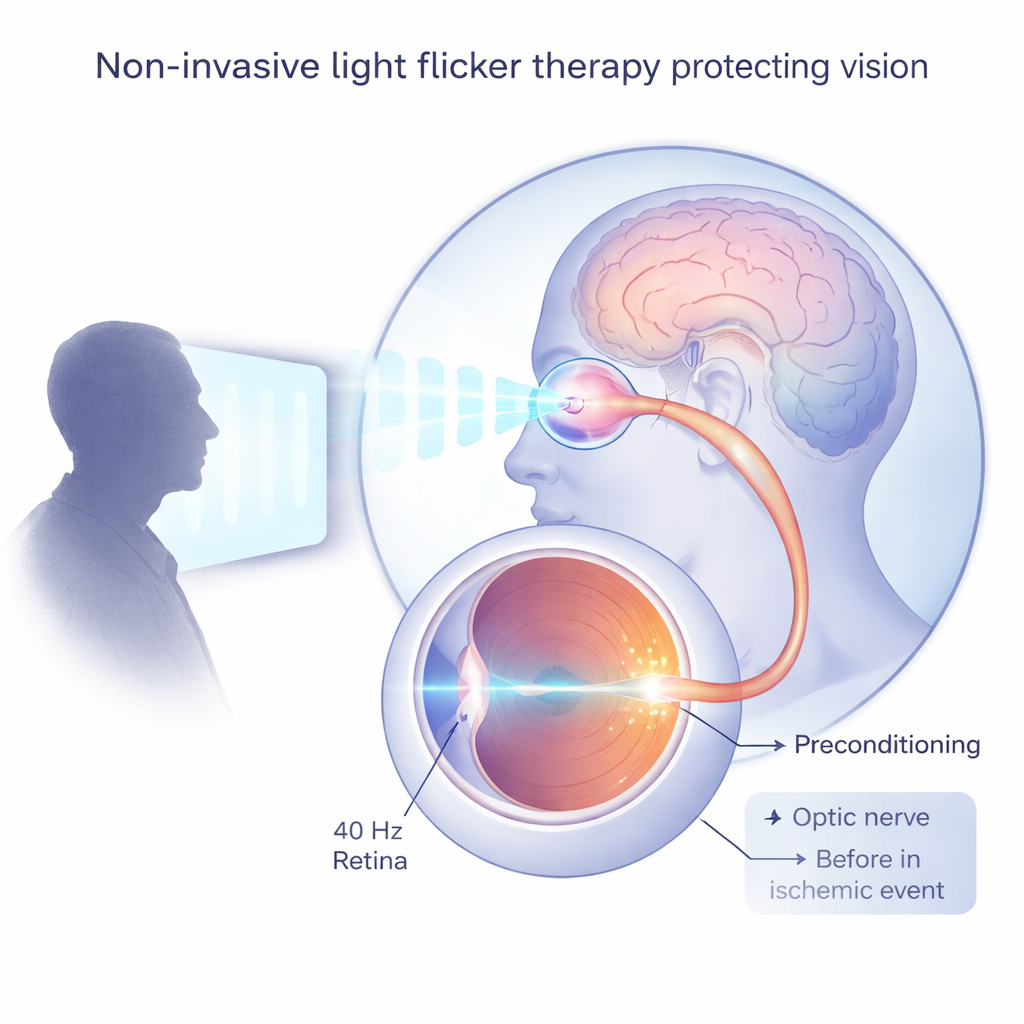
One promising idea borrows from heart and brain research: ischemic preconditioning, where a brief, controlled stress makes tissue more resistant to a later, more serious injury. Instead of briefly cutting off blood flow with a cuff, the authors used 40 Hz light flicker as a harmless stimulus targeted to the visual system. In their mouse model of NAION, they exposed animals to 40 Hz flickering light for one hour, twice a day, over three days before inducing optic nerve ischemia. Compared with mice that saw only steady light, preconditioned mice lost fewer retinal ganglion cells, retained a thicker nerve cell layer at the back of the eye, and showed stronger electrical responses along the visual pathway. The protection was strongest when the ischemic event occurred about 12 hours after the last flicker session, moderate at 24 hours, and disappeared when flicker ended 48–72 hours earlier.
Lasting benefits depend on timing
The team also asked how long this protective training lasts and whether it could help after damage has already begun. They found that mice preconditioned with 40 Hz flicker still had more surviving retinal ganglion cells and better visual responses four weeks after the ischemic event, a stage when degeneration is usually well established. However, when the same light therapy was started only after ischemia and continued for 10 days, it did not rescue nerve cells or visual function and even worsened certain signs of retinal thinning. These results indicate that the flicker acts like a vaccine rather than a cure: it must be given before the insult to build up resistance, and its beneficial window is limited to roughly a day before the blood supply problem begins.
Adenosine: the protective chemical messenger
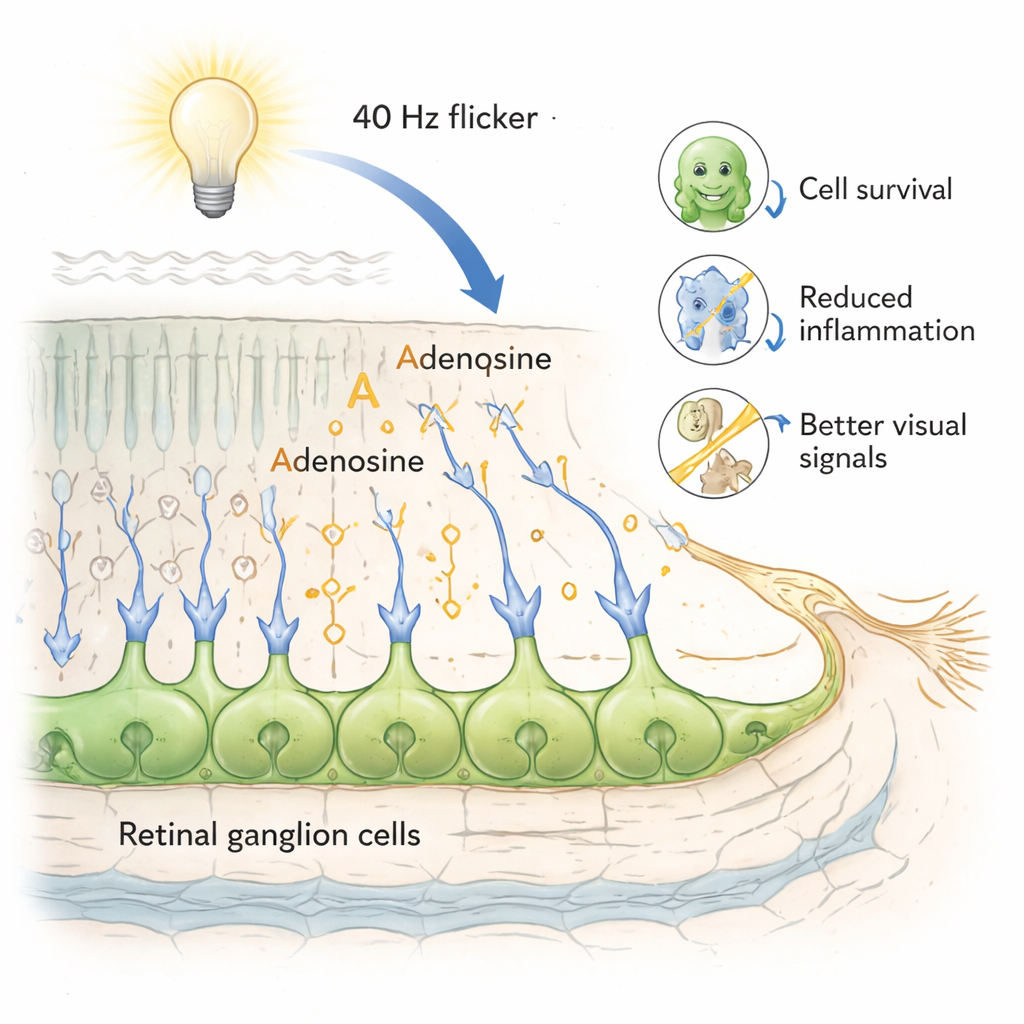
To uncover how 40 Hz flicker protects the optic nerve, the researchers focused on adenosine, a natural brain chemical that builds up during stress, dampens overexcited nerve cells, improves local blood flow, and is known to be central to classic preconditioning. They showed that an hour of 40 Hz flicker raised adenosine levels in the eye. When they blocked key adenosine transporters (ENT1/2) with the drug dipyridamole, the light-induced protection vanished, suggesting that moving adenosine across cell membranes is required. Blocking adenosine A1 receptors, which sit on nerve cells and help quiet electrical overactivity, also erased the benefits, yet did not change receptor abundance, implying that the critical step is activating existing A1 receptors, not making more of them. Importantly, flicker at 20 or 80 Hz did not provide the same protection, highlighting that 40 Hz is a special rhythm for this effect.
Cooling inflammation in the optic nerve
Beyond saving nerve cells, 40 Hz preconditioning also reduced inflammatory responses in the optic nerve. In untreated ischemic mice, microglia—the brain’s resident immune cells—became more numerous and switched into an activated, potentially damaging state. Preconditioned mice had fewer microglia and lower levels of an activation marker called CD68 in the front segment of the optic nerve. When A1 receptors were blocked, this calming effect on microglia was partly lost, further tying adenosine signaling to both cell survival and inflammation control. Together, these findings suggest that rhythmic light primes the visual system to respond to ischemia with quieter nerve signaling and a more restrained immune reaction.
What this could mean for people at risk
For patients, especially those who have already suffered NAION in one eye, these mouse results raise the possibility of a safe, home-friendly preconditioning therapy using 40 Hz light flicker to protect the remaining vision. Because NAION risk often persists over years and the condition can be bilateral, intermittent flicker sessions might one day be used to boost the optic nerve’s tolerance before an event occurs. Much work remains: the approach must be tested in older animals and larger models, the safest and most effective flicker dose must be defined, and researchers must ensure that repeated stimulation does not cause harm. Still, with 40 Hz light and sound already being explored clinically for disorders like Alzheimer’s disease, this study offers an encouraging proof of concept that the right kind of flickering light could help shield vulnerable eyes from a devastating form of vision loss.
Citation: Su, L., Lu, R., Huang, L. et al. 40 Hz flicker preconditioning protects nonarteritic anterior ischemic optic neuropathy via adenosine signaling. Commun Biol 9, 310 (2026). https://doi.org/10.1038/s42003-026-09591-1
Keywords: optic nerve ischemia, retinal ganglion cells, adenosine signaling, 40 Hz light flicker, vision protection