Clear Sky Science · en
Multi-organoid loop cerebral connectoids exhibit enhanced neuronal network dynamics and sequence-specific entrainment
Building Tiny Connected Brain Circuits
Our brains do not work as isolated islands of cells. Thoughts, memories, and movements emerge from signals racing along long-distance highways that link many brain regions together. This study shows how scientists can now mimic that kind of wiring in the lab by physically linking several miniature brain-like tissues, called organoids, into closed loops. These “loop connectoids” begin to show richer, more lifelike patterns of activity, offering a new way to probe how complex brain circuits work and how they might go wrong in disease.
From Mini Brains to Mini Networks
Brain organoids are tiny balls of tissue grown from human stem cells that self-organize into structures resembling parts of the developing brain. They contain many types of nerve and support cells and can generate electrical signals on their own. Until now, most organoid experiments looked at single organoids or simple fusions of two regions, which mainly capture local wiring. The authors wanted to move beyond this, toward lab-grown models that include long-distance links between multiple “regions,” more like the real brain’s communication lines that underlie thinking, perception, and behavior.
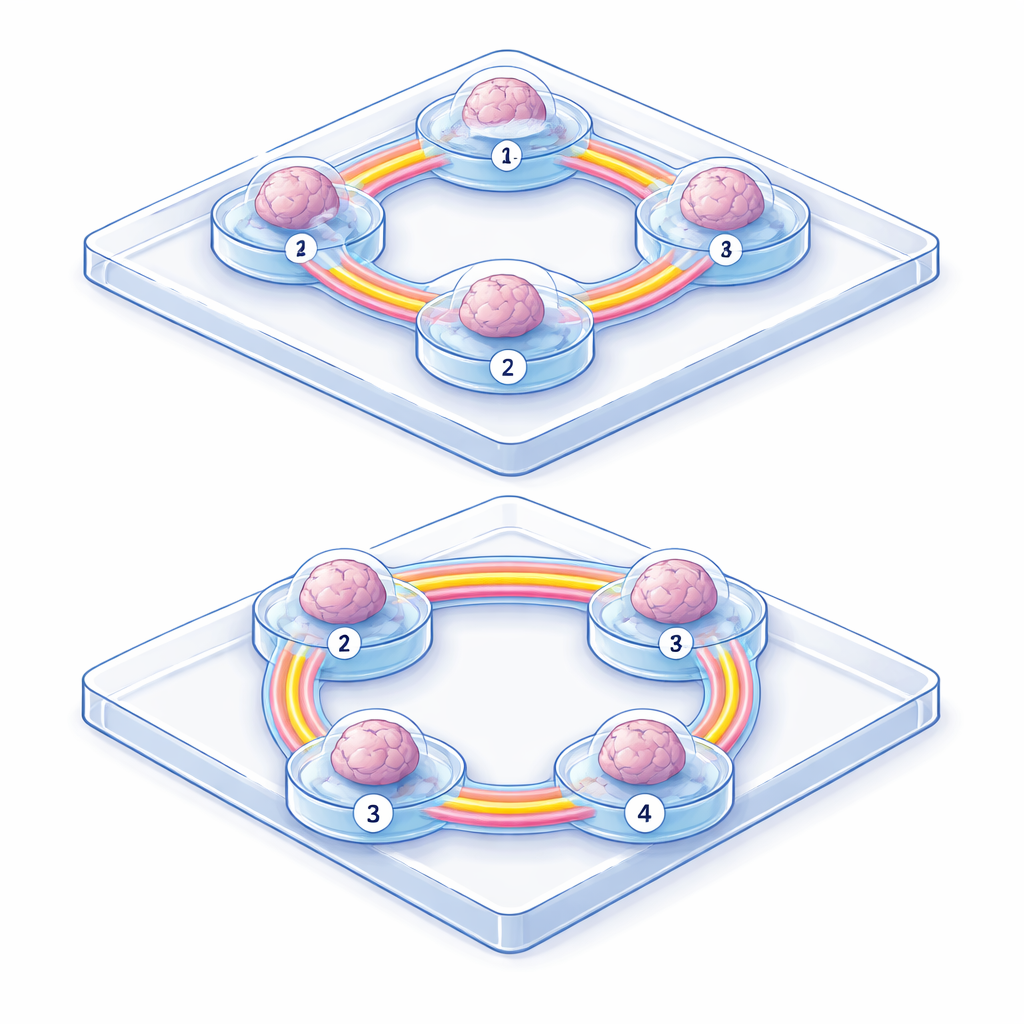
Engineering a Ring of Talking Organoids
To create these networks, the team grew cerebral organoids from human induced pluripotent stem cells and then placed them into custom-made microfluidic chips. Each chip had two, three, or four round chambers connected by narrow channels. Once an organoid settled into a chamber, its nerve fibers (axons) could only grow along the channels, where they naturally bundled together and bridged to neighboring organoids over about two weeks. With three or four organoids in a device, these bundles formed a complete ring, or loop. Under the microscope, the bundles stayed intact even when the plastic device was removed, confirming that the organoids had physically wired themselves together into a stable circuit.
Richer, Longer, and More Structured Brain Activity
Next, the researchers recorded electrical signals from each organoid using a grid of tiny electrodes. As the weeks passed, the organoids’ firing became more synchronized, especially between those directly linked by axon bundles. Networks with more organoids had more recording sites taking part and more connections overall, forming a modular structure where each organoid acted like a “local hub” joined to its neighbors. These multi-organoid loops showed more frequent bursts of activity and longer stretches of sustained firing than single organoids. The timing and size of these bursts became more varied when three or four organoids were linked, pointing to a richer repertoire of activity patterns that better resembles living brain networks.
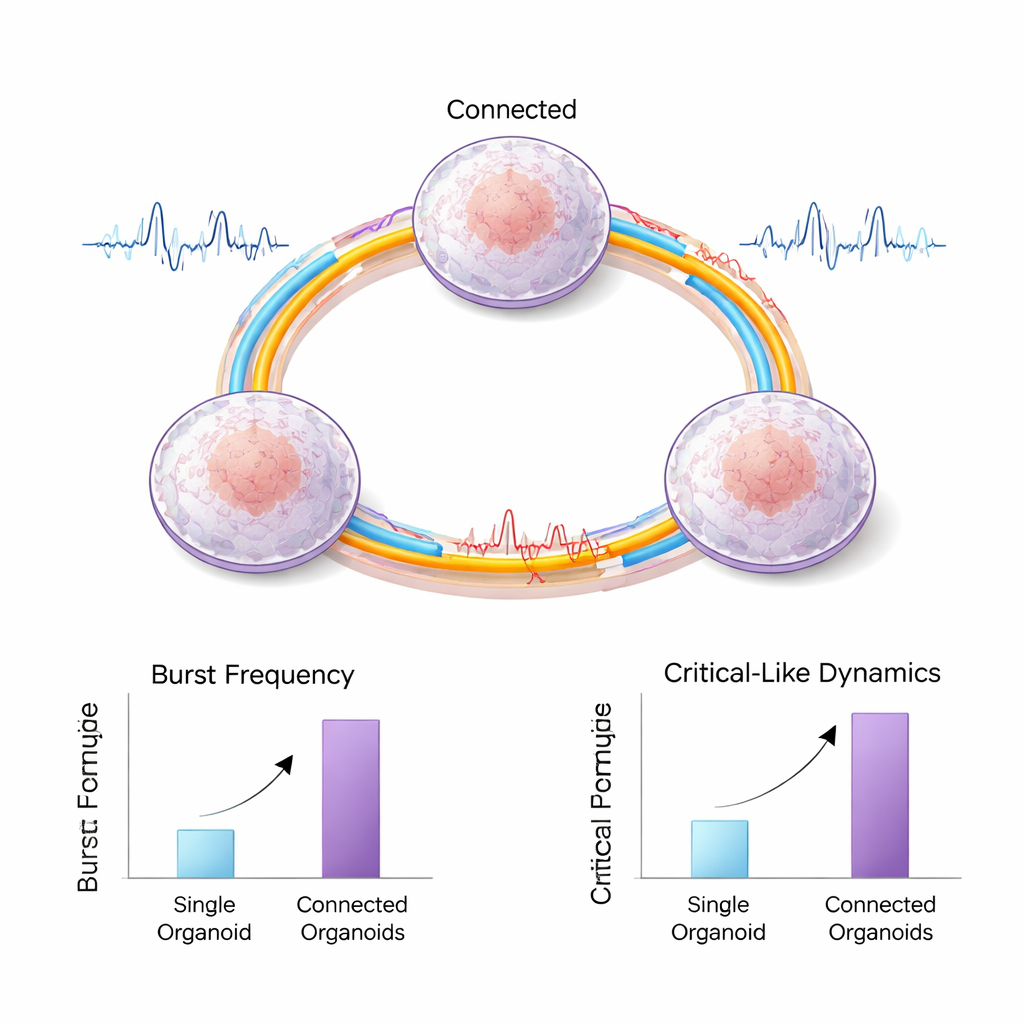
Tuning Toward a Sweet Spot of Brain-Like Behavior
The team also asked whether these networks operated near “criticality,” a sweet spot between too little and too much activity that is thought to support flexible information processing in the brain. By analyzing cascades of firing called “neuronal avalanches,” they found that connected organoids behaved more like systems at this critical point than single organoids did. Drugs that blocked major excitatory or inhibitory chemical signals shifted the bursting patterns, confirming that a balance of stimulation and braking is key to the complex dynamics. Finally, when the scientists used light-sensitive proteins to stimulate three connected organoids in a repeated sequence for many hours, the network’s spontaneous activity later tended to replay that same sequence. This sequence-specific “entrainment” disappeared when a blocker of plasticity-related enzymes was added, suggesting that the loop connectoids can undergo experience-dependent changes, a basic feature of learning.
Why These Tiny Loops Matter
In simple terms, this study shows that when several mini brains are wired together in a controlled loop, the whole network behaves more like a real brain than any one piece alone. The linked organoids fire in longer, more varied bursts, sit closer to an efficient operating point, and can be nudged into repeating learned patterns of activity. Because the system is modular and tunable, it can be expanded, rewired, and eventually populated with cells from patients. That makes loop connectoids a promising platform for studying how large-scale brain circuits develop, how they fail in conditions like autism or dementia, and how new drugs or stimulation therapies might restore healthy patterns of activity.
Citation: Duenki, T., Ikeuchi, Y. Multi-organoid loop cerebral connectoids exhibit enhanced neuronal network dynamics and sequence-specific entrainment. Commun Biol 9, 302 (2026). https://doi.org/10.1038/s42003-026-09589-9
Keywords: brain organoids, neural networks, microfluidic loops, neuronal dynamics, optogenetic stimulation