Clear Sky Science · en
Task demand modulates somatosensory-frontoparietal networks during delay and retrieval periods in tactile working memory
Why touch and memory make a powerful pair
Everyday tasks like typing on a keyboard, finding keys in a bag, or unlocking your phone by feel all rely on a special kind of short-term memory for touch. This study looks inside the human brain to see how it holds on to fleeting touch information, and how brain networks shift when the task becomes harder. Understanding this system not only deepens our grasp of how the brain works, but may also guide future tools for diagnosing and treating memory and attention problems.
Keeping track of touches in your mind
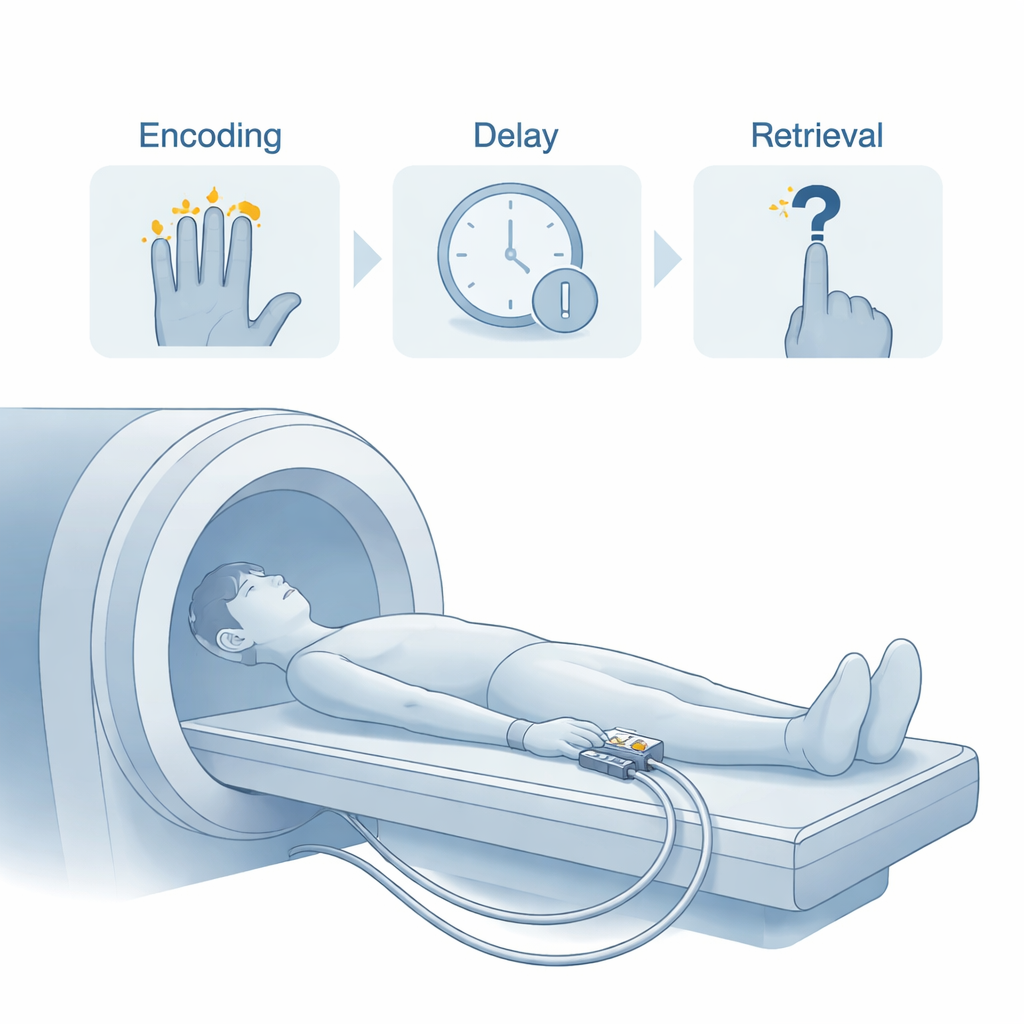
Working memory is the brain’s notepad: it briefly stores and manipulates information so we can use it right away. While most research has focused on sights and sounds, this study zooms in on touch. The researchers asked 28 healthy adults to lie in an MRI scanner while a special air-powered glove delivered quick taps to the fingertips of the right hand. In every trial, the pattern of taps during the first few seconds was the same, but what participants had to remember about that pattern changed across conditions. Sometimes they had to remember the full sequence of taps (a demanding task), sometimes only which finger was tapped twice (a simpler task), and sometimes they did not have to recall anything at all.
Turning up the difficulty knob
The team carefully separated three moments in each trial: an encoding phase when taps were delivered, a silent delay phase when nothing touched the fingers but the pattern had to be held in mind, and a retrieval phase when a new tap asked a yes/no question about what had been felt before. By comparing performance, they confirmed that the full-sequence task was harder: people were slower and made more mistakes when they had to remember the entire order of taps than when they only tracked the repeated finger or simply pressed a button without recalling anything. This behavioral drop-off showed that the researchers had successfully created low- and high-demand versions of tactile working memory.
Touch areas do more than just feel
Classic textbooks describe the primary somatosensory cortex—the strip of brain tissue that first processes touch from the skin—as a simple input station. Using high-field functional MRI, however, the researchers found that this region stayed active long after the taps ended, especially on the side of the brain opposite the stimulated hand and especially when the task was harder. Activity in this sensory area ramped up not just when taps were felt, but also while the pattern was being silently maintained and later checked. This pattern suggests that the brain “replays” or sustains touch-related signals in sensory cortex to keep them alive in memory, rather than handing them off entirely to higher-level control regions.
A conversation between feeling and control networks
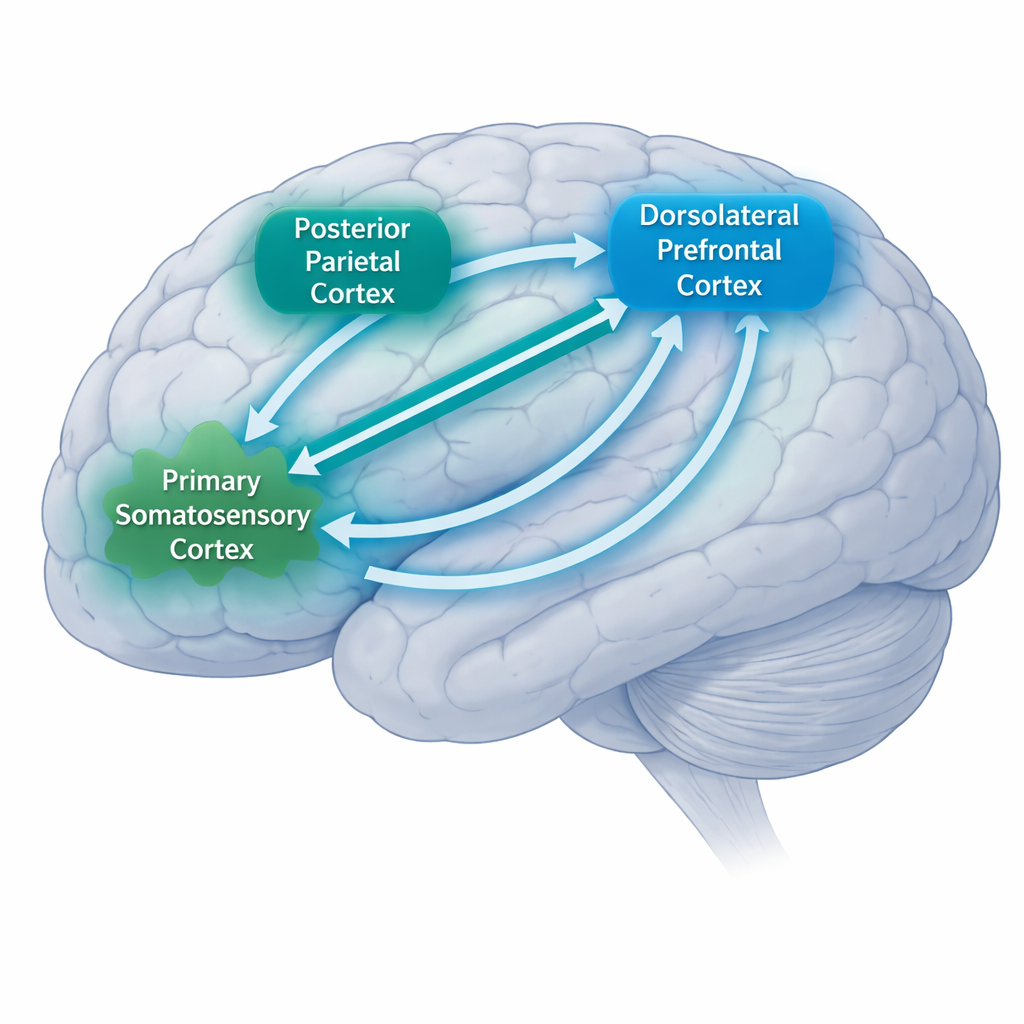
To understand how different brain areas talk to one another, the team analyzed connectivity between primary somatosensory cortex and two key control hubs: the posterior parietal cortex (involved in attention and spatial processing) and the dorsolateral prefrontal cortex (linked to planning and executive control). During the delay period, when participants silently held the touch sequence in mind, communication between touch and frontoparietal regions increased as task demands rose. More detailed modeling showed that, under high demand, the posterior parietal cortex sent especially strong excitatory signals to the touch area, as if reinforcing the stored pattern. During retrieval, when participants had to compare a new tap to what they remembered, parietal regions drove prefrontal cortex, which in turn sent boosted signals back to the touch area, sharpening the brain’s ability to read out the stored tactile information.
What this means for our understanding of memory
For non-specialists, the key message is that the brain does not store touch information in a single “memory box.” Instead, memory for touch emerges from a flexible collaboration between the regions that first feel the touch and the regions that control attention and decision-making. When a task is easy, this network can run in a relatively low-gear mode. When the task becomes more demanding, the front and parietal regions push harder on the sensory cortex, strengthening and reshaping touch signals during both the waiting period and the moment of recall. This work helps explain how the brain balances limited resources when we juggle complex sensory information and points toward more realistic models of working memory that rely on active, demand-dependent loops between sensation and control.
Citation: Sun, D., Zhang, J., Fu, S. et al. Task demand modulates somatosensory-frontoparietal networks during delay and retrieval periods in tactile working memory. Commun Biol 9, 312 (2026). https://doi.org/10.1038/s42003-026-09586-y
Keywords: tactile working memory, somatosensory cortex, frontoparietal network, brain connectivity, fMRI