Clear Sky Science · en
Sex- and etiology-specific effects on predictive processing in the inferior colliculus of two rat models of autism
Why our brains care about surprising sounds
Imagine walking down a busy street when a car horn suddenly blares. Your brain instantly flags that sound as important against the background noise. Many autistic people experience these sound worlds differently—sometimes finding everyday noises overwhelming, sometimes barely noticing them. This study asks a simple but deep question: at a very early stage of hearing, in the midbrain, do males and females with autism-like traits process sound surprises in different ways, and does it matter whether those traits arise from genes or from the prenatal environment?
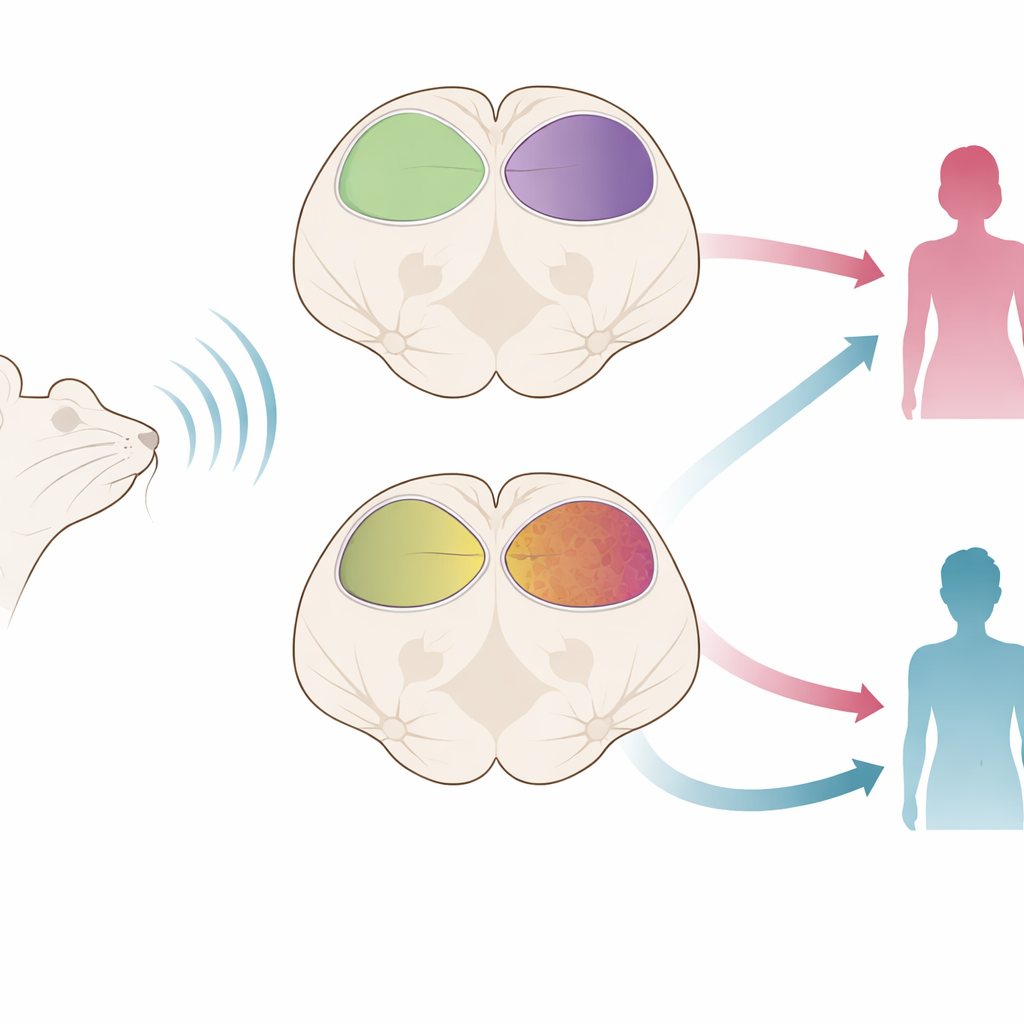
A sound-detecting hub deep in the brain
The work focuses on a small structure in the midbrain called the inferior colliculus, a crucial crossroads where sound information from the ears is first combined with signals from higher brain areas. In rats, as in humans, this hub contains two main routes: a “classic” route that faithfully carries sound details such as pitch and loudness, and a more flexible route that weighs context, novelty, and relevance. The researchers used two well-established rat models that mimic different causes of autism: one with a mutation in a gene linked to synapse function (Grin2b), and another in which developing embryos were exposed to the drug valproic acid, a known environmental risk factor.
Probing how neurons react to regular and odd sounds
To test how these brain circuits track patterns, the team recorded activity from individual neurons while they played simple tone sequences through a tiny speaker to one ear. In one sequence, a single tone was repeated over and over, with a rare odd tone slipped in—much like a single drumbeat suddenly changing. In another, tones marched up or down in pitch in a perfectly predictable staircase without repetitions. By comparing each neuron’s responses to the repeated, orderly, and rare tones, the researchers could separate three ingredients of predictive listening: how much a neuron “gets used to” repetition, how strongly it reacts when a pattern is broken, and the overall size of its mismatch response to surprise.
Different starting points for males and females
Even before sounds arrived, female control rats showed higher spontaneous firing in this midbrain hub than males, suggesting a naturally more active baseline state. When sounds were played, control females responded less to repeated tones and to orderly sequences than males, but produced stronger signals tied specifically to violations of expected patterns. Put simply, male brains in this region emphasized stable tracking of regular sound structure, while female brains emphasized detecting when that structure was broken. These sex-linked styles appeared in both the classic and context-sensitive routes of the inferior colliculus.
How autism-like changes reshape early sound prediction
Introducing autism-linked risk factors shifted these patterns, and the shifts depended strongly on both sex and brain route. In females, both the Grin2b mutation and prenatal valproic acid exposure boosted the overall mismatch response to surprising sounds, largely by strengthening adaptation to repetition, while in some cases weakening the pure “error” signal when a pattern was broken. Prenatal valproic acid also lowered females’ already high baseline activity, especially in the context-sensitive pathway. In males, effects were more limited: prenatal valproic acid reduced their mismatch responses in the context-sensitive route, while the Grin2b mutation had little impact on early prediction signals. These results point to a particular vulnerability—and flexibility—of the non-classic, context-focused pathway, especially in females.
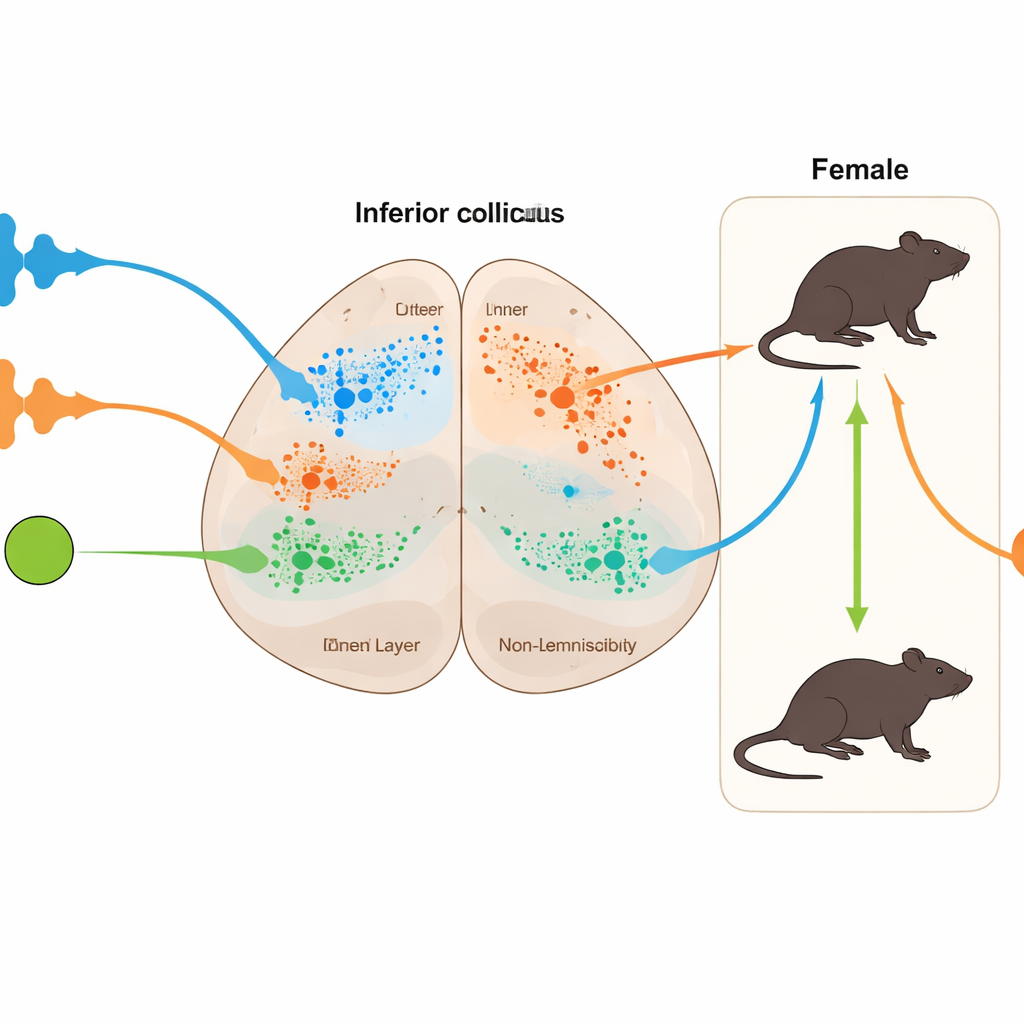
What this means for understanding autistic hearing
For a layperson, the key message is that early sound processing in the brain is not uniform: males and females start from different “listening styles,” and genetic versus environmental risk factors for autism nudge those styles in distinct directions. Rather than a single, simple change in how loudly the brain responds to sounds, autism-like conditions alter the balance between getting used to repeating sounds and reacting to unexpected ones, especially in circuits that weigh context and emotional relevance. This work in rats cannot by itself explain human experiences of sound, but it supports the idea that autism includes multiple biological subtypes—and that sex and cause both shape how the brain predicts and reacts to the noisy world.
Citation: Cacciato-Salcedo, S., Lao-Rodríguez, A.B. & Malmierca, M.S. Sex- and etiology-specific effects on predictive processing in the inferior colliculus of two rat models of autism. Commun Biol 9, 356 (2026). https://doi.org/10.1038/s42003-026-09585-z
Keywords: auditory processing, predictive coding, autism models, sex differences, inferior colliculus