Clear Sky Science · en
Single-cell atlas reveals cellular heterogeneity and BMP5-mediated regulation of adipogenic differentiation in sheep adipose tissue
Why sheep fat can teach us about health
Fat is more than padding; it is an active organ that helps animals survive cold, hunger, and disease. Sheep are especially interesting because some breeds store huge reserves of fat in their tails, a natural "energy backpack" for hard times. This study used cutting-edge single-cell genetic tools to map, in fine detail, the different kinds of cells that make up sheep fat and to discover how one key signal, a molecule called BMP5, helps decide whether tail fat cells grow and store energy. Understanding these processes could guide leaner livestock breeding and shed light on human obesity and metabolic disease.
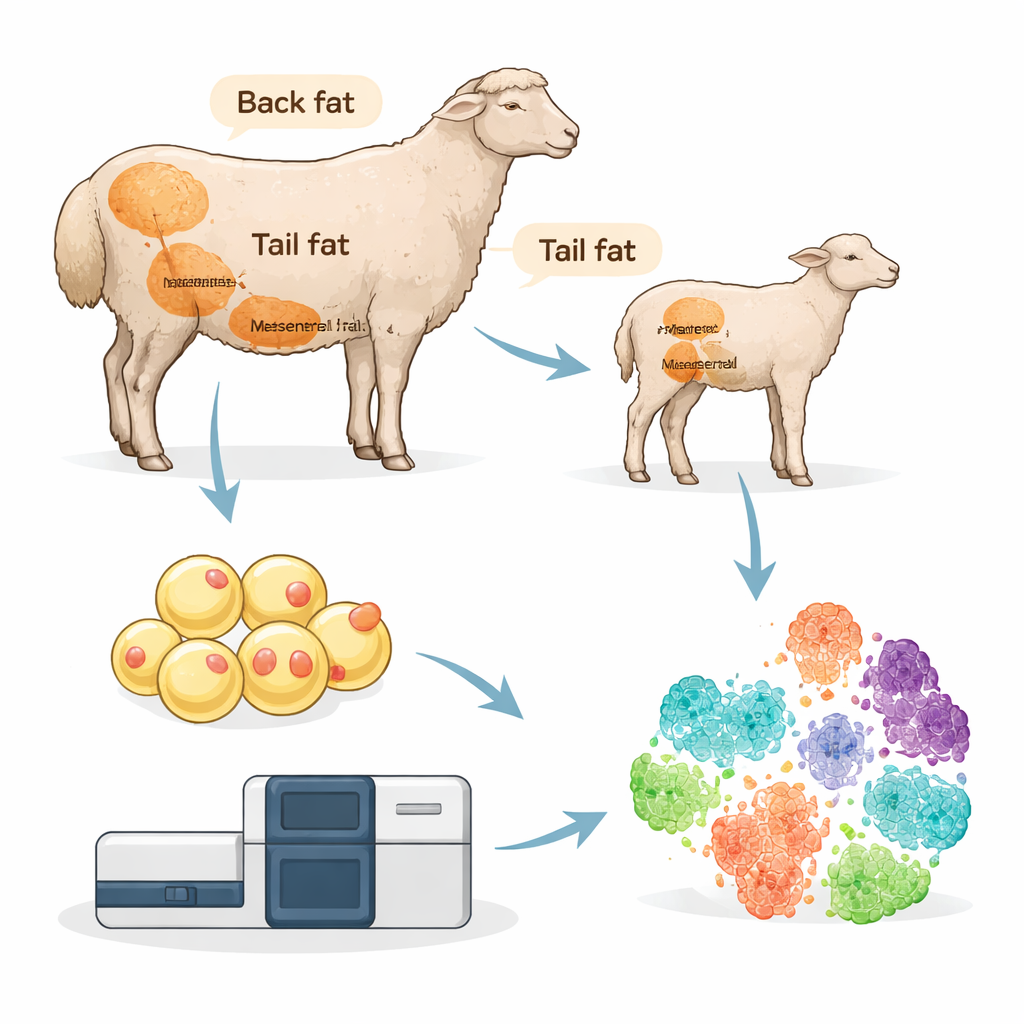
Different kinds of fat, different jobs
Fat in the body is not all the same. The researchers focused on four major fat depots in Hu sheep: fat under the back skin, fat in the tail, and two kinds of deep "visceral" fat around internal organs. By analyzing more than 64,000 individual cell nuclei, they built a cellular atlas of these depots. They found nine main cell families, including mature fat cells, stem and progenitor cells that can turn into fat, immune cells, and cells that line blood vessels. Each depot had its own mix. Back and tail fat were especially rich in mature fat cells geared toward storing energy, while visceral fat carried more immune cells that likely help manage inflammation and whole-body metabolism.
Tail fat’s special reserve of flexible cells
The team then zoomed in on the fat-rich tail, sampling it at birth and at 2, 4, and 6 months of age. They discovered that tail fat holds a high proportion of a special kind of stem-like cell called fibroadipogenic progenitor cells. These cells can become either fat-storing cells or fibrous support cells, giving the tail depot both structural strength and the ability to expand its energy reserves when needed. One sub-group of these progenitors, abundant right after birth, showed strong activity in genes that control cell division and early development, hinting that the first weeks of life are a critical window when the tail’s future fat capacity is set.
How a single signal steers fat formation
Using computational tools, the researchers examined how cell types in tail fat "talk" to one another through chemical signals. Among dozens of signaling routes, one stood out in newborn tails: the BMP pathway. In this pathway, stem and early fat cells secreted a protein called BMP5, which bound to receptors on nearby pre-fat cells and appeared to push them toward becoming fully developed fat cells. As the animals aged, the strength of this BMP5 signal dropped, matching a general slowdown in new fat cell formation. When the team compared gene activity between newborn tail fat and a visceral fat depot, BMP5 and related genes were clearly more active in the tail, reinforcing its role as a driver of tail-specific fat buildup.
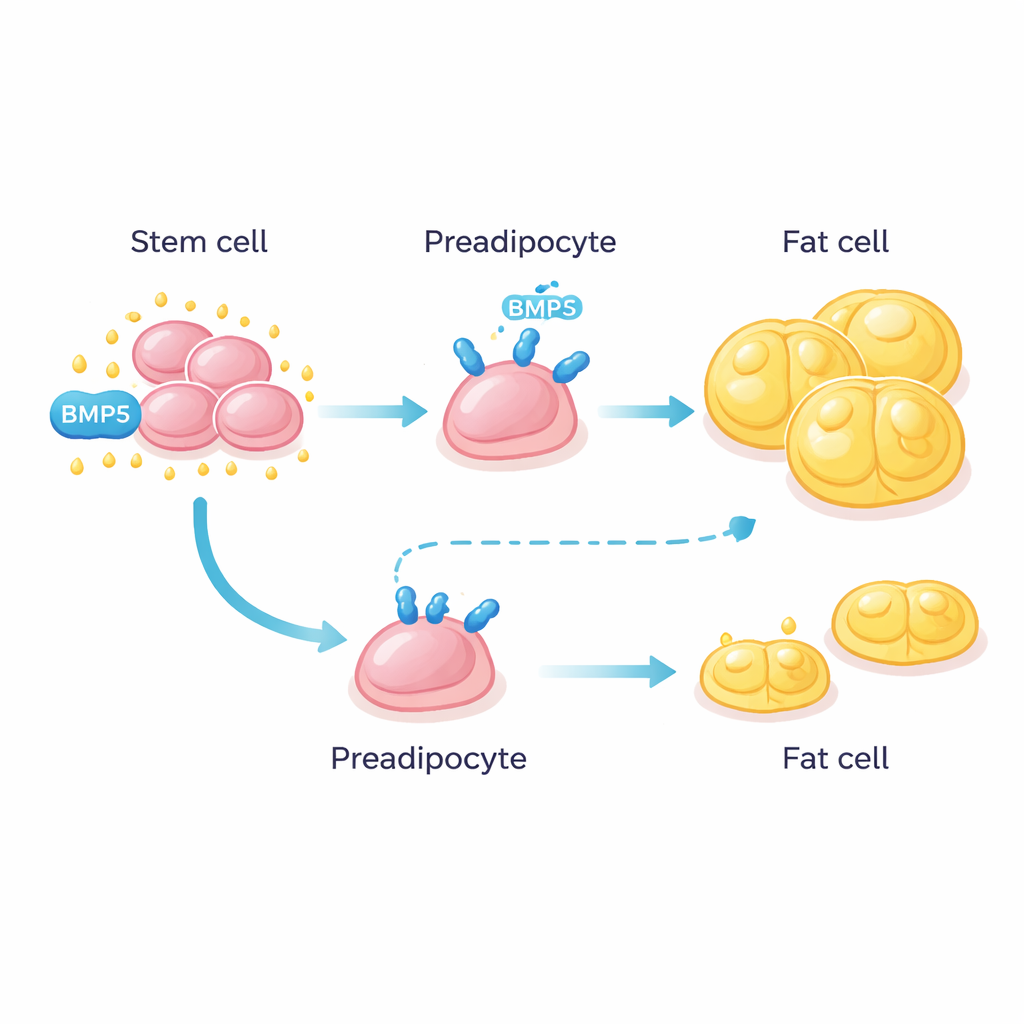
Switching BMP5 off trims fat storage
To test whether BMP5 truly controls fat formation, the scientists grew tail fat cells in the lab and used small RNA molecules to switch the BMP5 gene off. The result was striking: cells with reduced BMP5 stored less triglyceride, the main form of fat, and key fat-related genes were turned down. This experiment suggests that BMP5 acts like a volume knob for tail fat development. Turning it up helps build a big, energy-rich tail; turning it down leads to leaner tissue. Because BMP5’s activity appears concentrated in tail and other subcutaneous fat, the authors suggest it might be possible in the future to reduce unwanted external fat in livestock without harming the desirable fat inside muscles.
What this means for animals and people
In simple terms, this work shows that different fat depots in sheep are made of different cell communities and follow distinct growth rules. Tail fat is equipped with flexible stem-like cells and a strong BMP5 signal that together build a robust energy store. By charting these cells one by one, the study points to BMP5 as a key controller of when and where new fat cells form. For farmers, such knowledge could inform breeding or gene-editing strategies to produce leaner animals that use feed more efficiently. For human health, the sheep atlas offers a large-mammal model to explore why some fat depots are more harmful than others and how early-life signals shape lifelong risks of obesity and metabolic disease.
Citation: Cheng, J., Han, K., Xu, D. et al. Single-cell atlas reveals cellular heterogeneity and BMP5-mediated regulation of adipogenic differentiation in sheep adipose tissue. Commun Biol 9, 292 (2026). https://doi.org/10.1038/s42003-026-09581-3
Keywords: adipose tissue, single-cell atlas, sheep tail fat, BMP5 signaling, fat metabolism