Clear Sky Science · en
A paraventricular hypothalamic control of social stress susceptibility by targeting brown adipose tissue β3 adrenoceptor
Why body fat matters for mood
Depression is often thought of as a problem of the mind, but growing evidence shows the body’s organs also play a powerful role. This study explores how a special heat‑producing fat, called brown fat, communicates with the brain during social stress in mice. By tracing this hidden connection, the researchers uncover how signals from the brain to brown fat can increase inflammation in the body and, in turn, make animals more likely to show depression‑like behaviors.
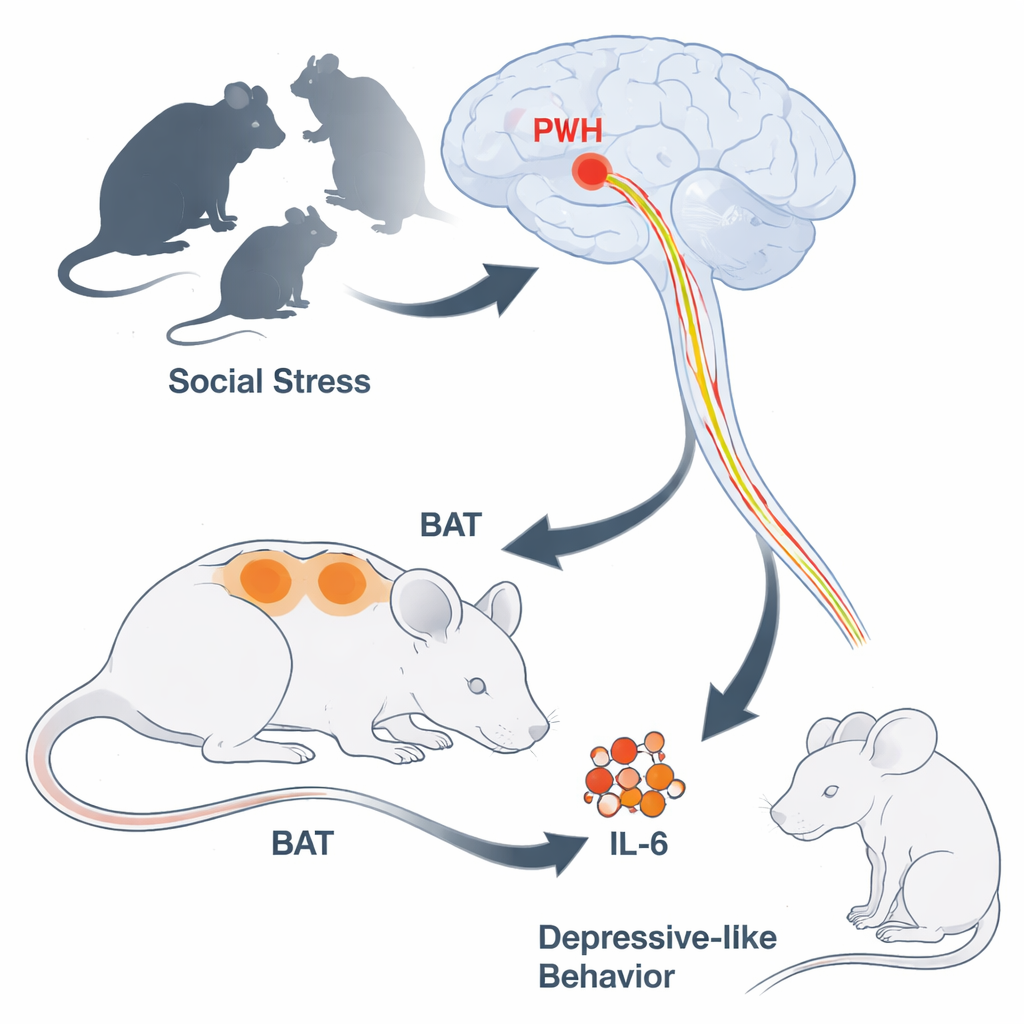
A stress circuit linking brain and body
The team focused on a deep brain region called the paraventricular hypothalamus, or PVH, which helps coordinate the body’s responses to stress. They used a mouse model in which repeated attacks by a larger, aggressive mouse create a long‑lasting form of social stress. Some mice became socially withdrawn and showed other depression‑like signs; others remained resilient. When the researchers examined brown fat from these animals, they found that the “susceptible” mice had higher activity in nerves supplying the fat and higher levels of a docking protein on fat cells known as the beta‑3 adrenergic receptor. This suggested that the brain might be driving brown fat to behave differently in vulnerable animals.
Brown fat’s role in shaping mood
To test cause and effect, the scientists boosted beta‑3 receptors with a drug in otherwise normal mice. Those animals spent more time immobile in a forced swim test and became more likely to avoid social contact after mild stress—both common measures of depression‑like behavior in rodents. Removing the main patch of brown fat prevented these drug‑induced changes, showing that the behavioral shift depended on signals specifically in brown fat rather than elsewhere in the body.
Inflammation as the messenger
Brown fat does more than burn calories; it also releases hormones and immune molecules into the bloodstream. By analyzing gene activity, the researchers discovered that stressed, susceptible mice had turned on programs in brown fat linked to the inflammatory molecule interleukin‑6 (IL‑6). Levels of IL‑6 were elevated both in brown fat and in blood, and the two measures rose and fell together. When the scientists surgically removed brown fat before stress, the spike in circulating IL‑6 disappeared. Blocking the stress‑related nerve supply to fat, or blocking beta‑3 receptors, also prevented IL‑6 from rising, while directly stimulating beta‑3 receptors mimicked the stress effect—again only when brown fat was present. These results point to brown fat as a key source of stress‑induced IL‑6.
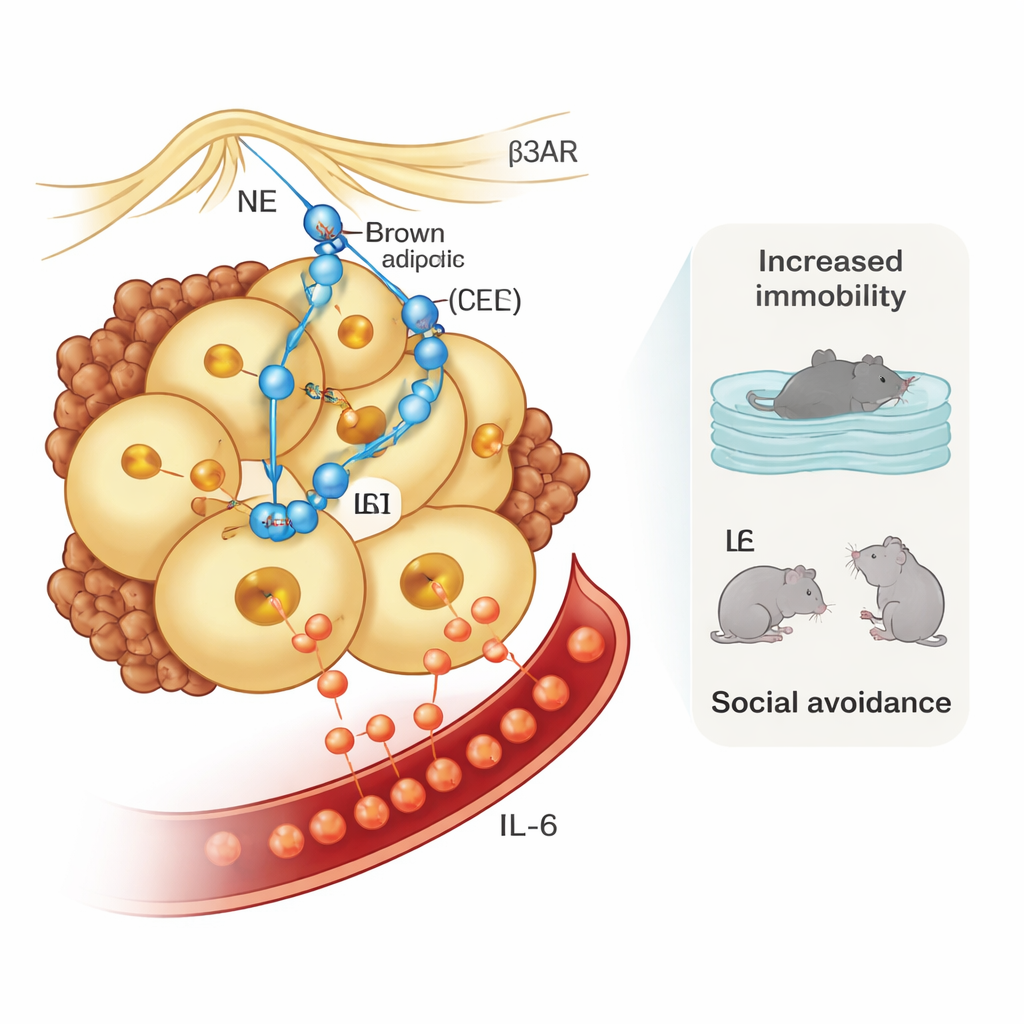
How the brain talks to brown fat
Next, the team asked how the PVH brain region actually reaches brown fat. They injected a tracing virus into brown fat that travels backward along nerve pathways. After several days, labeled cells appeared in several brain areas, with the strongest signal in the PVH, indicating a multi‑step nerve route from this nucleus to fat. When the scientists artificially activated PVH nerve cells using a chemogenetic tool—a designer receptor turned on by a harmless drug—brown fat ramped up IL‑6 production, and mice became more socially avoidant after mild stress. Interrupting the sympathetic nerves that carry signals to fat blocked both the IL‑6 increase and the depression‑like behaviors, confirming that an intact brain‑to‑fat nerve circuit is required.
What this means for understanding depression
For a non‑specialist, the takeaway is that depression‑like behavior in these mice was not driven solely by changes in the brain. Instead, social stress activated a PVH‑centered brain circuit that signaled through the sympathetic nerves to brown fat, switched on beta‑3 receptors, boosted production of the inflammatory molecule IL‑6, and ultimately increased vulnerability to social stress. While this work was done in animals, humans also have brown fat and similar stress pathways. The findings suggest that targeting brown fat signaling or IL‑6 production—rather than just brain chemistry—could offer new ways to prevent or treat certain forms of depression that are linked to chronic social stress and inflammation.
Citation: Du, X., Zhang, J., Wang, Q. et al. A paraventricular hypothalamic control of social stress susceptibility by targeting brown adipose tissue β3 adrenoceptor. Commun Biol 9, 307 (2026). https://doi.org/10.1038/s42003-026-09574-2
Keywords: depression, social stress, brown adipose tissue, inflammation, brain–body interaction