Clear Sky Science · en
A division of labor in perception-action integration via hierarchical alpha-beta to beta-gamma coupling and local catecholaminergic control
How the Brain Links Seeing and Doing
Everyday life depends on quickly deciding whether to act or hold back: brake at a red light, ignore a pop-up, stop your hand from touching a hot pan. This study asks how the brain’s internal rhythms help us switch between "go" and "stop," and how a common medication, methylphenidate (MPH, known from ADHD treatment), tunes those rhythms to improve self-control.
Stopping, Starting, and Confusing Signals
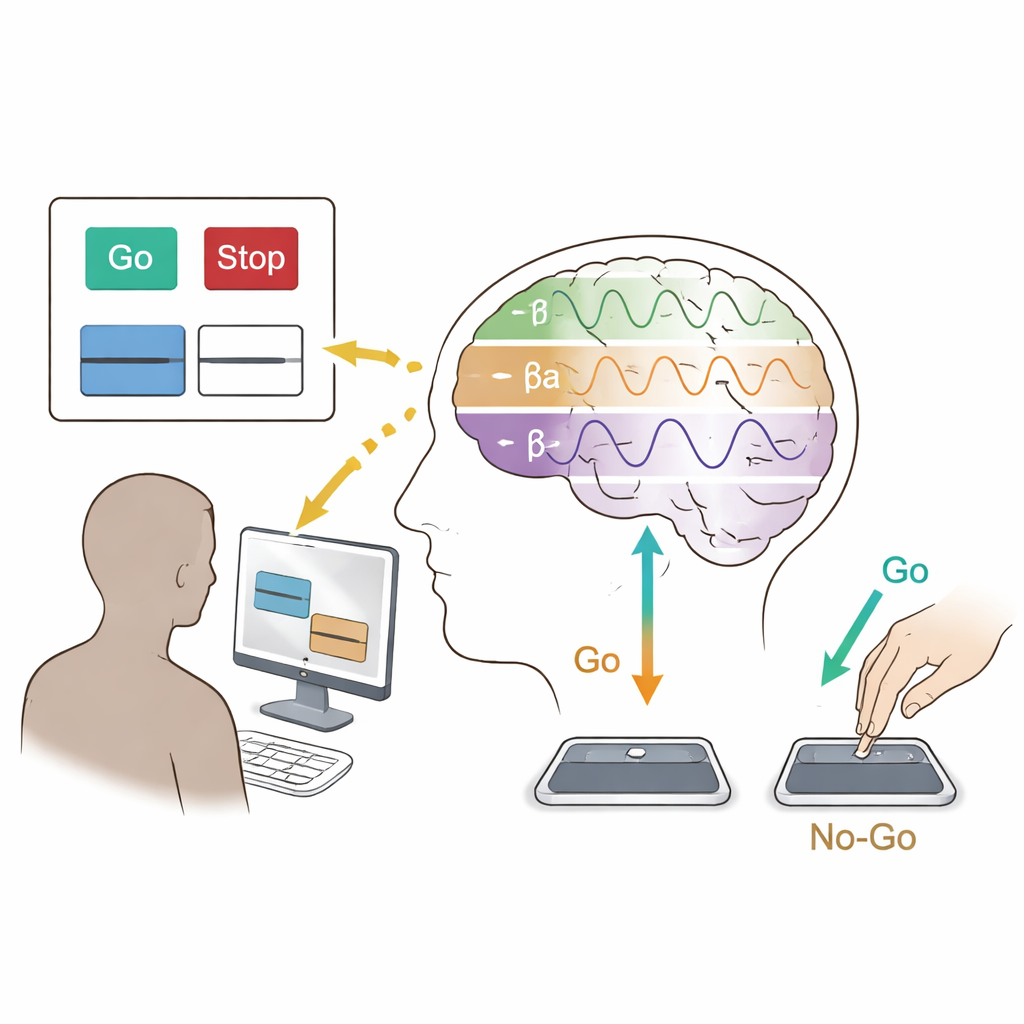
The researchers used a computer task where volunteers either pressed a key (“Go” trials) or had to withhold a response (“No-Go” trials). Some signals were very easy to tell apart: a green word meaning “press” versus a red word meaning “stop.” Others were more confusing, sharing colors or shapes so that “go” and “stop” looked similar. In these overlapping cases, the brain had to undo and rebuild its usual link between what is seen and what is done. As expected, people made far more mistakes—pressing when they should not—when the signals overlapped. When they took methylphenidate instead of placebo, they made fewer such errors, especially in the more confusing overlapping condition, showing that the drug improved the ability to stop at the right moment.
Brain Rhythms Working Together
While participants performed the task, the team recorded their brain activity with EEG. Instead of looking only at how strong each rhythm was, they focused on how slower and faster rhythms worked together, a pattern called phase–amplitude coupling. In simple terms, they asked: do slow waves set the timing for bursts of faster activity, like a conductor guiding an orchestra? They studied four main rhythm ranges often seen in thinking and acting: alpha, beta, and gamma (plus theta, which turned out to be less important here). They found that three pairings were especially active when people were stopping actions: alpha–beta, alpha–gamma, and beta–gamma couplings, with beta–gamma being the strongest. Theta-related couplings were weak and did not reliably stand out from noise.
A Timing Hierarchy for Flexible Control
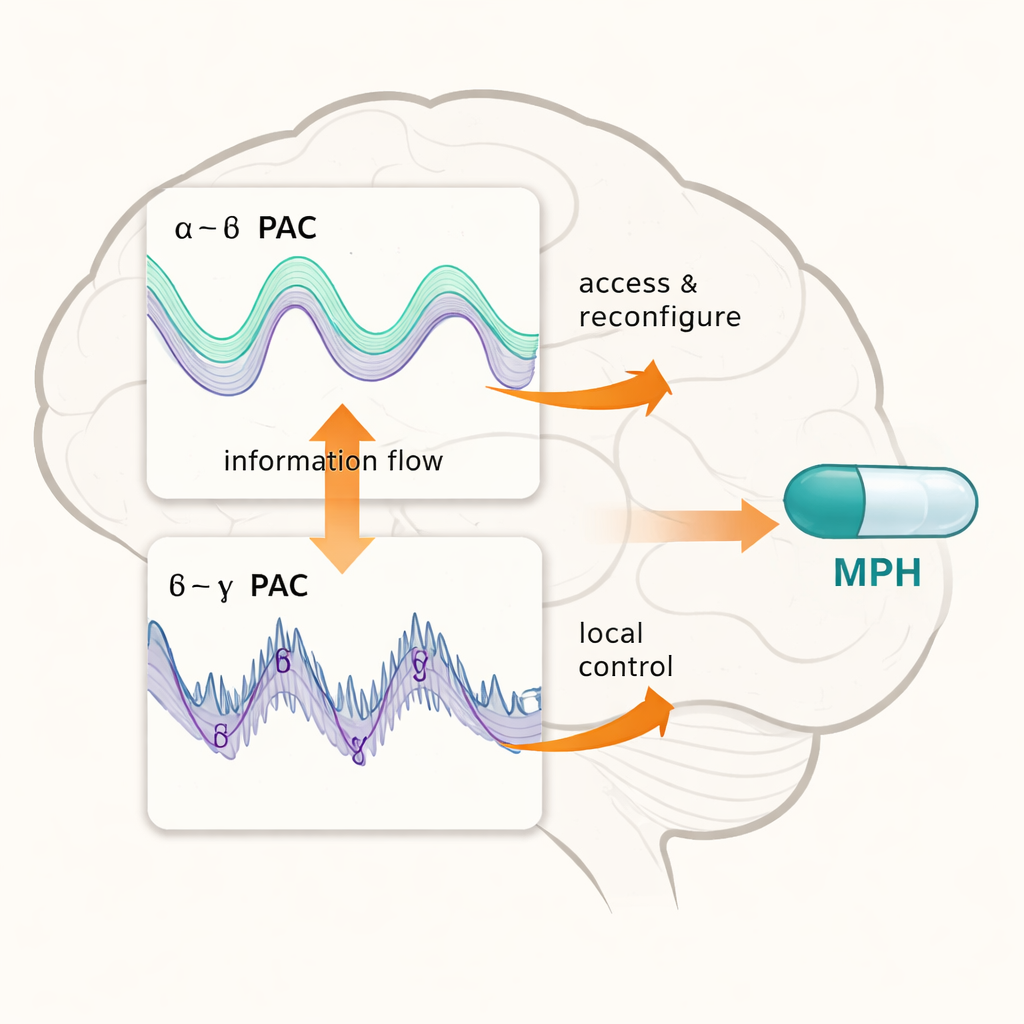
To understand when these couplings mattered, the researchers tracked them over time after each signal appeared. Alpha–beta coupling showed two peaks: an early one about 130–250 milliseconds after the signal, and a later one around 530–770 milliseconds. Beta–gamma coupling was mainly stronger in this later period. When the "go" and "stop" signals overlapped and demanded more flexible control, both alpha–beta and beta–gamma couplings became stronger than in the easy condition. This suggests a division of labor: early on, alpha–beta coupling helps access and adjust the link between perception and action; later, beta–gamma coupling helps refine and stabilize the updated plan. Using an information-theory method, the authors also found that changes in alpha–beta coupling tended to predict later changes in beta–gamma coupling, but not the other way around. That means slower rhythms (alpha–beta) set the stage for how faster rhythms (beta–gamma) operate, forming a hierarchical control chain rather than a flat network.
How Medication Tweaks Local Control
The study also tested how catecholamines—brain chemicals like dopamine and noradrenaline, boosted by methylphenidate—interact with this rhythm hierarchy. Under methylphenidate, the overall pattern of information flow from alpha–beta to beta–gamma stayed the same, and alpha–beta coupling itself did not change reliably. However, beta–gamma coupling became stronger in specific time windows, both in easy and difficult trials. Brain source estimates pointed to regions involved in attention, feature binding, and state resetting, such as parts of the parietal cortex and posterior midline areas. Taken together, this suggests that medication does not rewrite the overall hierarchy of control but tunes local computations where beta–gamma rhythms help maintain and sharpen the active "do" or "don’t" representation.
What This Means for Everyday Self-Control
For a layperson, the main message is that the brain uses a carefully timed division of labor to connect what we see with what we do. Slower rhythms coordinate when information is accessed and reconfigured, while faster rhythms handle the fine details and stability of the chosen action plan. Methylphenidate appears to leave the basic chain of command intact but boosts the precision of the local control stage. Understanding this layered system may help explain why such medications can improve self-control in conditions like ADHD and could guide future approaches to support flexible, goal-directed behavior.
Citation: Zhupa, M., Beste, C. A division of labor in perception-action integration via hierarchical alpha-beta to beta-gamma coupling and local catecholaminergic control. Commun Biol 9, 284 (2026). https://doi.org/10.1038/s42003-026-09564-4
Keywords: response inhibition, brain rhythms, methylphenidate, perception–action integration, cognitive control