Clear Sky Science · en
Evolving brain function and connectivity patterns during mentalizing in children and adults
Why understanding others’ minds matters
Everyday life depends on an invisible skill: our ability to guess what other people are thinking and feeling, and to separate their perspective from our own. This capacity, often called "reading minds" in everyday language, shapes how children make friends, how adults work together, and how we all navigate social conflicts. The study summarized here asks a simple but profound question: how does the brain system that supports this social skill change from childhood through adulthood and into middle age?
A social skill that grows and changes
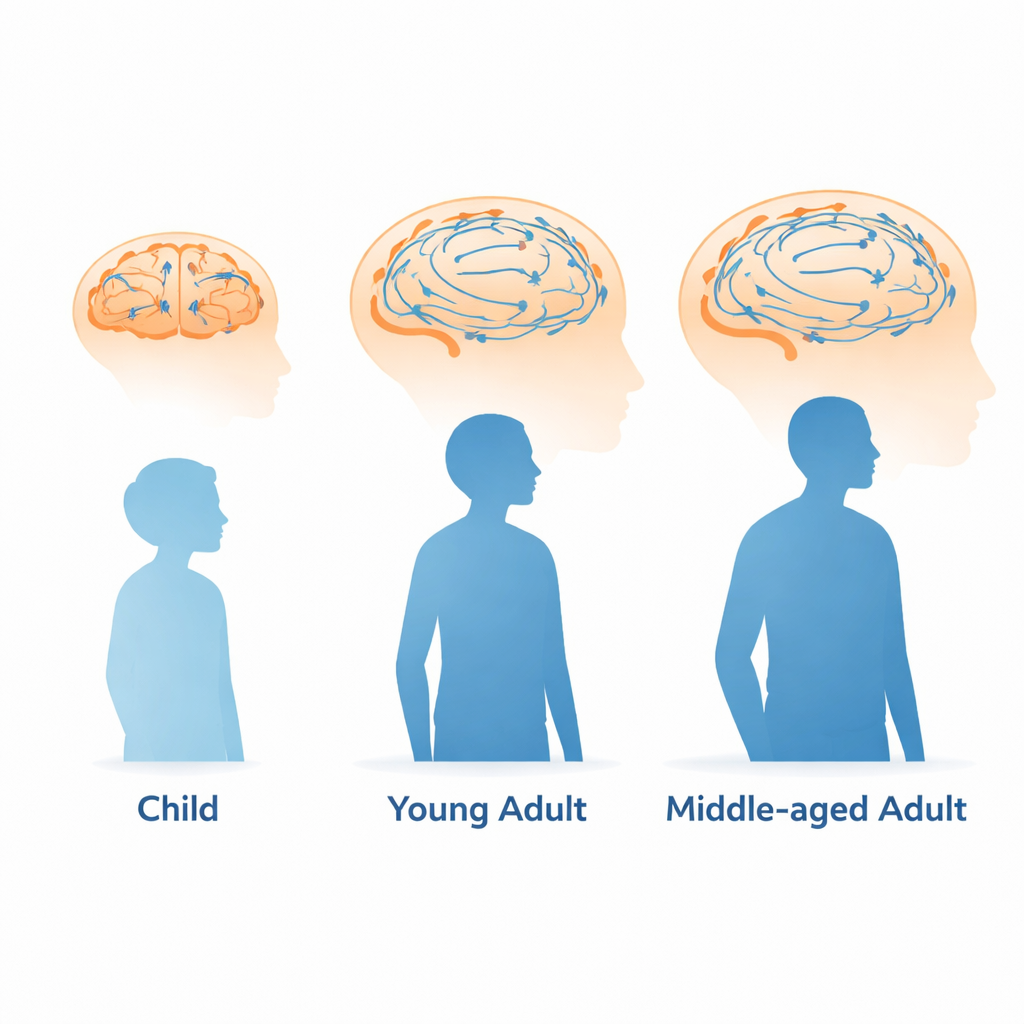
The researchers focused on mentalizing, the process of inferring others’ thoughts, intentions, and emotions. Good mentalizing is linked to fewer behavior problems, fewer physical complaints without clear medical causes, and better long-term emotional health. Difficulties with this skill are common in conditions such as depression and autism. Children start showing early signs of mentalizing in infancy, but the more explicit, reasoning-based form – where you can explain what someone else believes or feels – continues to sharpen throughout childhood and adolescence. At the same time, earlier work in adults has painted a mixed picture, with some studies suggesting that these social abilities decline in later life.
Peeking into the thinking brain
To explore how the brain supports mentalizing across age, the team used functional magnetic resonance imaging (fMRI) in 181 people: 80 children aged 6 to 14, and 101 adults aged 20 to 61. Participants completed a cartoon-based game in the scanner. In each short story, they saw characters in everyday situations and had to choose the most likely ending, sometimes by using physical rules (for example, how objects move) and sometimes by taking into account what the characters were thinking or feeling. This playful design made it possible to study the social brain in both children and adults using the same task, and to compare not just how active different brain regions were, but how strongly these regions worked together during mentalizing.
The common core of the social brain
When people reasoned about others’ minds, children and adults activated a remarkably similar set of brain areas. This shared “social network” included regions deep in the middle of the brain (such as the precuneus and posterior cingulate), areas near the junction of the temporal and parietal lobes on each side of the head, and several regions in the front of the brain collectively known for supporting complex decision-making and self-reflection. Emotional centers like the amygdala and insula were also engaged. Adults were more accurate than children on the task overall, but children’s performance improved steadily with age. Surprisingly, the level of activity in these regions did not change dramatically with age within either group, suggesting that the basic building blocks of the social brain are already in place by middle childhood.
From local wiring to long-distance teamwork
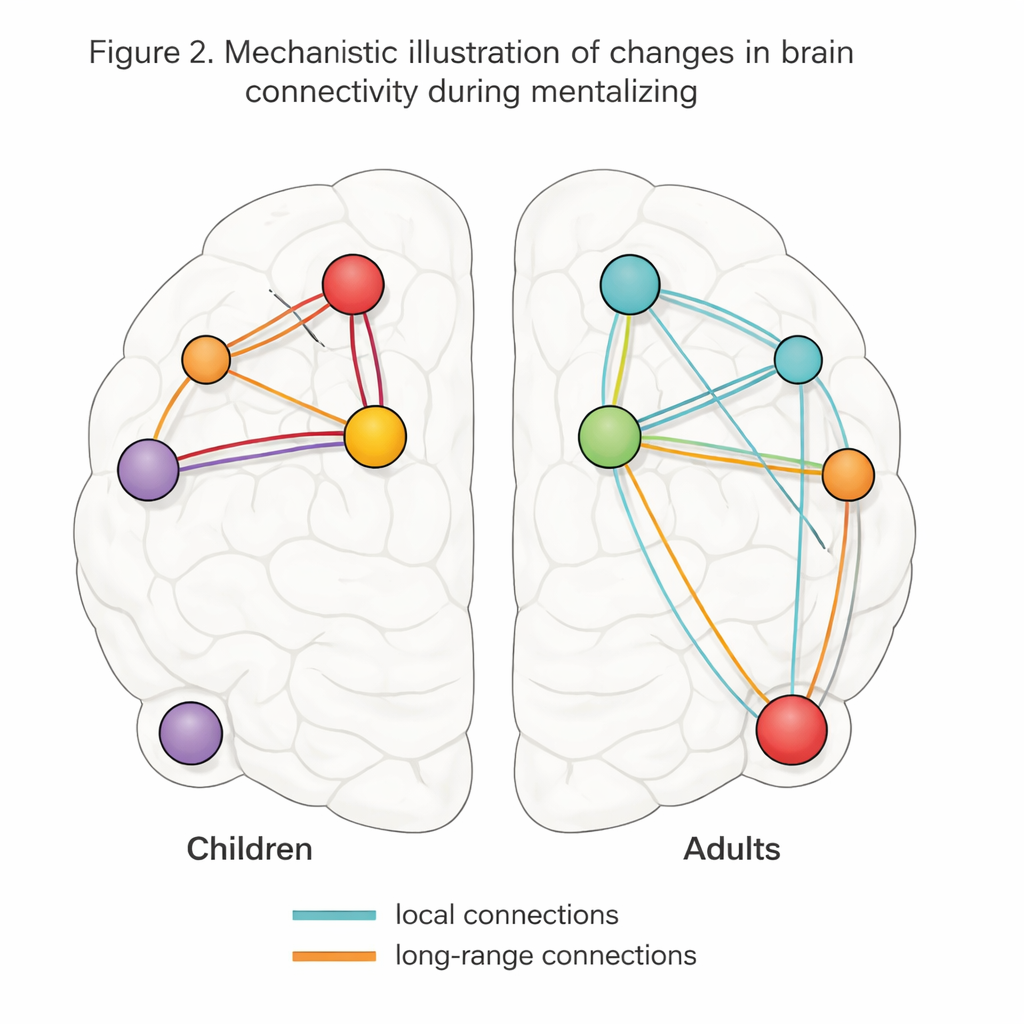
The more striking age differences emerged when the researchers examined functional connectivity – how tightly activity in different regions rose and fell together. Children showed strong short-distance connections within the front of the brain and within back regions, but little evidence of long-distance communication between front and back. As children grew older, these long-range connections gradually strengthened. Adults, by contrast, displayed a more fully integrated network in which frontal, back, and side regions were all strongly linked during mentalizing. Yet within adulthood, especially into middle age, the strength of several of these long-range and frontal connections tended to decline. When all ages were considered together, overall network strength followed an upside-down U-shape: increasing from childhood, peaking in early adulthood around 32 years of age, then slowly decreasing.
Why these brain changes matter for real life
Connectivity was not just a technical measure; it helped explain behavior. In children, stronger long-distance connections between front and back regions predicted better mentalizing performance, and these connections partly explained why older children did better than younger ones. In adults, however, changes in connectivity no longer tracked performance as clearly, hinting that mature brains may rely on additional strategies or backup networks to maintain social skills even as some connections weaken. Taken together, the findings suggest that as children grow, their social brains shift from relying on nearby “local” circuits to depending on a more distributed, long-distance communication network. This network reaches its highest level of integration in early adulthood and then gradually loosens, without necessarily causing immediate declines in everyday social understanding.
Citation: Borbás, R., Dimanova, P., Saikkonen, D. et al. Evolving brain function and connectivity patterns during mentalizing in children and adults. Commun Biol 9, 282 (2026). https://doi.org/10.1038/s42003-026-09562-6
Keywords: social brain, theory of mind, brain development, functional connectivity, lifespan cognition