Clear Sky Science · en
Backward alpha band oscillations shape perceptual bias under probabilistic cues
How the Brain Bets on What Comes Next
Everyday perception is full of educated guesses. When you glimpse a friend in a crowd or catch a road sign in bad weather, your brain quietly uses past experience to fill in the gaps. This study asks a deceptively simple question: how, in physical terms, does the brain send these expectations to the parts of the cortex that actually analyze incoming sights? By watching subtle brain rhythms while people performed a visual task, the authors show that waves of neural activity traveling from the front of the brain toward the back help tilt our decisions toward what we expect to see.
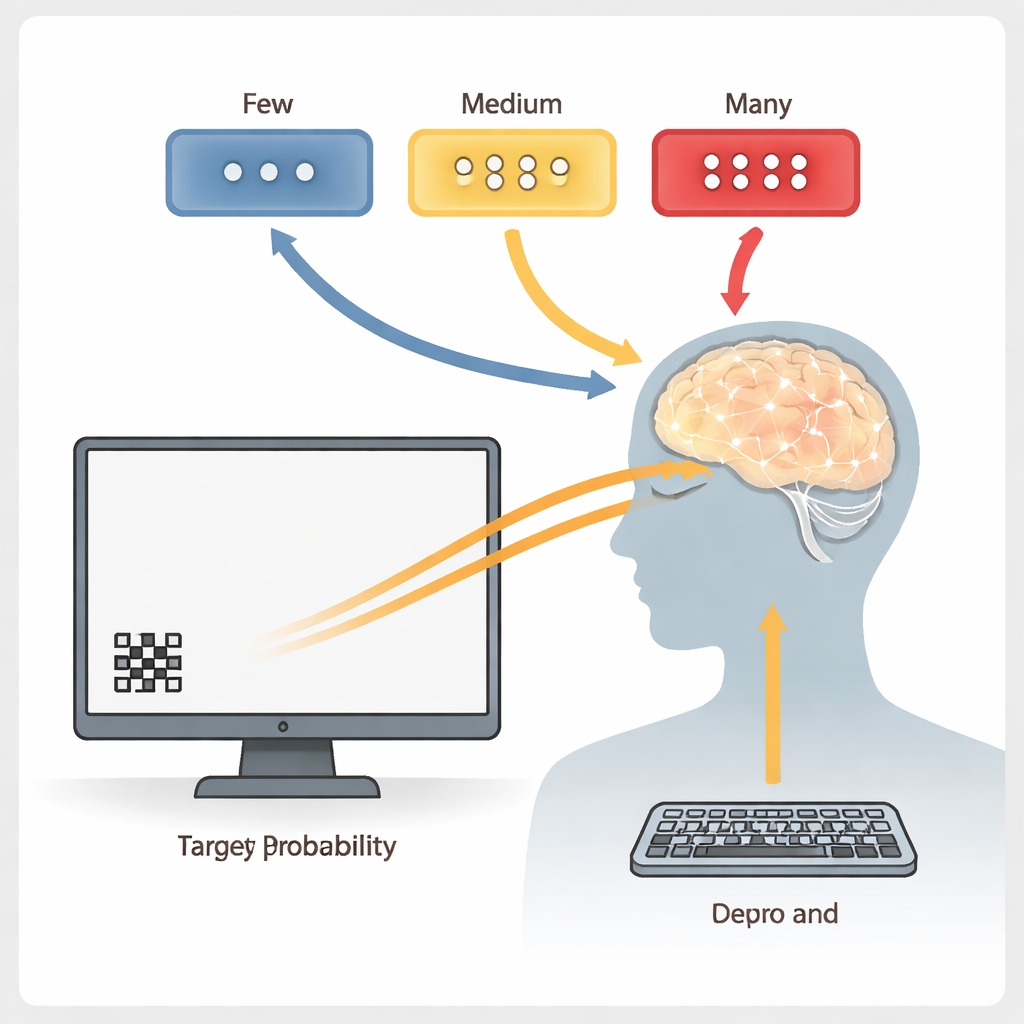
A Game of Visual Guesswork
Volunteers took part in a demanding visual detection game. On each trial, they stared at a screen waiting for a brief checkerboard pattern to flash in the lower left corner. Sometimes the checkerboard contained faint gray circles (the target), and sometimes it did not. Before each checkerboard appeared, a colored bar at the center of the screen served as a cue about how likely the target was to appear: one version signaled a high chance, another a low chance, and a third was neutral. Crucially, these cues were honest—the actual probabilities matched the colors—so participants could, in principle, use them to adjust their bets about whether a target was present.
Cues Change Decisions, Not Eyesight
The researchers analyzed performance using signal detection theory, which separates how well people can tell targets from non-targets from how willing they are to say "yes, I saw it." The cues hardly changed raw sensitivity: participants were not actually seeing better or worse when the target was more or less likely. Instead, cues mainly shifted their decision criterion. When the cue suggested a low chance of a target, people demanded stronger evidence before saying "present" and became conservative. When the cue suggested a high chance, they relaxed their standard and were more willing to report seeing the target. In other words, expectations biased the decision rule rather than the basic visual signal.
Backward Brain Waves Carry Expectations
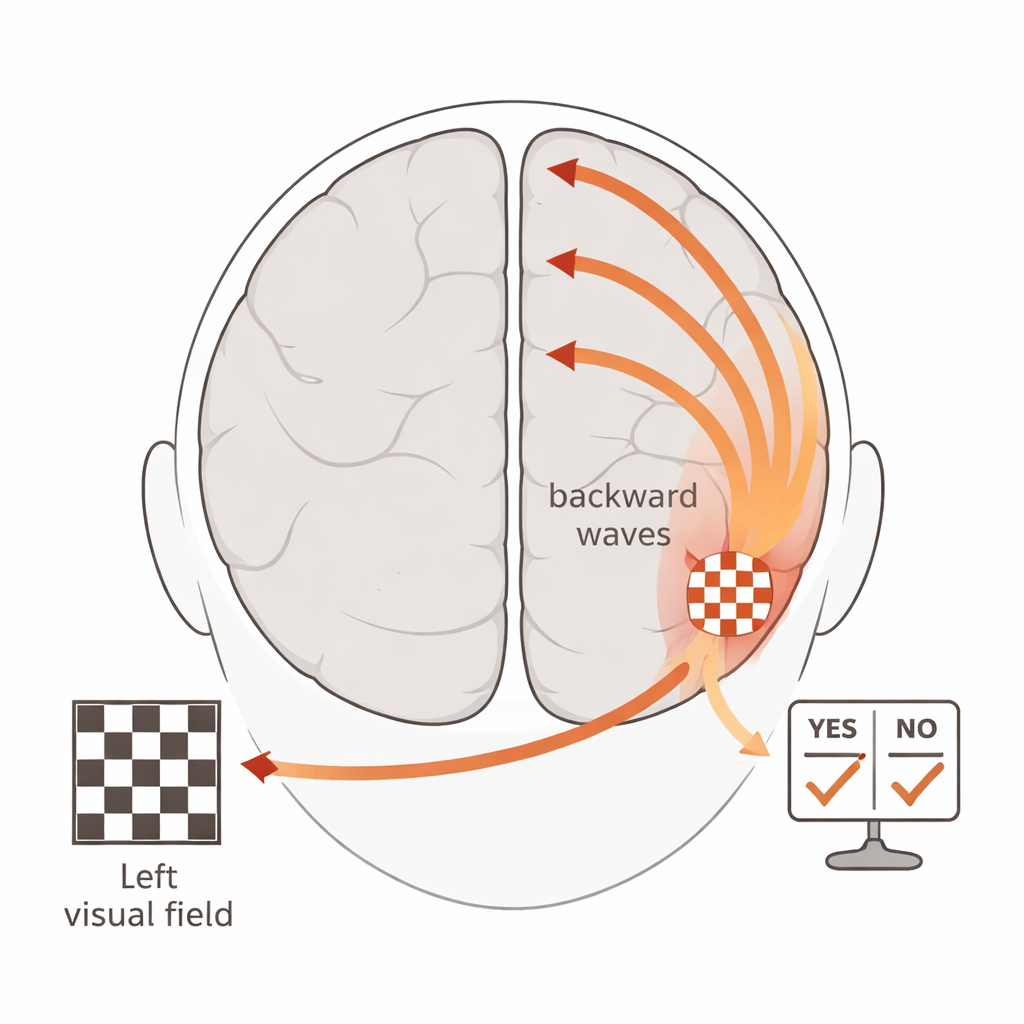
While people played this game, the team recorded electrical activity from the scalp using EEG. They focused on alpha waves—rhythms around 8 to 14 cycles per second—because these oscillations are known to organize communication between brain regions. Instead of treating alpha as a static rhythm, the authors tracked how waves of alpha activity propagated across electrodes from front to back or back to front. They found that, just before the checkerboard appeared, alpha waves tended to travel from frontal toward occipital regions ("backward" waves) in the hemisphere that would process the upcoming stimulus. The stronger these backward waves were, the more a person’s decision criterion shifted in line with the cue’s probability. Forward-traveling alpha waves, moving from the back to the front of the head, did not show this tight link to expectation-driven bias.
Different Brains, Different Strategies
Not everyone used the cues to the same extent. By looking at how much alpha power over visual areas changed between high- and low-probability trials, the researchers separated participants into "prior-driven" individuals, who strongly integrated expectations, and "sensory-driven" individuals, who relied more on the raw sensory input. Prior-driven participants showed especially strong backward alpha waves in the hemisphere opposite the visual stimulus, consistent with robust top-down signals from frontal regions to visual cortex. Sensory-driven participants, in contrast, showed relatively more forward waves in that hemisphere, hinting that their brains prioritized the flow of information from sensory regions upward rather than the downward flow of predictions.
From Brain Rhythms to Everyday Bias
To link these pieces, the authors tested whether backward alpha waves influenced decisions indirectly by changing local alpha power in visual areas. Their analyses supported this chain: stronger backward waves were associated with greater modulation of alpha power over parieto-occipital cortex, which in turn predicted larger shifts in decision bias. Put simply, expectations seem to ride on backward-traveling alpha waves from the front of the brain to the back, where they tune visual regions into a more or less receptive state. This tuned state then nudges us toward saying "yes" or "no" in ambiguous situations. For a layperson, the message is that perception is not a passive readout of the eyes, but an active, rhythmic negotiation between what the world shows us and what the brain already believes is likely to appear.
Citation: Tarasi, L., Alamia, A. & Romei, V. Backward alpha band oscillations shape perceptual bias under probabilistic cues. Commun Biol 9, 280 (2026). https://doi.org/10.1038/s42003-026-09559-1
Keywords: predictive coding, alpha brain waves, perceptual decision-making, visual expectations, EEG traveling waves