Clear Sky Science · en
Variations in carbon flux allocation among cassava (Manihot esculenta) cultivars arise from balanced competition between starch accumulation and structural component development
Why root crops don’t just make starch
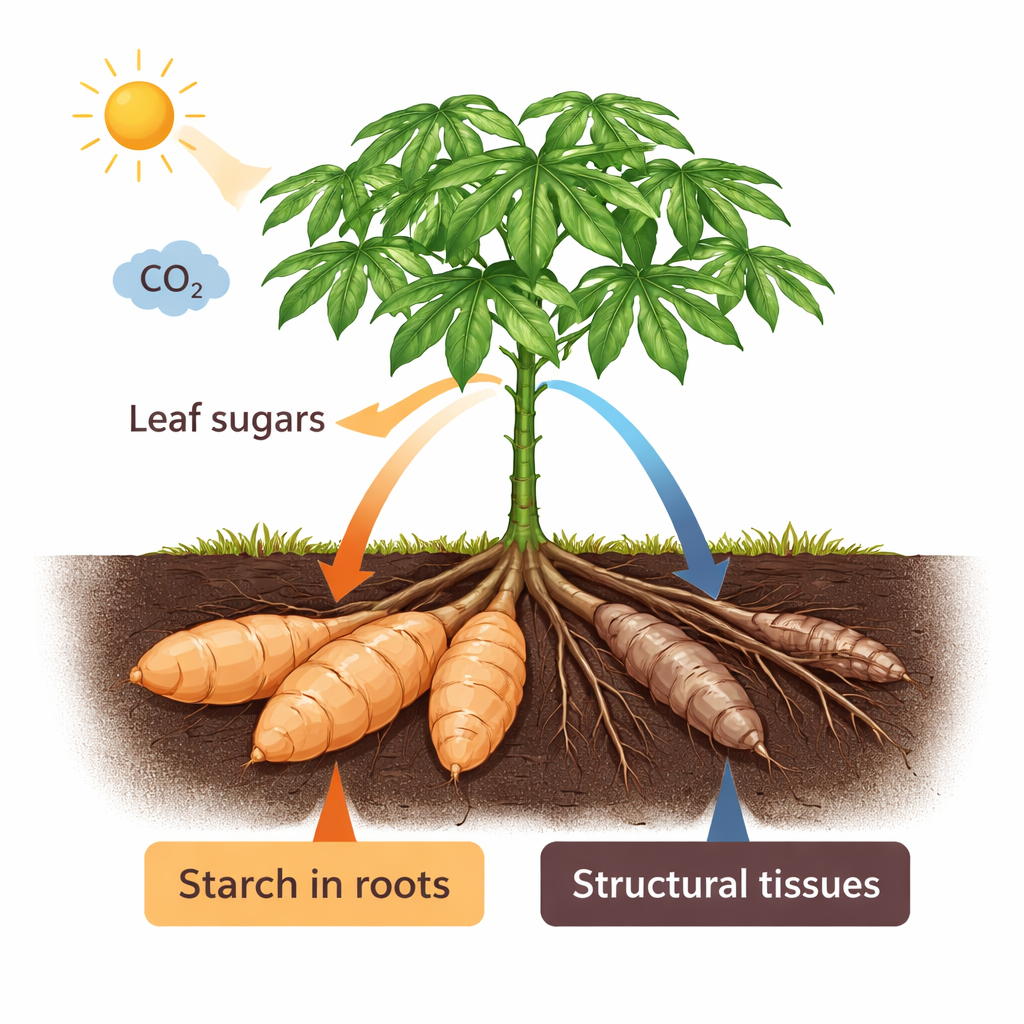
Cassava is a humble tropical root that feeds hundreds of millions of people and supplies starch for food and industry worldwide. Yet not all cassava plants are created equal: some pack their storage roots with starch, while others build tougher, woodier tissue instead. This study asks a deceptively simple question with big implications for food security and bio-based materials: when a cassava plant turns carbon from the air into sugars, what makes it choose between filling its roots with starch or reinforcing them with structural substances like lignin and cellulose?
Two cassavas, two different carbon choices
The researchers compared two cassava varieties that look similar above ground but behave very differently below ground. One, called FX01, produces roots rich in starch. The other, SC16, yields roots that are lower in starch but higher in woody structural components. Using detailed measurements of photosynthesis, sugar levels, and enzyme activity, they found a surprising twist: SC16 actually has stronger photosynthesis in its leaves and higher levels of soluble sugars in its roots, yet it still stores less starch than FX01. The key difference is not how much sugar arrives in the roots, but what the roots do with that sugar once it gets there.
How roots decide between stockpiling and building
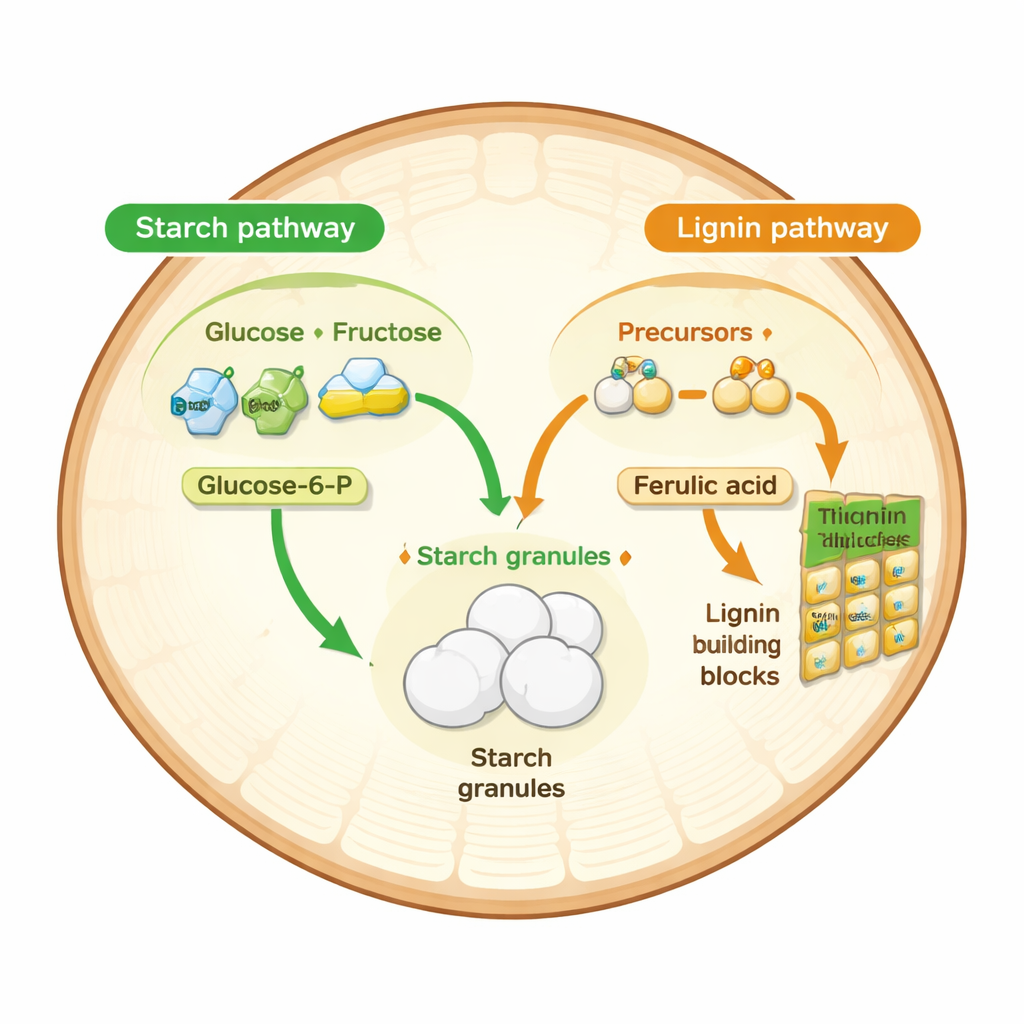
To follow the fate of carbon with precision, the team exposed cassava plants to carbon dioxide marked with a non-radioactive label, carbon‑13. They then tracked how this labeled carbon moved through hundreds of different compounds over nearly two weeks. In FX01, the high‑starch variety, labeled carbon rushed into a chain of sugar phosphates and a crucial molecule called ADP‑glucose, the immediate building block for starch granules. Enzymes that cut sucrose efficiently and add phosphate groups to sugars were more active and more strongly expressed in FX01, creating a smooth pipeline from incoming sucrose to stored starch. In SC16, by contrast, labeled carbon tended to pile up in sucrose and simple sugars, indicating a bottleneck: the roots were good at receiving carbon, but relatively poor at pushing it all the way into starch.
When roots choose strength over energy
The same carbon‑tracing approach revealed that SC16 sends more carbon into a different direction: toward lignin, the rigid substance that stiffens cell walls and gives wood its strength. Many intermediate compounds along this route were more abundant in SC16, and the labeled carbon moved quickly into ferulic acid, a key stepping‑stone on the way to lignin building blocks. Enzymes and genes linked to lignin production, especially one called MeCOMT8, were more active in SC16. This shows that carbon isn’t just “lost” when starch is low—it is actively redirected into structural materials that make roots tougher and more fibrous, at the expense of starchy reserves.
Flipping the switch in favor of starch
To test whether this lignin route really competes with starch storage, the scientists partially turned off the MeCOMT8 gene in cassava using a temporary gene‑silencing technique. In these plants, lignin levels in the roots dropped and the chemical signs of lignin precursors declined. At the same time, ADP‑glucose levels rose and starch content increased by more than half compared with control plants. This genetic tweak effectively nudged carbon away from reinforcing cell walls and toward filling root cells with starch granules, confirming that a few critical steps act as decision points in the plant’s internal carbon budget.
What this means for future crops
For non‑specialists, the message is clear: more photosynthesis alone does not guarantee more edible yield. In cassava, what really matters is how efficiently roots convert incoming sugar into starch, and how strongly they “prefer” to invest carbon in strong cell walls rather than energy‑rich reserves. By pinpointing enzymes like sucrose synthase, starch‑forming proteins, and MeCOMT8 as key traffic controllers, this work offers concrete targets for breeding or biotechnological approaches. In the long run, guiding more of cassava’s carbon into starch and a bit less into lignin could help produce varieties that are both productive in the field and rich in calories, supporting food and industrial demands without expanding farmland.
Citation: Li, M., Xu, J., Cai, Z. et al. Variations in carbon flux allocation among cassava (Manihot esculenta) cultivars arise from balanced competition between starch accumulation and structural component development. Commun Biol 9, 277 (2026). https://doi.org/10.1038/s42003-026-09556-4
Keywords: cassava starch, carbon allocation, lignin biosynthesis, root crops, plant metabolism