Clear Sky Science · en
Representational differentiation and integration within the hippocampal circuit during naturalistic stimuli
How Movies Reveal the Brain’s Inner Maps
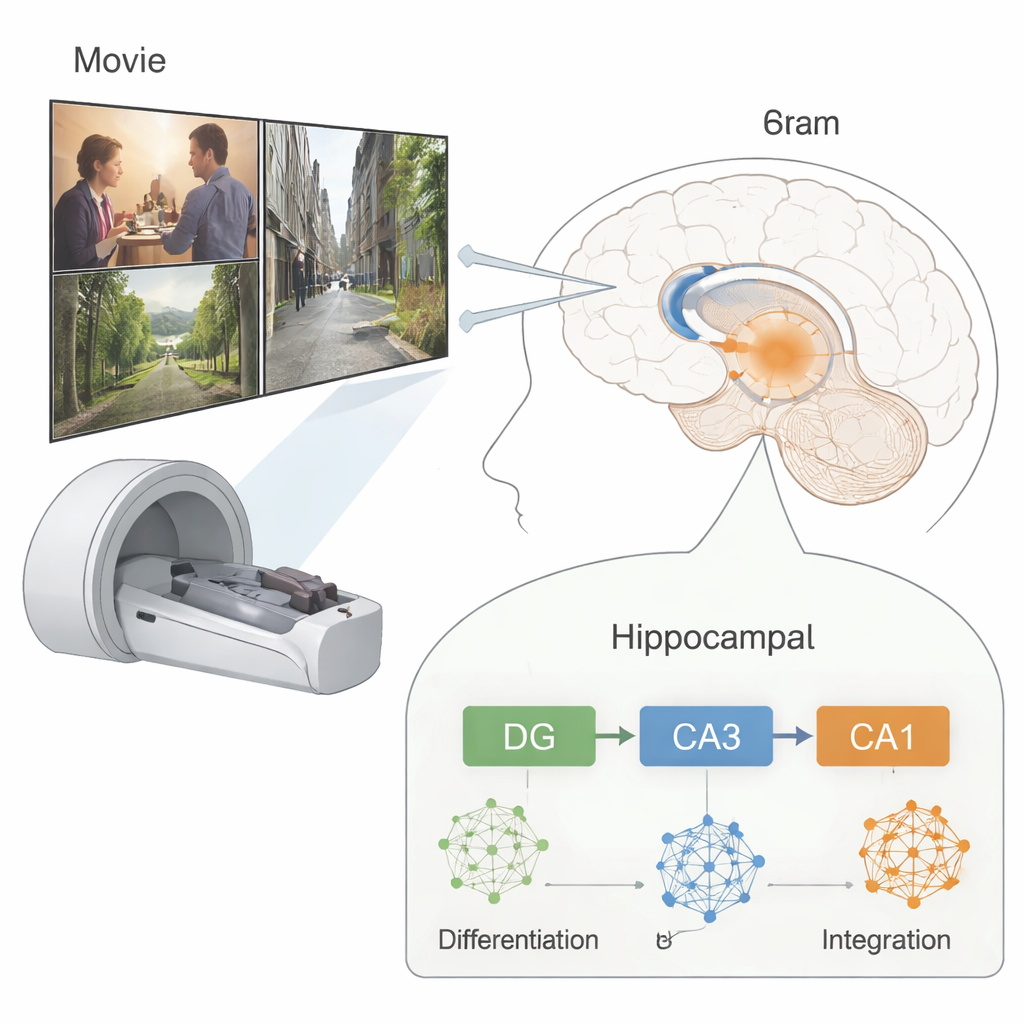
When you watch a movie, your mind effortlessly tracks places, characters, and plot twists. This study asks a deceptively simple question: how does the brain turn this flood of sights and sounds into an organized “map” of the story? By examining people’s brain activity while they watched film clips inside an MRI scanner, the researchers show that a key memory structure—the hippocampus—acts like both a divider and a unifier, separating similar moments into distinct memories while also knitting related events together into a coherent whole.
Turning Stories into Mental Maps
The authors start from the idea of “cognitive maps”: internal models that help us organize knowledge and navigate not only physical space but also social networks, ideas, and narratives. Instead of using simple lab tasks, they focused on movie clips that better resemble real life. Using a large public dataset collected in an ultra–high-field 7‑Tesla MRI scanner, they tracked how the hippocampus reacted, second by second, as 157 young adults watched a variety of film segments—from independent shorts to Hollywood scenes. Each moment of the movie was described in detail with semantic labels such as objects and actions, allowing the team to compare what was on the screen with what was happening in the brain.
Following the Plot in the Memory Center
Within the hippocampus, there are subregions that work together in a circuit: the dentate gyrus (DG), CA3, and CA1. The researchers asked whether these areas captured not just the movie’s content but also the relationships between different moments in the story. By comparing the similarity of movie frames (based on their semantic labels) to the similarity of brain activity patterns, they found that all three hippocampal subregions encoded the evolving meaning of the movie. Moreover, the networks formed by these activity patterns showed “small‑world” organization: a balance of tight local clustering and efficient long‑range connections, a hallmark of many complex biological and social networks.
Separating Details and Weaving Them Together
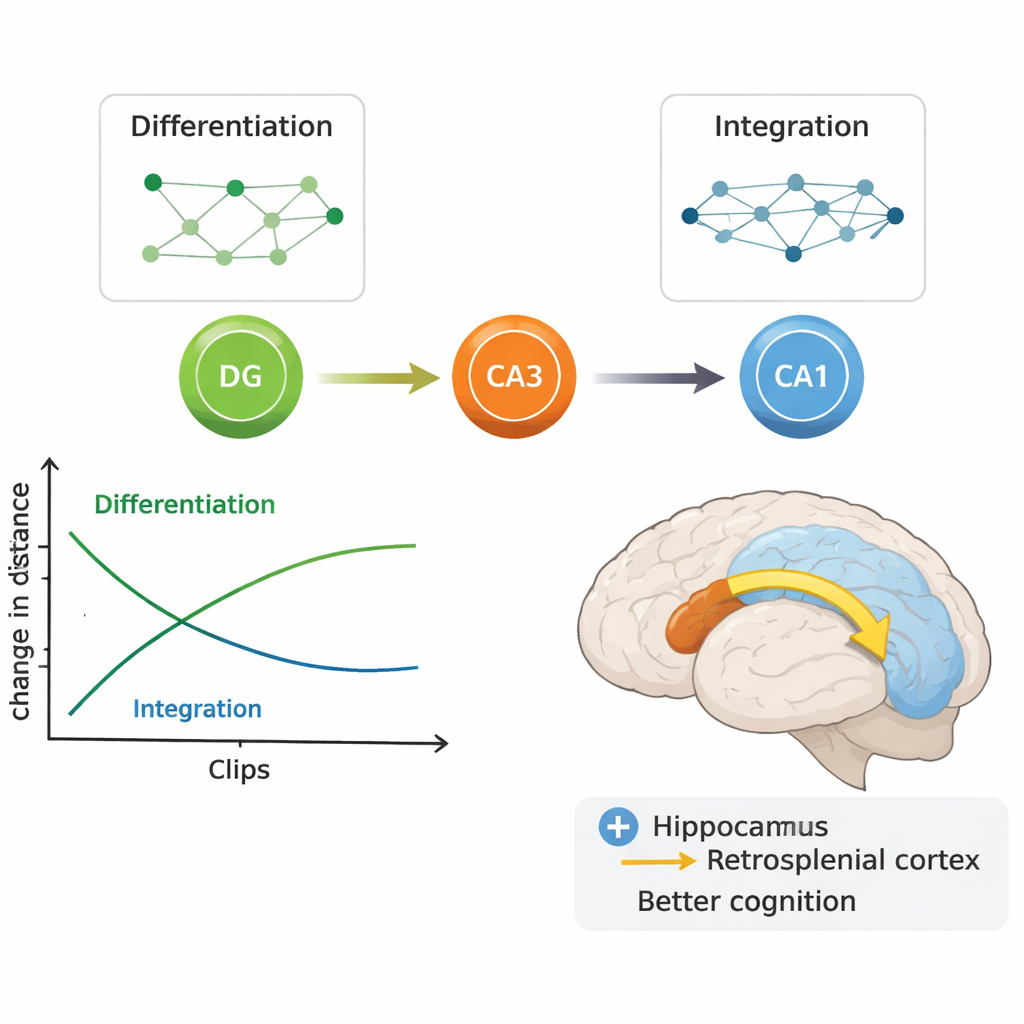
To probe how representations changed as information flowed through the circuit, the team used a geometry-aware measure called geodesic distance, which captures how far apart two states are within a complex network. As signals moved from DG to CA3, these distances tended to increase, indicating that similar moments in the movie were being pulled apart into more distinct representations—a process the authors interpret as “differentiation,” akin to pattern separation. In contrast, from CA3 to CA1, distances shrank: representations became more clustered and integrated, suggesting that CA1 helps blend related pieces of the narrative into more unified, higher-level summaries.
Linking the Memory Hub to the Rest of the Brain
The hippocampus does not work in isolation. The researchers next examined how its subregions coordinated with the cortex—the outer layer of the brain—while people watched the films. Using an approach that looks at brain signals shared across viewers, they found strong coupling between hippocampal subfields and regions involved in memory and scene processing, including the retrosplenial cortex, parahippocampal cortex, parts of the prefrontal cortex, and visual areas. Crucially, stronger integration from CA3 to CA1 was tied to stronger communication between CA1 and these cortical regions, especially the retrosplenial cortex, suggesting that successful “weaving together” of story elements inside the hippocampus goes hand in hand with broader brain-wide coordination.
Why Some People Follow the Story Better
Finally, the authors asked how these brain processes relate to individual differences in thinking ability. They used summary scores that capture each participant’s overall cognitive performance (such as reasoning, vocabulary, and spatial skills) and emotional well‑being. People whose hippocampal representations showed stronger integration along the CA3–CA1 pathway tended to have higher cognitive scores. Even more striking, connectivity between CA1 and the retrosplenial cortex statistically mediated this relationship: the degree to which hippocampal integration boosted cognition depended on how strongly CA1 communicated with the retrosplenial cortex. Emotional scores, in contrast, were not explained by these measures.
What This Means for Everyday Memory
In plain terms, this work suggests that when you follow a complex movie—or any real‑world stream of experience—your hippocampus is busy both pulling similar moments apart and stitching related events together into a map-like structure. The sharper this internal integration process, and the better CA1 talks to regions like the retrosplenial cortex, the more it seems to support general cognitive abilities. These findings offer a window into how the brain turns rich, continuous experience into structured knowledge, and may eventually help guide strategies to strengthen memory and thinking in everyday life and in clinical conditions that affect the hippocampus.
Citation: Sun, L., Liu, Q., Li, S. et al. Representational differentiation and integration within the hippocampal circuit during naturalistic stimuli. Commun Biol 9, 274 (2026). https://doi.org/10.1038/s42003-026-09554-6
Keywords: hippocampus, cognitive maps, movie viewing, memory integration, brain networks