Clear Sky Science · en
Rhizosphere microbial functions drive ecological stoichiometry in soils across an elevational gradient of a temperate mountain ecosystem
Why the hidden life around roots matters
Soils quietly support nearly all life on land, storing nutrients that feed plants and, ultimately, people. Yet climate change and land misuse are pushing many soils toward crisis, eroding their structure, depleting nutrients, and weakening their ability to lock away carbon. This study asks a deceptively simple question with big consequences: how does the microscopic life around plant roots help control the balance of key soil nutrients—carbon (C), nitrogen (N), and phosphorus (P)—as climate shifts along a mountain slope?
A natural laboratory on a mountainside
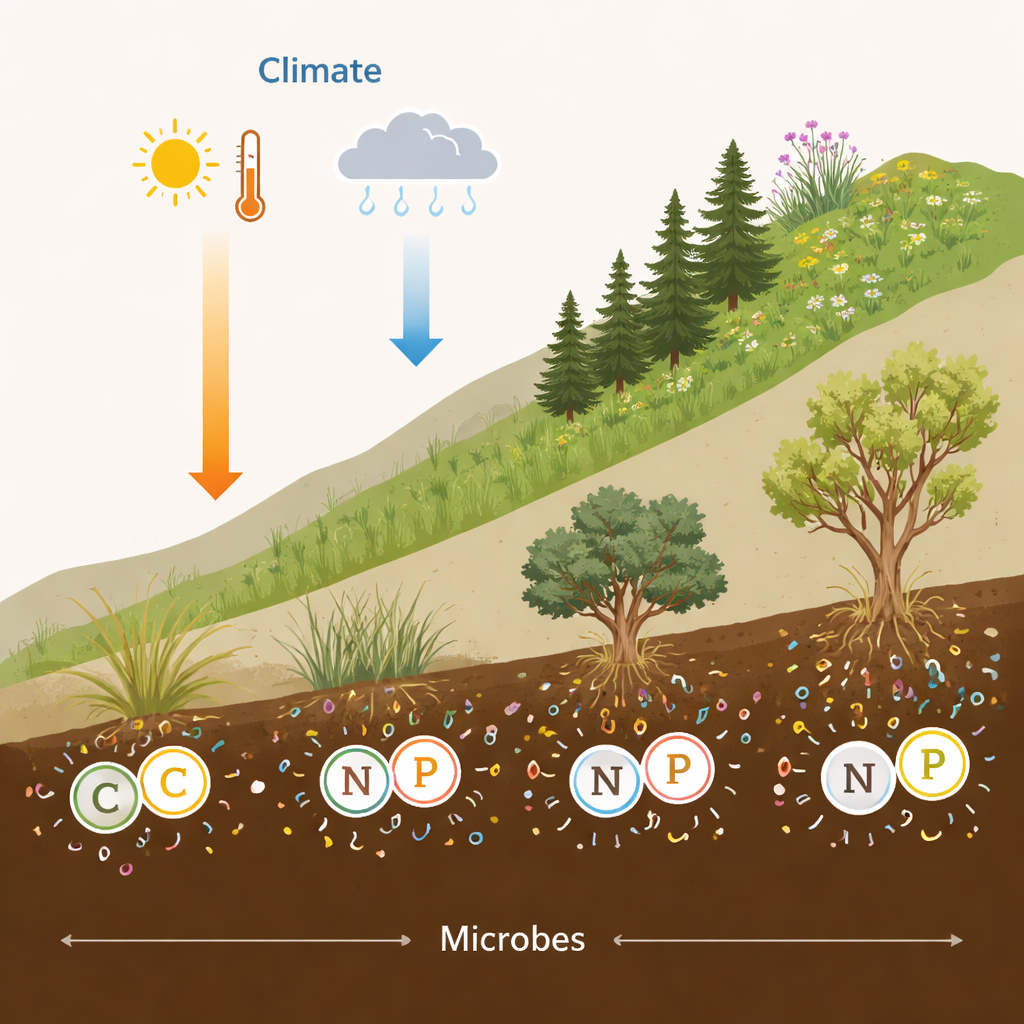
The researchers turned the Helan Mountains in northwestern China into a living laboratory. Along a climb of about 2,190 meters, the landscape changes from dry desert steppe to lush alpine meadow. At 17 sites across this elevational range, the team focused on 20 dominant plant species. Around their roots, they collected paired samples of tightly clinging “rhizosphere” soil and the slightly more distant “ectorhizosphere” soil. They measured how much C, N, and P were stored in these soils and in the microbes living there, and they sequenced microbial DNA to learn which bacteria and fungi were present and which genes they carried for processing these nutrients.
Climate, moisture, and the tug-of-war over soil nutrients
Across the mountain, the amounts and ratios of soil carbon, nitrogen, and phosphorus changed markedly. Warmer sites tended to lose C and N, suggesting that rising temperatures spur microbes to break down organic matter faster, releasing these elements from the soil. In contrast, wetter sites with higher rainfall and soil moisture showed greater C and N storage, likely because plants grow more, drop more litter, and support active—but not overly wasteful—microbial communities. Phosphorus behaved differently: its total amount stayed relatively stable, reflecting its tight bond to mineral particles and long-term geological controls. The ratios among C, N, and P were not fixed; they shifted nonlinearly with climate and soil conditions, revealing thresholds at which nutrient limitation and soil functioning can change abruptly.
Microbial communities tailor-made by plants and place
The microscopic life surrounding roots proved highly diverse and strongly shaped by plant species. Bacterial and fungal communities differed clearly among vegetation types—from desert shrubs to conifer forests and alpine meadows—and these differences were more closely tied to plant identity than to climate alone. Certain bacterial groups that thrive in nutrient-poor conditions dominated in harsher, drier sites, where they likely help recycle scarce resources efficiently. Beyond who is there, what microbes can do turned out to be crucial: across samples, the team cataloged thousands of genes involved in cycling C, N, and P. The diversity and composition of these functional genes varied with plant hosts and environment, and they were tightly linked to how much of each nutrient the soil contained and how those nutrients were balanced.
Genes as switches for soil balance
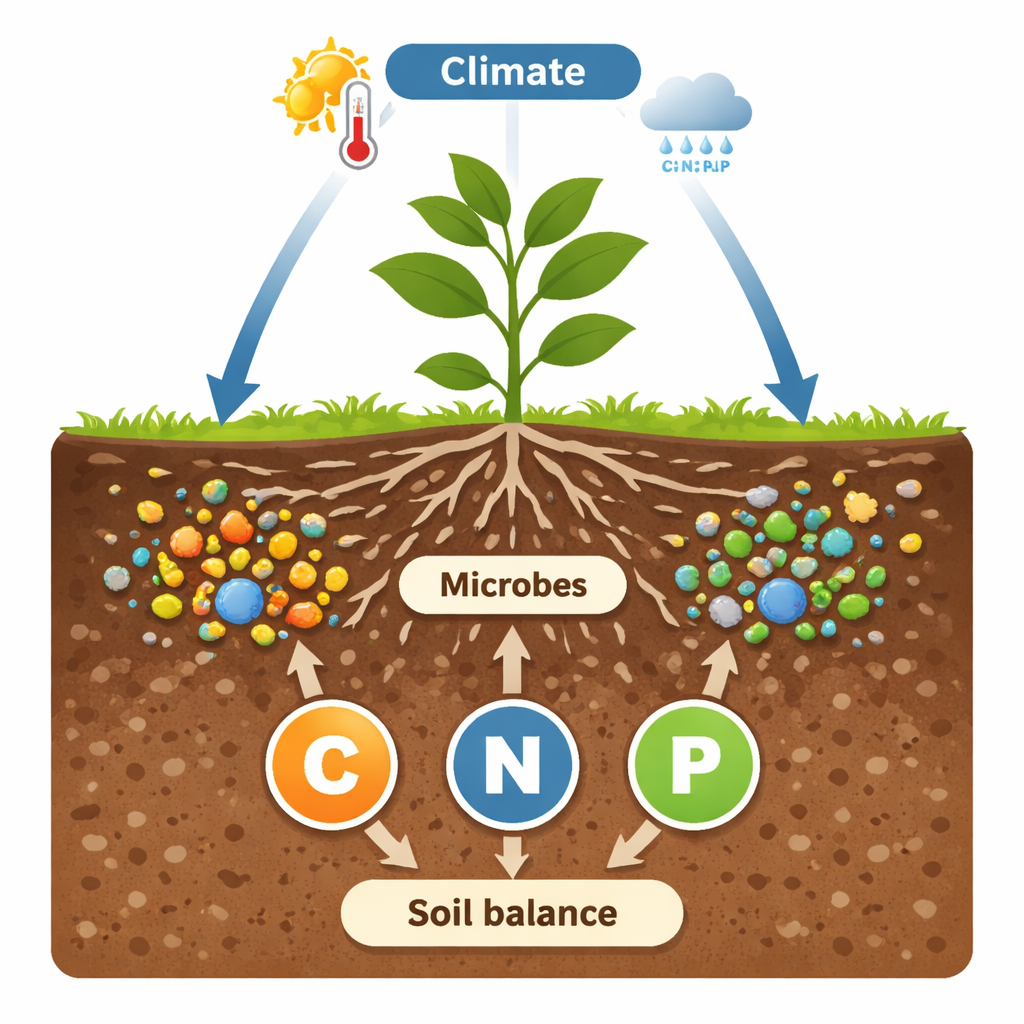
By combining many lines of evidence in statistical models, the study showed that gene-level functions in the rhizosphere microbiome are powerful predictors of soil nutrient patterns at the root–soil interface. Genes involved in breaking down carbon, fixing nitrogen from the air, and releasing or capturing phosphorus acted like a control panel for the soil’s C:N:P balance. Microbial biomass itself, especially its own C:N:P makeup, strongly tracked soil phosphorus levels, hinting that living and dead microbes form an important, active phosphorus reservoir. Geographic features and basic soil properties such as moisture still mattered, but much of their influence ran through microbes: climate affected microbial communities; those communities, through their genes, in turn reshaped soil nutrient storage and ratios.
What this means for soil and climate futures
For non-specialists, the main message is that the microscopic world around plant roots is a critical middleman between shifting climate and the health of soils. As temperatures warm and rainfall patterns change, soil microbes—and the genes they carry—will help decide whether soils lose or retain carbon and key nutrients, affecting everything from crop yields to carbon storage and ecosystem stability. The study suggests that managing and restoring soils in dry, temperate mountain regions should pay close attention to nurturing beneficial root-associated microbial communities, because these tiny organisms help keep the soil’s nutrient “budget” in balance under an increasingly erratic climate.
Citation: Yang, Y., Qiu, K., Zhang, Y. et al. Rhizosphere microbial functions drive ecological stoichiometry in soils across an elevational gradient of a temperate mountain ecosystem. Commun Biol 9, 276 (2026). https://doi.org/10.1038/s42003-026-09553-7
Keywords: soil microbiome, rhizosphere, carbon nitrogen phosphorus, mountain ecosystems, climate change