Clear Sky Science · en
Distinct contributions of prefrontal, parietal, and cingulate signals to exploratory decisions
Why our brains need to explore
Everyday choices, from buying a new phone to picking a restaurant, involve a tug-of-war between sticking with what we know and searching for something better. This study asks a simple but powerful question: when we explore, do different parts of the brain handle different kinds of curiosity—such as learning more about what we already have versus hunting for brand‑new options? Using brain scans and a carefully designed decision task, the researchers show that three brain regions work together, each with its own specialty, to guide how and when we explore.

Two kinds of looking around
The authors begin by splitting exploration into two everyday styles. “Internal exploration” means digging deeper into an option you already see, like reading more reviews of a phone you’re considering. “External exploration” means looking elsewhere, such as checking out competing models in other shops. Although both feel like “just exploring,” they actually rely on different information: one reduces uncertainty about a known choice, the other searches the wider environment for possibly better alternatives. The study’s core goal was to see whether the brain separates these two styles of exploring, and how that compares to the moment we stop exploring and finally accept an option.
A game of boxes and points
To probe these processes, volunteers lay in an MRI scanner and played a game involving hidden rewards. On each trial, they saw a grid of boxes, with one option revealed as four colorful dials, each dial showing a range of possible points. Only one dial per option actually determined the reward, so options with more varied dials were more uncertain. At each step, players could accept an option to gain its points, use internal exploration to remove one dial and make that option more predictable, or use external exploration to open a new box and reveal another option. Exploration cost points, shown on the screen, so participants had to balance learning more against spending too much. By analyzing thousands of decisions with a mathematical model, the researchers estimated how much people valued internal exploration, external exploration, and simply accepting a good option.
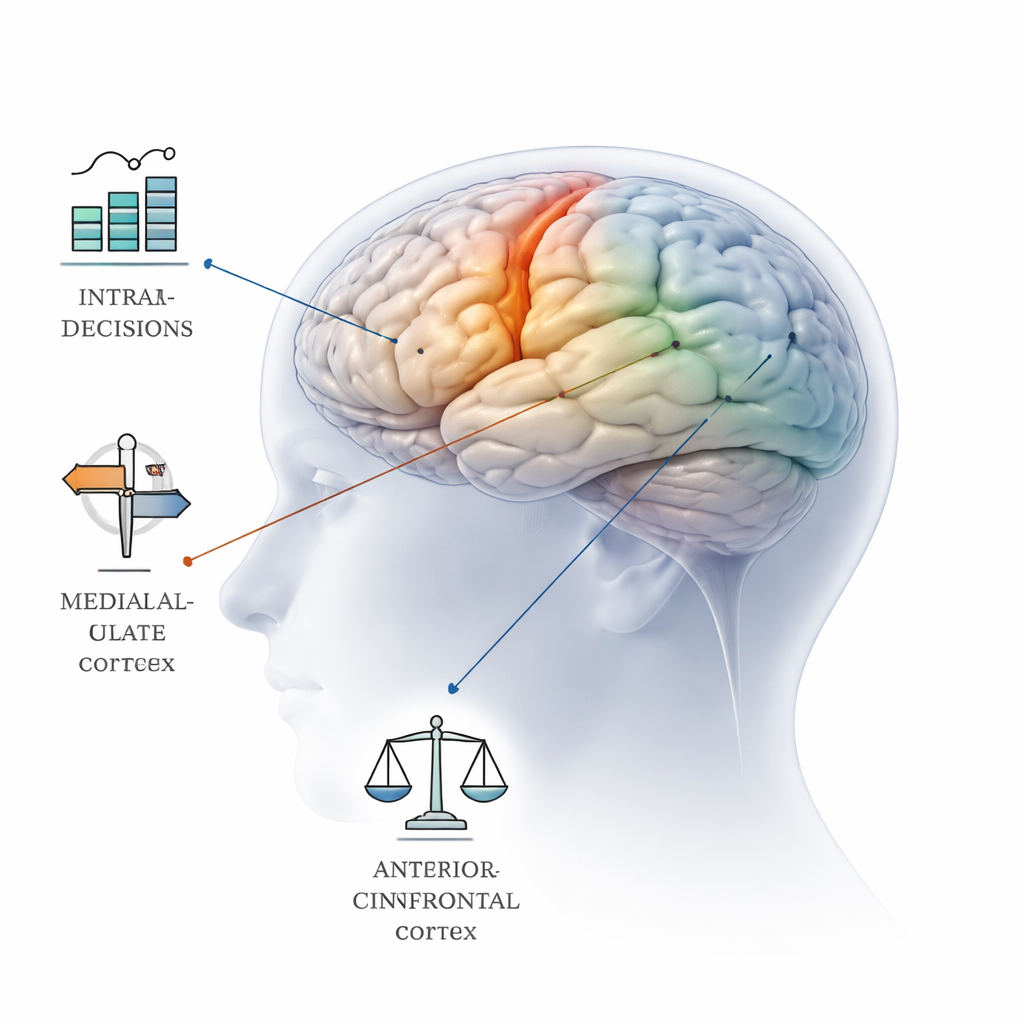
Three brain hubs with different jobs
Brain imaging revealed a clear division of labor. Activity in a region near the top back of the brain, the intraparietal sulcus, rose when an existing option was both promising and uncertain—the perfect target for internal exploration. Importantly, this signal appeared regardless of what the person ultimately did next, suggesting this area constantly tracks how much extra information could be gained by probing what is already on the table. Another midline region, the anterior cingulate cortex, lit up with the overall attractiveness of the broader environment, supporting external exploration. It seemed to monitor whether it might be worthwhile to move on and search for new options, particularly after repeated, unsatisfying attempts to refine the current choice.
A common value meter in the front of the brain
A third region at the front of the brain, the medial prefrontal cortex, behaved differently. Instead of specializing in one type of exploration, it flexibly tracked whichever decision was about to be made. When participants chose to accept, this region reflected the value of the best available option. When they chose internal or external exploration, it shifted to encode the value of that specific exploratory move. In other words, it acted like a general value meter—converting very different kinds of actions (learning more, looking elsewhere, or cashing in) onto a single scale that can guide choice. This supports the idea of a “neural common currency,” where diverse possibilities are translated into a comparable signal that helps us decide.
What this means for everyday choices
For a layperson, the message is that the brain does not treat all curiosity the same way. One set of circuits weighs whether it is worth digging deeper into what we already have, another keeps tabs on whether the world around us might hold better opportunities, and a third region integrates these signals into a final decision about what to do next. Understanding this division of labor helps explain why some people over‑research a single option while others constantly hunt for alternatives—and why disruptions in these brain areas, as seen in some mental health conditions, might lead to unhelpful patterns of indecision or endless searching.
Citation: Chan, V.K.S., Wong, N.H.L., Woo, TF. et al. Distinct contributions of prefrontal, parietal, and cingulate signals to exploratory decisions. Commun Biol 9, 272 (2026). https://doi.org/10.1038/s42003-026-09550-w
Keywords: exploratory decision-making, brain networks, uncertainty, reward processing, cognitive neuroscience