Clear Sky Science · en
Deciphering multiway multiscale brain network connectivity from birth to 6 months
Why Baby Brains Matter
The first months of life are a time of breathtaking brain growth. Long before babies speak their first words or take their first steps, their brains are quietly wiring up the systems that will support thinking, feeling, moving, and relating to others. This study asks a simple but profound question: instead of looking at brain regions two at a time, what happens if we examine how groups of three networks work together in newborns and young infants? The answer reveals that the building blocks of our adult brain organization may already be in place within the first six months after birth.
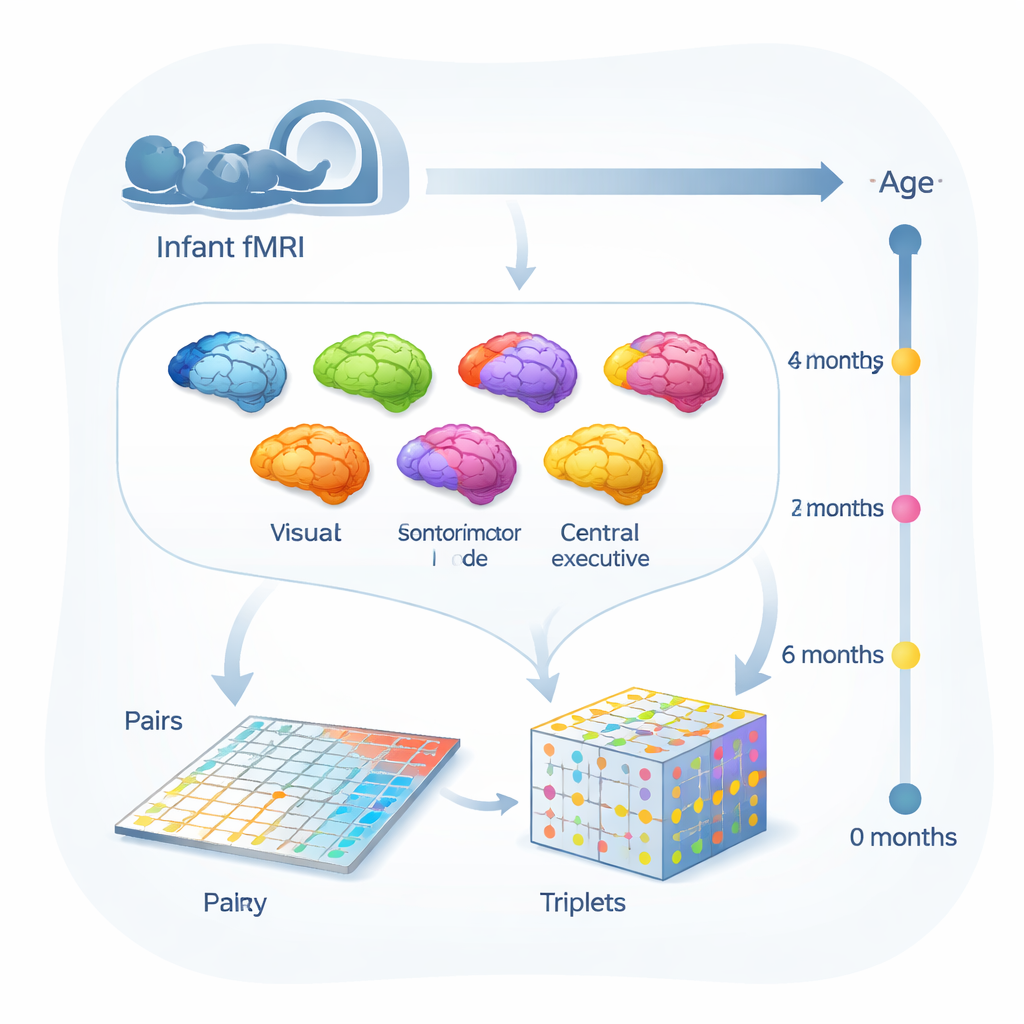
Looking Beyond Simple Connections
Most brain studies map how pairs of regions rise and fall in activity together, a bit like checking which two instruments in an orchestra tend to play at the same time. But the brain is a complex, nonlinear system, more like a full orchestra than a duet. Focusing only on pairs risks missing the richer harmonies created when several networks work together at once. This is especially important in infancy, when the brain is rapidly organizing itself and early patterns of coordination may foreshadow later learning, health, and behavior.
Scanning Sleeping Infants
To explore this, the researchers collected high-quality brain scans from 71 typically developing infants, many of whom were scanned more than once, yielding 126 scans in total between 4 and 179 days of age. All scans were taken while the babies slept naturally in an MRI scanner, which measures slow, spontaneous fluctuations in blood flow across the brain. Using advanced analysis, the team identified 105 distinct brain networks, including those involved in vision, movement, emotion, language, and higher thinking. These networks were grouped into broad domains, such as visual, sensorimotor, limbic (emotion), language, and higher cognitive control.
Pairs Versus Trios of Brain Networks
The team then compared two ways of describing how these networks interact. First, they used traditional pairwise measures, which ask how strongly the activity of one network is linked to another. Second, they calculated "triple" interactions, capturing how three networks jointly share information. Technically, this triple measure can detect complex, nonlinear relationships that do not show up when only looking at pairs. When the scientists examined how these interaction patterns changed with age, they found that triple interactions were dramatically more informative: while pairwise measures uncovered just over a thousand age-related connections, triple interactions revealed more than 80,000 network triplets whose coordination shifted systematically over the first six months.
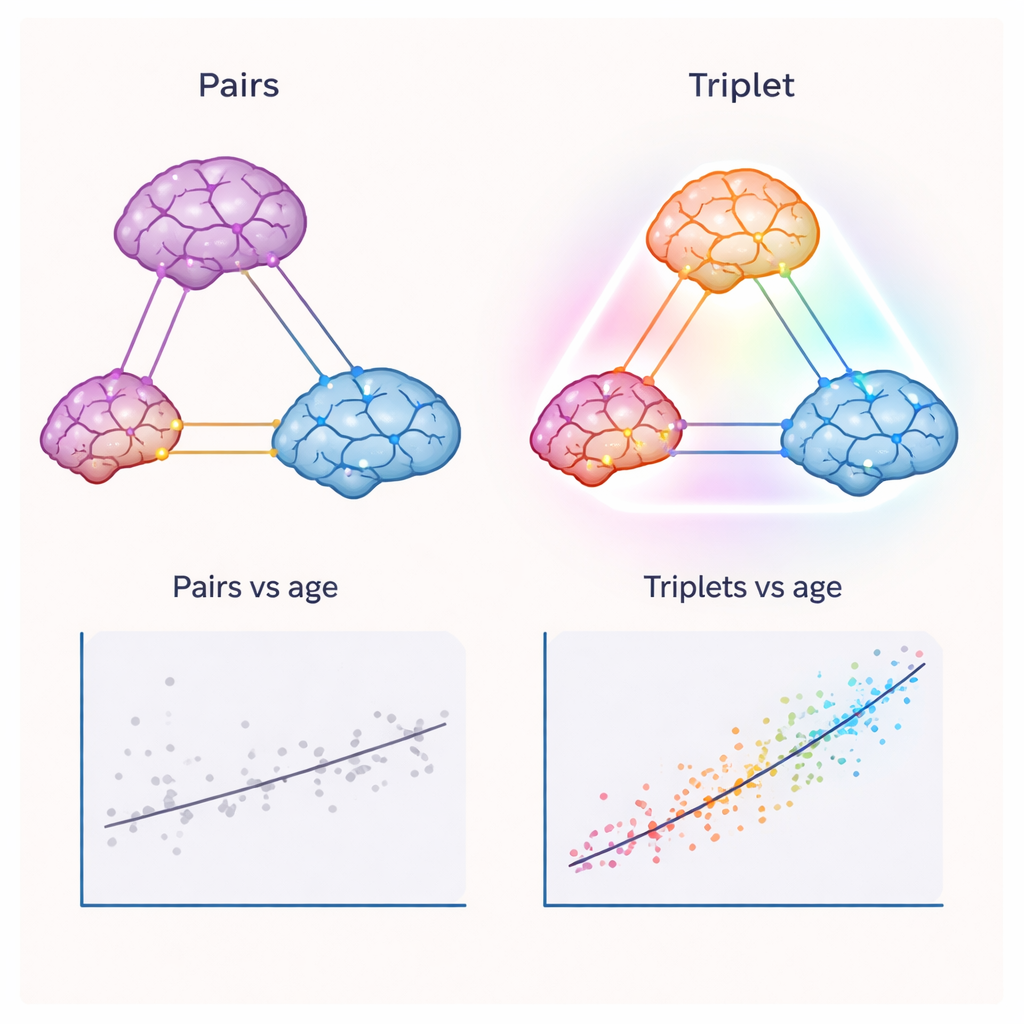
Early Signs of the Adult-Like Brain
These triple interactions were not random. Many involved networks known from adult studies, such as the default mode network (linked to inward-focused thought), the salience network (which helps detect important events), and the central executive network (which supports attention and problem solving). Together, these three form a well-known "triple network" model of the adult brain, thought to sit at the heart of many mental processes and disorders. Strikingly, the infant triplet patterns already resembled this adult configuration, suggesting that the basic framework for how core brain networks cooperate is present within months of birth. The researchers also showed that triple interactions highlighted language and salience-related systems that pairwise methods missed, implying that more subtle, nonlinear coordination is already emerging in these higher functions.
What This Means for Early Development
In plain terms, the study shows that baby brains are not just collections of isolated regions or simple pairs of connections. Instead, from birth to six months, groups of three or more networks are already forming coordinated patterns that grow and reorganize with age. By considering these richer patterns, scientists can gain a more complete picture of how the infant brain lays down the foundations for later thinking, feeling, and learning. In the future, these kinds of higher-order measures could help detect atypical developmental trajectories earlier and more reliably than traditional pairwise approaches, opening the door to earlier support for children at risk.
Citation: Li, Q., Fu, Z., Walum, H. et al. Deciphering multiway multiscale brain network connectivity from birth to 6 months. Commun Biol 9, 271 (2026). https://doi.org/10.1038/s42003-026-09549-3
Keywords: infant brain development, functional connectivity, brain networks, resting-state fMRI, higher-order interactions