Clear Sky Science · en
The Late Quaternary climate impact on the genome of the woodland strawberry (Fragaria vesca), a perennial herb
Strawberries as Time Travelers
Woodland strawberries may look delicate, but their DNA carries a rugged travel diary of surviving ice ages and shifting climates. By reading this genetic record, scientists can see how plants responded when vast ice sheets advanced and retreated across Europe. That history matters today: the same traits that once helped strawberries endure extreme cold and habitat change may determine whether they can withstand modern global warming.
Following the Berry Trail Across Europe
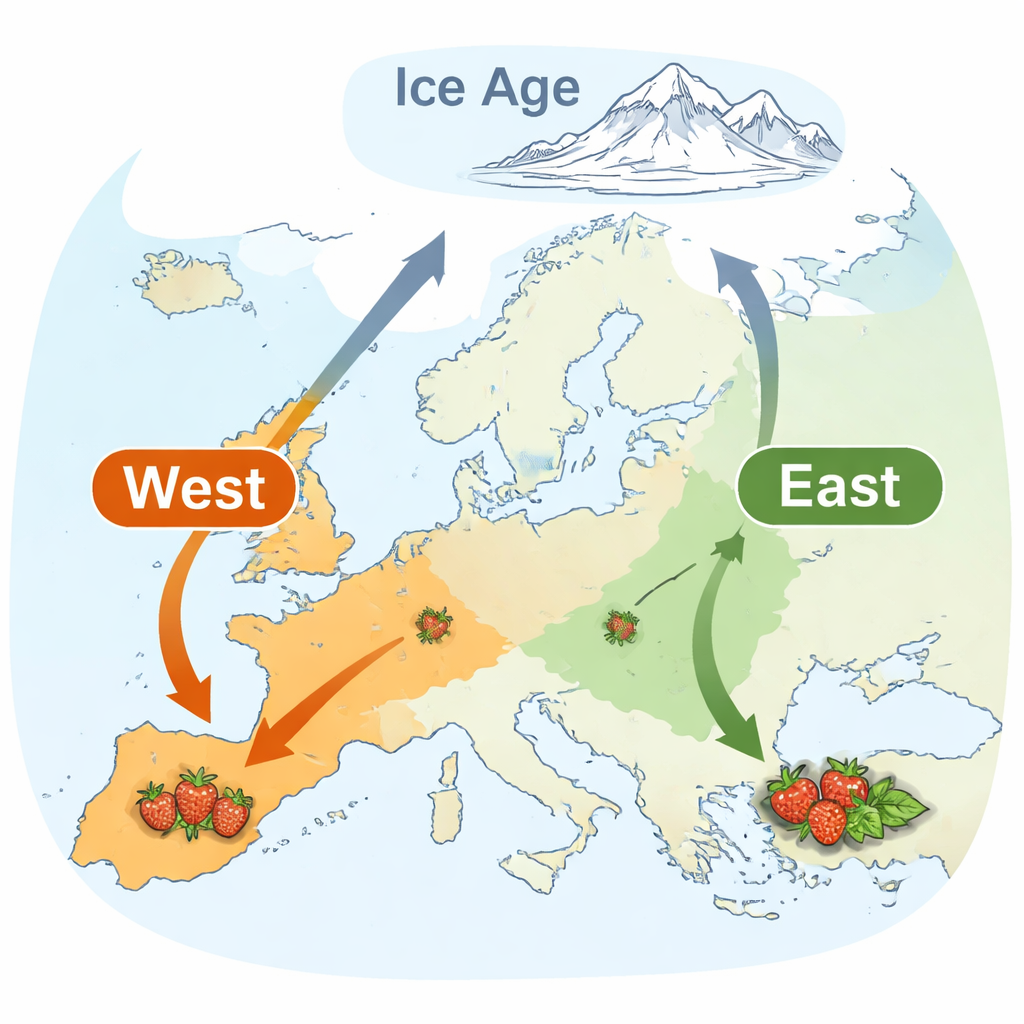
Researchers sequenced 200 woodland strawberry plants collected from forests, meadows, and roadsides across most of Europe. Each plant’s genome held clues about where its ancestors lived and how they moved as climates warmed and cooled. When the team compared these genomes, they discovered that Europe’s strawberries fall into two big families: a western group stretching from Spain to Britain and western Scandinavia, and an eastern group running from the Balkans and Romania up through Finland and northern Norway. Plants from central Europe and Norway often carried a mix of both, revealing long-standing contact zones where the two families meet and interbreed.
Ice Age Hideouts and Safe Havens
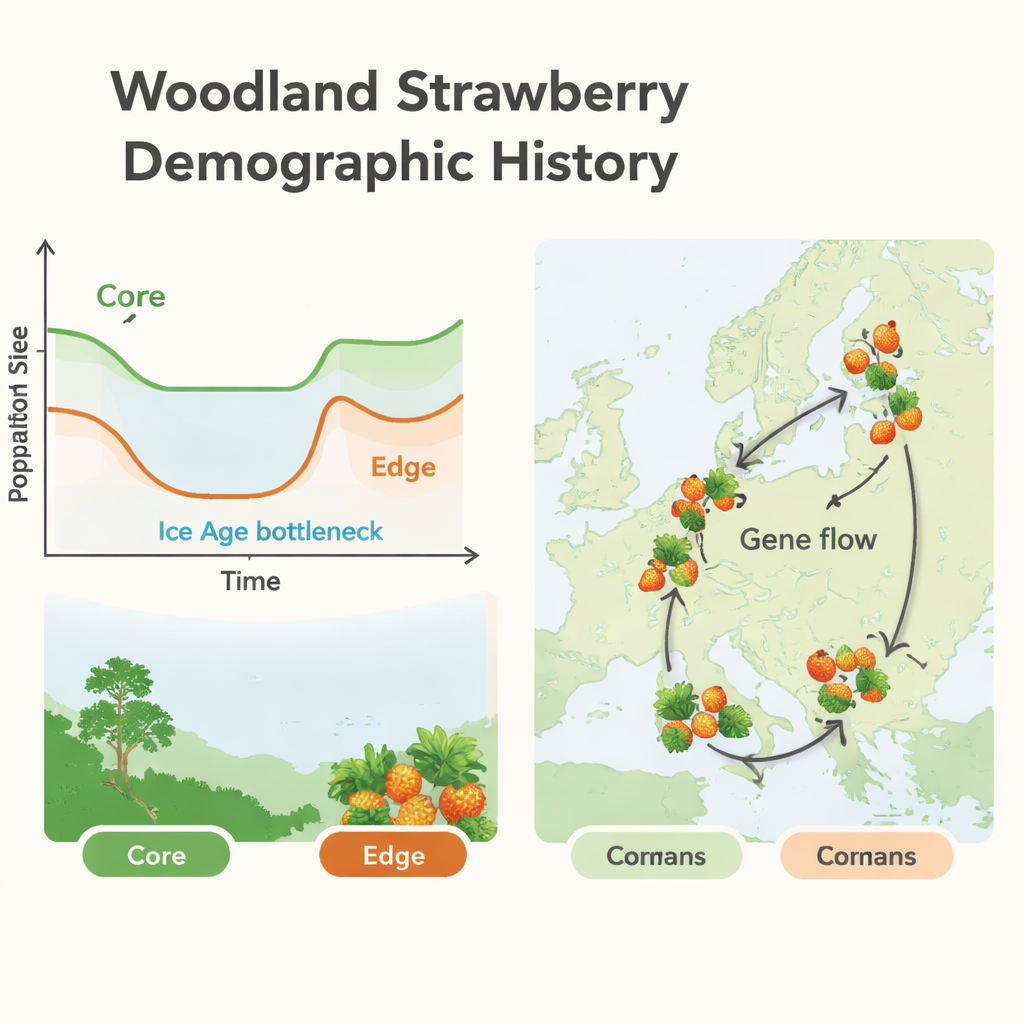
The pattern in the DNA points back to repeated “hideouts” where strawberries survived during ice ages. As glaciers spread and climates cooled, many populations shrank or disappeared from the north, but others endured in southern and southeastern Europe. Particularly large, healthy populations in Croatia, Romania, and Lithuania seem to trace back to such long-term refuges. These core populations kept relatively high genetic diversity and stable numbers through several glacial cycles, acting as a reservoir from which the species could later recolonize the continent when conditions improved.
Edge Populations Under Stress
Strawberries living on the edges of the range—such as in Iberia, Iceland, and far northern Norway—tell a different story. Their genomes show signs of strong inbreeding and repeated population crashes, especially during the coldest phases of the last ice age. Some northern populations appear to have survived in tiny “microrefuges” near the Arctic, hanging on through harsh conditions and then rapidly expanding when the climate warmed. These small, isolated groups now carry very low genetic diversity, making them both uniquely adapted to extreme environments and potentially vulnerable to rapid modern warming.
Rebuilding Europe’s Strawberry Network
As the last ice sheets retreated and the Holocene warm period began, woodland strawberries spread north again in multiple waves. The genetic data suggest that western and eastern Europe were mostly recolonized from different southern sources—western from Iberia and Italy, eastern from the Balkans and nearby regions. Over time, a chain of large, partially mixed populations formed from the Mediterranean to southern Scandinavia, with central Europe acting as a bridge where genes from east and west meet and mingle. This living network still helps maintain the species’ overall genetic health, even though modern habitat fragmentation and deforestation have begun to break it apart.
What This Means for the Future
By treating strawberry genomes as historical records, the study shows how past climate swings carved Europe into western and eastern genetic regions, with robust core populations and fragile edges. For a layperson, the key message is that not all strawberry populations are equal: a few large, genetically rich groups in southeastern and central Europe quietly support the long-term survival and adaptability of the whole species. Protecting these core populations and the corridors that connect them will be critical if woodland strawberries—and the many other plants that share their habitats—are to cope with the accelerating climate changes of the coming centuries.
Citation: Toivainen, T., Salonen, J.S., Kirshner, J. et al. The Late Quaternary climate impact on the genome of the woodland strawberry (Fragaria vesca), a perennial herb. Commun Biol 9, 263 (2026). https://doi.org/10.1038/s42003-026-09539-5
Keywords: woodland strawberry, ice age refugia, plant climate adaptation, population genomics, European biodiversity