Clear Sky Science · en
Neither rats nor mice have a broad thermoneutral zone: implications for physiological studies
Why room temperature matters to lab animals
Most of us rarely think about how much energy we spend staying warm, because humans typically live close to our temperature comfort zone. For mice and rats raised in laboratories, however, the room thermostat can dramatically change how their bodies work. This study asks a deceptively simple question with big implications for biomedical research: at what temperatures do mice and rats feel “comfortable,” and how does that affect the way we interpret experiments meant to model human disease? 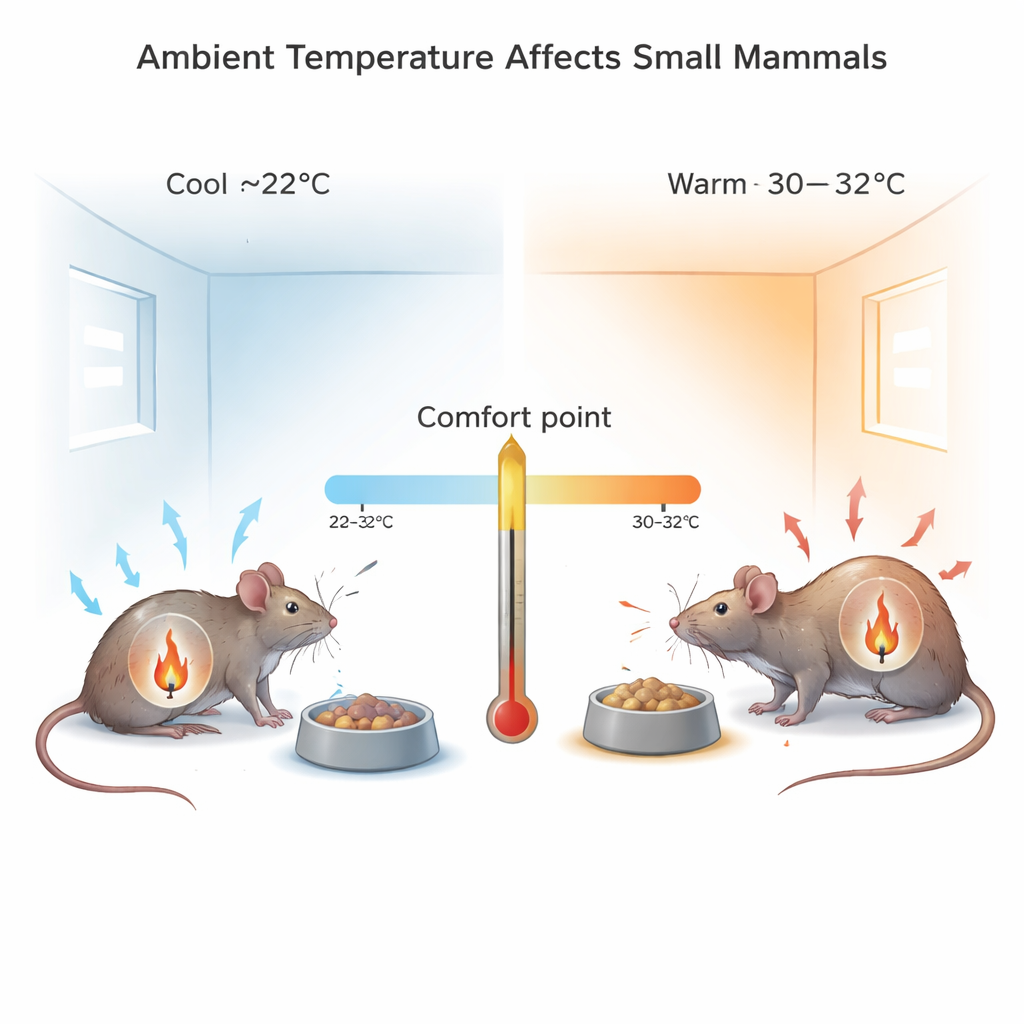
Small bodies, big heat losses
Mice and rats are far smaller than humans, with much more body surface area relative to their weight. That makes them lose heat quickly to their surroundings. At the coolish temperatures common in animal facilities (around 22 °C, typical room temperature), single-housed mice spend about a third of their daily energy just keeping warm. Rats, being larger, lose heat more slowly, but they are still more sensitive to room temperature than people are. These differences raise a concern: if mice and rats are constantly fighting the cold while humans are not, could that distort studies of metabolism, obesity, and new drugs?
Not a broad comfort band, but a single sweet spot
To tackle this, the researchers carefully measured how much energy mice and rats used, how much they ate, how active they were, and what their core body temperature was while the room temperature was slowly stepped from 22 °C up to 35 °C. Instead of finding a broad, flat “comfort range” where energy use is minimal, they discovered something sharper: both species have a thermoneutral point, a narrow temperature at which energy spent on warmth is lowest. Below this point, energy use climbs because the animals must generate extra heat; above it, their core temperature rises, signaling heat strain rather than comfort. For mice, this sweet spot lies around 30–32 °C; for rats, near 30 °C.
Heat stress shows up as lost appetite and weight
At first glance, warmer housing might seem kinder and more human-like, since it reduces the need for cold defense. But above about 30 °C, both mice and rats began to show clear signs of heat stress: their body temperature rose, they ate less, their respiratory patterns shifted to burning more fat, and they lost weight. In rats—especially those made obese by a high-fat diet—pushing temperatures to 31–32 °C was poorly tolerated; some animals could not safely remain in those conditions. When obese rats at 30 °C received a drug that stimulates heat production in brown fat, their body temperature shot up so much that the experiment had to be stopped, underscoring how close they already were to their thermal limits. 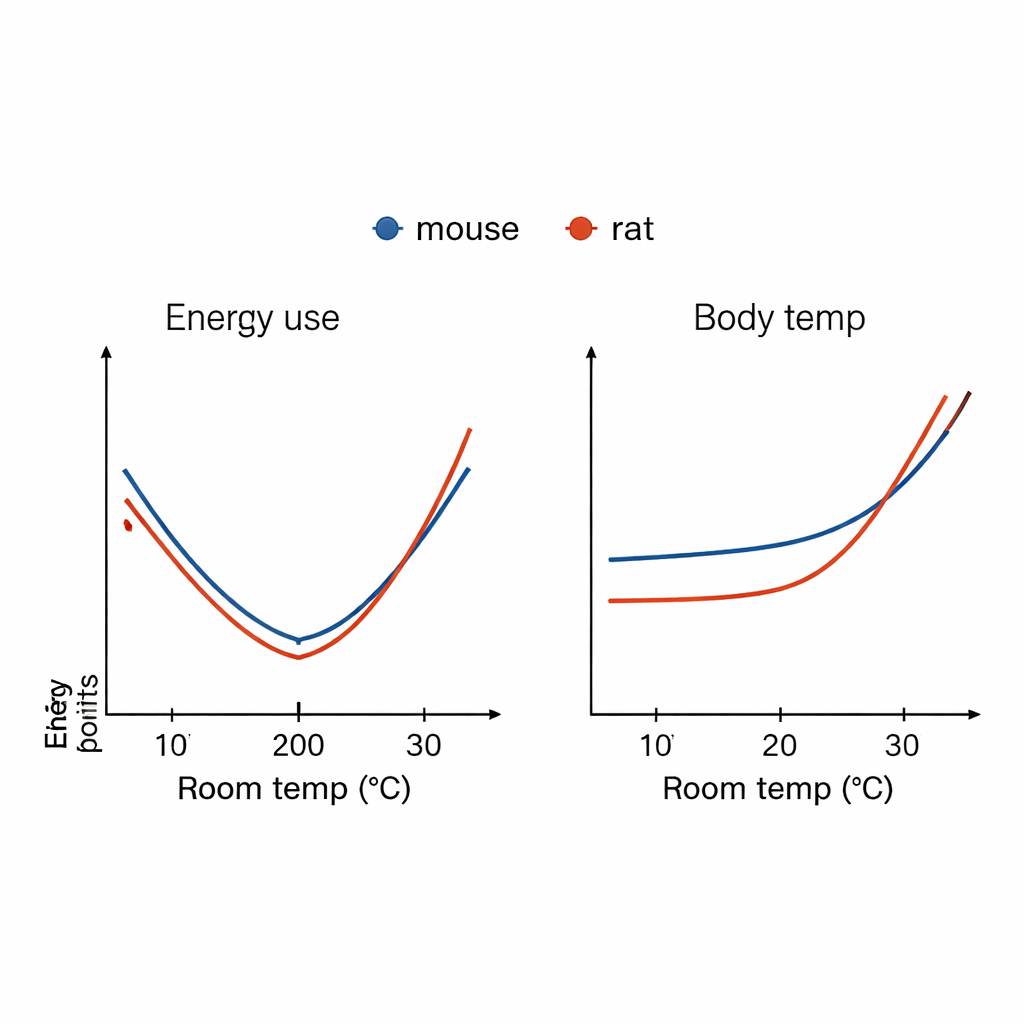
Body fat is not a warm coat
Intuitively, one might assume that fatter animals are better insulated against the cold, much as humans with more body fat sometimes tolerate chilly water better. By analyzing how resting energy use changed with temperature, the authors could estimate whole-body heat loss, a measure of insulation. Surprisingly, they found little difference between lean and obese animals: added fat did not meaningfully reduce heat loss in either mice or rats. Their fur, body size, and how easily they can change blood flow to the skin appear to matter more than the thickness of their fat layer, at least within the ranges studied.
Choosing the right temperature for better science
For researchers, the main takeaway is that neither mice nor rats enjoy a broad, human-like thermal comfort zone. Instead, they have a narrow thermoneutral point, and housing them much cooler or warmer reshapes their metabolism, appetite, and body temperature. The authors argue that keeping both species around 28–29 °C strikes a practical balance: it greatly reduces the extra energy they must spend staying warm, while still avoiding the heat stress that appears once temperatures reach and exceed 30 °C. For readers, this means that something as mundane as the lab thermostat can strongly influence how well rodent studies mimic human biology—and that tuning it carefully may improve the reliability and relevance of experiments that ultimately guide human health treatments.
Citation: Jacobsen, J.M., Pedersen, K., Vydrová, M. et al. Neither rats nor mice have a broad thermoneutral zone: implications for physiological studies. Commun Biol 9, 256 (2026). https://doi.org/10.1038/s42003-026-09534-w
Keywords: thermoneutrality, energy expenditure, rodent models, ambient temperature, heat stress