Clear Sky Science · en
Comprehensive metabolic profiling across five lifespan stages in murine hippocampus and cortex reveals sex-related variation in age-related cognitive decline
Why brain aging differs between women and men
Many families notice that memory problems and dementia, such as Alzheimer’s disease, seem to strike women more often than men. This study asks a simple but important question: does the aging brain of females and males "burn fuel" differently, in ways that might explain this gap? By tracking how mouse brains use sugar and other small molecules over their entire lifespan, the researchers uncover sex-specific patterns that may help explain why older females are more vulnerable to cognitive decline.
Following memory from youth to old age
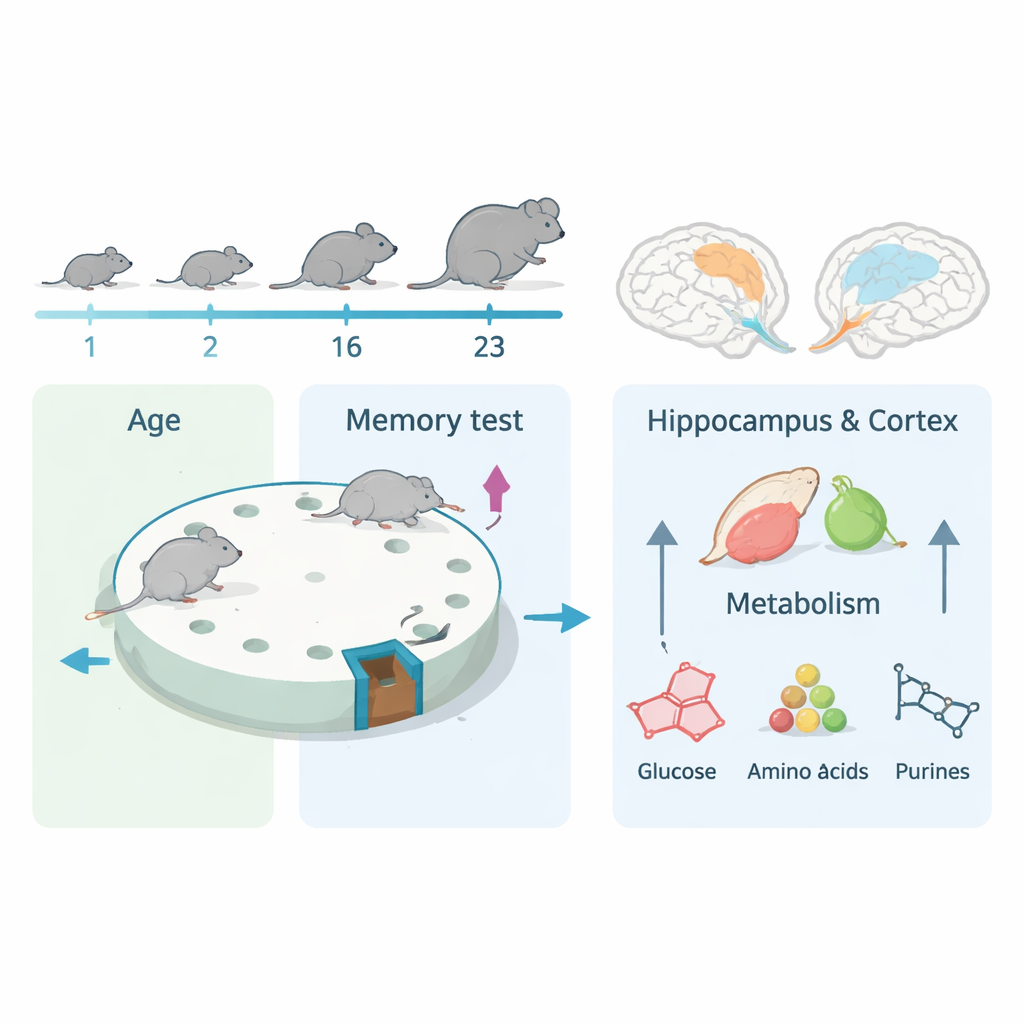
To connect brain chemistry with behavior, the team first measured memory performance in male and female mice at five life stages, from one month (roughly childhood) to 23 months (old age). Using the Barnes maze, a circular platform where mice must remember the location of a hidden escape box, they found that both sexes began to show clear memory problems by 16 months. However, by 23 months, females performed noticeably worse than males, taking longer to find the escape route. Importantly, differences in walking speed did not fully explain these results, indicating that the decline was truly cognitive rather than simply due to slower movement.
How the aging brain spends its sugar
The brain runs primarily on glucose, a form of sugar. To see exactly how this fuel was used, the researchers injected mice with a labeled form of glucose that they could track as it moved through the brain’s chemical pathways. They focused on the hippocampus and cortex, regions critical for learning and memory. In both sexes and at all ages, glucose was quickly broken down, flowing through three main routes: a fast energy-making chain, a pathway that helps handle oxidative stress and build DNA building blocks, and the deeper “power plant” cycle that extracts the most energy. The labeled products surged within half an hour and faded by 2.5 hours, showing that brain sugar use is rapid and dynamic throughout life.
Different fuel strategies in female and male brains
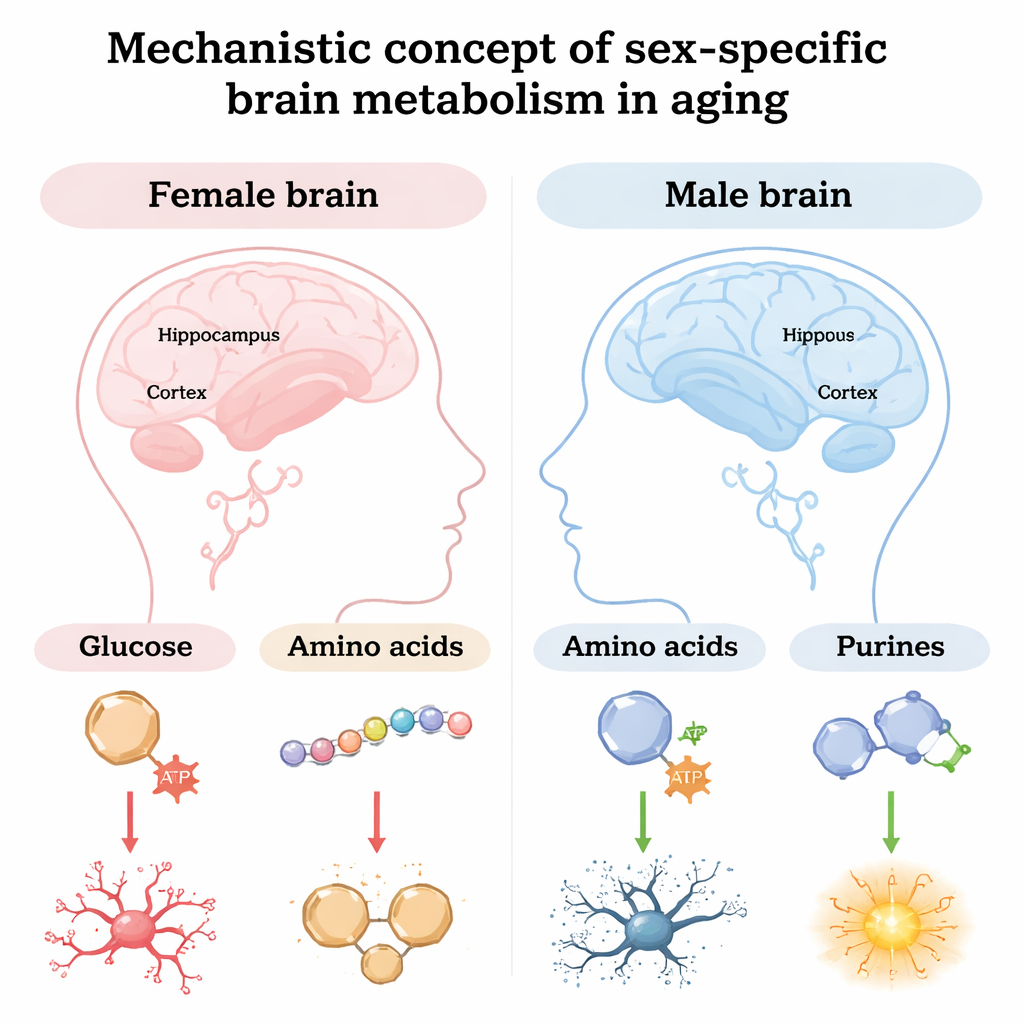
Although both sexes used the same basic routes, their strategies changed with age in different ways. Young females had lower overall glucose throughput than males but shunted relatively more sugar into the protective pathway that helps manage oxidative stress and build nucleotides. From early adulthood to midlife, female and male brains looked more similar. In old age, however, a split emerged: males continued to ramp up glucose use in the energy-producing cycle, seemingly as a compensatory response to aging, while females showed a marked drop. At the same time, females shifted their purine metabolism—from building vital signaling molecules like adenosine and related compounds earlier in life to breaking them down later. Males, in contrast, tended to preserve these energy and signaling stores into old age.
Signals, protection, and waste removal in the aging brain
Beyond sugar, the team mapped hundreds of other small molecules. They found pronounced sex differences in amino acids, the building blocks of proteins and many brain messengers. In youth and again in old age, females generally showed higher levels of several amino acids than males. Crucial messenger-related molecules, such as those derived from glutamate and aspartate, shifted in ways that suggested healthier myelin formation and neuron support in young females, but a loss of protective molecules and potential excitotoxic stress in aged females. The study also uncovered age- and sex-dependent changes in histidine-derived antioxidants and in the arginine–urea cycle, which helps detoxify ammonia. These defense and waste-removal systems appeared better balanced in midlife but became disrupted in old age, particularly in females, potentially compounding their vulnerability.
What this means for healthy brain aging
Taken together, the findings paint a picture of two different metabolic journeys to old age. Male mouse brains maintain or even boost sugar burning and purine building as they age, which may help keep neurons supplied with energy and signaling molecules. Female brains, by contrast, show earlier loss of this metabolic resilience: declining glucose throughput, a switch from purine synthesis to breakdown, and greater disruption in amino acid, antioxidant, and detoxification pathways. These combined shifts align with the more severe memory decline seen in older female mice and may mirror the higher rates of dementia observed in human women. The work underscores that sex is not just a demographic label but a biological factor that shapes how the brain ages, suggesting that future prevention and treatment strategies for cognitive decline may need to be tailored differently for women and men.
Citation: Long, X., Liu, W., Chen, C. et al. Comprehensive metabolic profiling across five lifespan stages in murine hippocampus and cortex reveals sex-related variation in age-related cognitive decline. Commun Biol 9, 249 (2026). https://doi.org/10.1038/s42003-026-09527-9
Keywords: brain aging, cognitive decline, sex differences, brain metabolism, Alzheimer’s risk