Clear Sky Science · en
A compendium of chromatin interaction maps in the Giant Panda genome
Pandas, DNA, and the Hidden World Inside Cells
Giant pandas are famous for chewing bamboo, but inside their cells lies another remarkable story. This study explores how the panda’s DNA folds into intricate three-dimensional (3D) shapes, and how those shapes help different organs—like the heart, liver, and gut—do their specialized jobs. By mapping this hidden architecture across nine tissues and linking it to evolution, the researchers open a new window into how pandas function, adapt, and stay healthy. 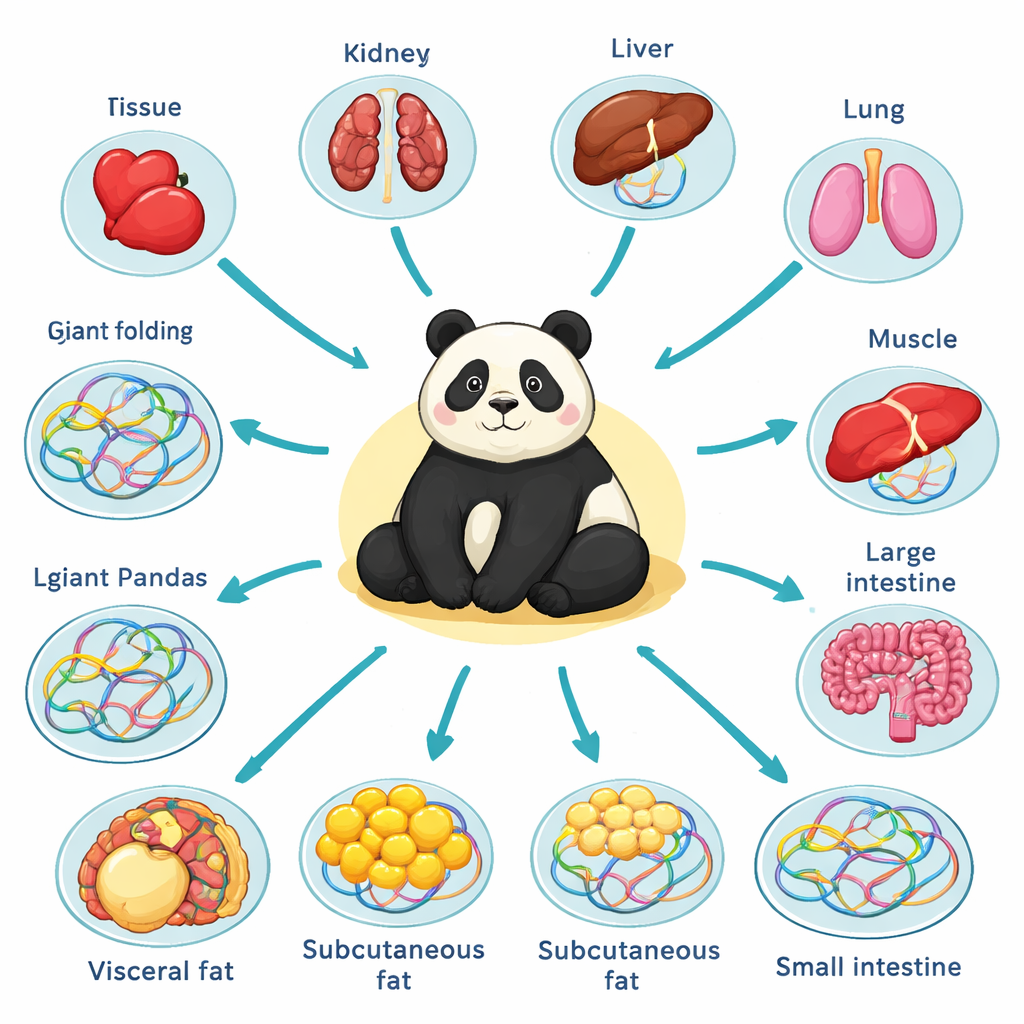
Many Organs, One Genome, Different Activity
Every cell in a panda’s body carries the same genome, yet a kidney cell behaves very differently from a muscle cell. The team began by profiling which genes are switched on in nine tissues: heart, kidney, liver, lung, skeletal muscle, large and small intestine, and two types of fat. They found that over 60 percent of all protein-coding genes are active in each tissue, but not to the same extent. Some genes are “housekeeping” genes, running basic cellular machinery everywhere. Others are “tissue-specific,” turned on strongly in only one organ or a related group of organs. For example, the kidney has an especially rich set of unique genes tied to filtering blood and handling salts, while the intestines show unusually complex gene activity, hinting at their demanding role in digestion and nutrient handling.
Folding the Genome into Active and Quiet Neighborhoods
DNA is not stretched out like a straight thread—it folds into neighborhoods where genes are either easier or harder to access. The researchers divided the panda genome into two broad types of zones: active “A” areas full of genes and activity, and quieter “B” areas where genes tend to be off. About 70 percent of the genome keeps the same status across tissues, but roughly 30 percent flips between A and B depending on the organ. When a region moves into an A neighborhood in a specific tissue, nearby genes are much more likely to turn on and support that tissue’s job. For instance, some liver and muscle genes that help with metabolism or contraction sit in A zones only in those tissues. 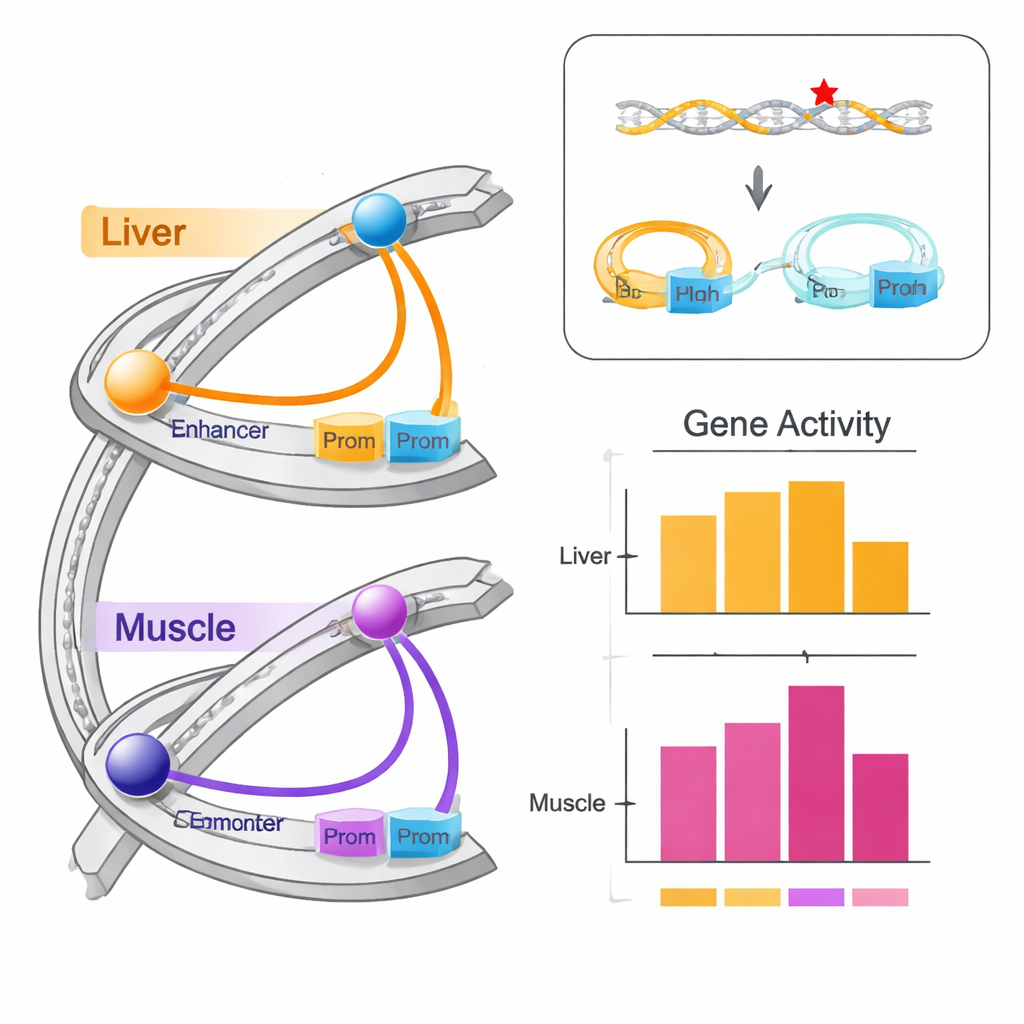
Loops, Domains, and Communication Along the DNA
Zooming in further, the team studied how the DNA folds into blocks called topologically associating domains (TADs), and how distant control regions, called enhancers, loop over to contact gene switches (promoters). These loops and blocks act like wiring diagrams for gene control. The study found thousands of TAD boundaries, many of which change from one tissue to another. Where new boundaries appear, genes inside often change their activity, especially in muscle and immune-related genes. Even more dynamic are the enhancer–promoter loops: over a third of these contacts are unique to a single tissue. Genes with more and stronger enhancer connections are usually more active. Classic muscle regulators like MYF5 and MYOD1, for example, form dense networks of loops in muscle but not in other tissues, helping drive muscle development and repair.
3D DNA Shapes and Panda Evolution
The researchers then asked how this 3D wiring might relate to the panda’s evolution—its bamboo diet, high-altitude lifestyle, and differences between regional populations. They overlaid millions of natural DNA variants from wild pandas onto the 3D maps and found that genetic changes tend to pile up in enhancer regions, especially those that act in only one tissue. Some of these changes sit in enhancers connected to immune genes in the gut and under-the-skin fat of pandas from wetter environments, supporting the idea that better defenses against pathogens have been favored there. Others lie in enhancers linked to genes involved in energy use and response to low oxygen, consistent with life in cool, mountainous forests. The study also pinpointed panda-specific DNA segments that have evolved unusually fast and now act as long-distance enhancers touching genes tied to growth, metabolism, and coping with low oxygen levels.
Why This 3D View of Panda DNA Matters
To a layperson, the central message is that it is not just the letters of DNA that matter, but also how that DNA is folded and wired in three dimensions. In the giant panda, these 3D structures differ from tissue to tissue and help explain which genes are switched on where. They also provide a crucial missing link between silent DNA changes and visible traits, such as organ function, disease risk, and adaptation to bamboo and high-altitude habitats. By building the first comprehensive 3D genome atlas for multiple panda tissues, this work offers a powerful reference for future studies of panda health, conservation, and evolution.
Citation: Liu, P., Zhang, J., Cai, K. et al. A compendium of chromatin interaction maps in the Giant Panda genome. Commun Biol 9, 244 (2026). https://doi.org/10.1038/s42003-026-09522-0
Keywords: giant panda genome, 3D chromatin, tissue-specific gene expression, enhancer–promoter interactions, adaptive evolution