Clear Sky Science · en
The oldest sepioid cephalopod from the Cretaceous discovered by Digital fossil-mining with zero-shot learning AI
A hidden clue in ancient seas
Long before whales and dolphins, the oceans were ruled by squid- and cuttlefish‑like creatures. Yet their story is hard to read because the soft parts of their bodies rarely fossilize. This study combines cutting‑edge artificial intelligence with painstaking rock imaging to uncover a tiny but powerful clue: the oldest known fossil from a group that includes modern cuttlefish and bobtail squid. For anyone curious about how life’s major lineages arise and diversify, it shows how new digital tools can rewrite chapters of evolution that once seemed lost.
Why tiny beaks matter
Modern oceans are full of “sepioids,” the ten‑armed relatives of squid that include cuttlefish and bobtail squid. They are abundant, ecologically important hunters and a major food source for larger animals. Yet their deep evolutionary history is surprisingly murky. Classic fossils such as ammonites preserve hard external shells, but living sepioids have internal supports or are almost entirely soft‑bodied, leaving little trace in rock. One exception is their beaks: tough, chitinous mouthparts that fossilize far better than the rest of the animal. By focusing on these miniature jaws, scientists can identify groups of ancient cephalopods even when everything else has vanished.
Mining rocks with digital eyes
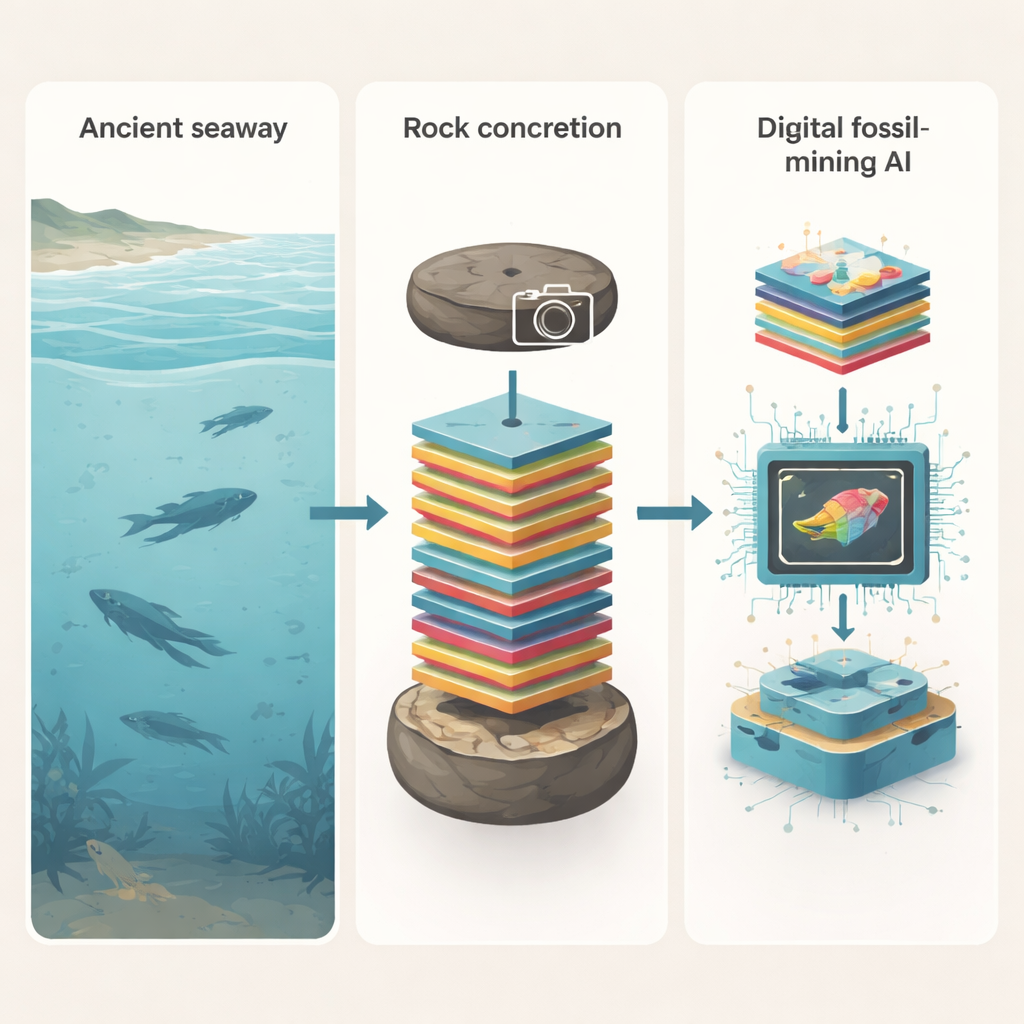
In this work, researchers studied hard carbonate concretions from Late Cretaceous rocks in South Dakota, formed about 74 to 67 million years ago in the Western Interior Seaway, a vast inland ocean that once split North America. Rather than cracking the rocks open in search of visible fossils, they used “grinding tomography,” slicing each concretion into thousands of ultra‑thin layers and photographing every slice in high resolution and full color. These huge image stacks were then passed to a zero‑shot learning AI system called DEVA, built on the Segment Anything Model. Unlike traditional machine‑learning tools, which must be trained on known shapes, this AI can outline any distinct object it finds, even if that object has never been seen before. In effect, the authors built a digital fossil‑mining machine that can comb through massive datasets and flag every embedded structure that looks like a separate body.
Meeting Uluciala, the in‑between sepioid
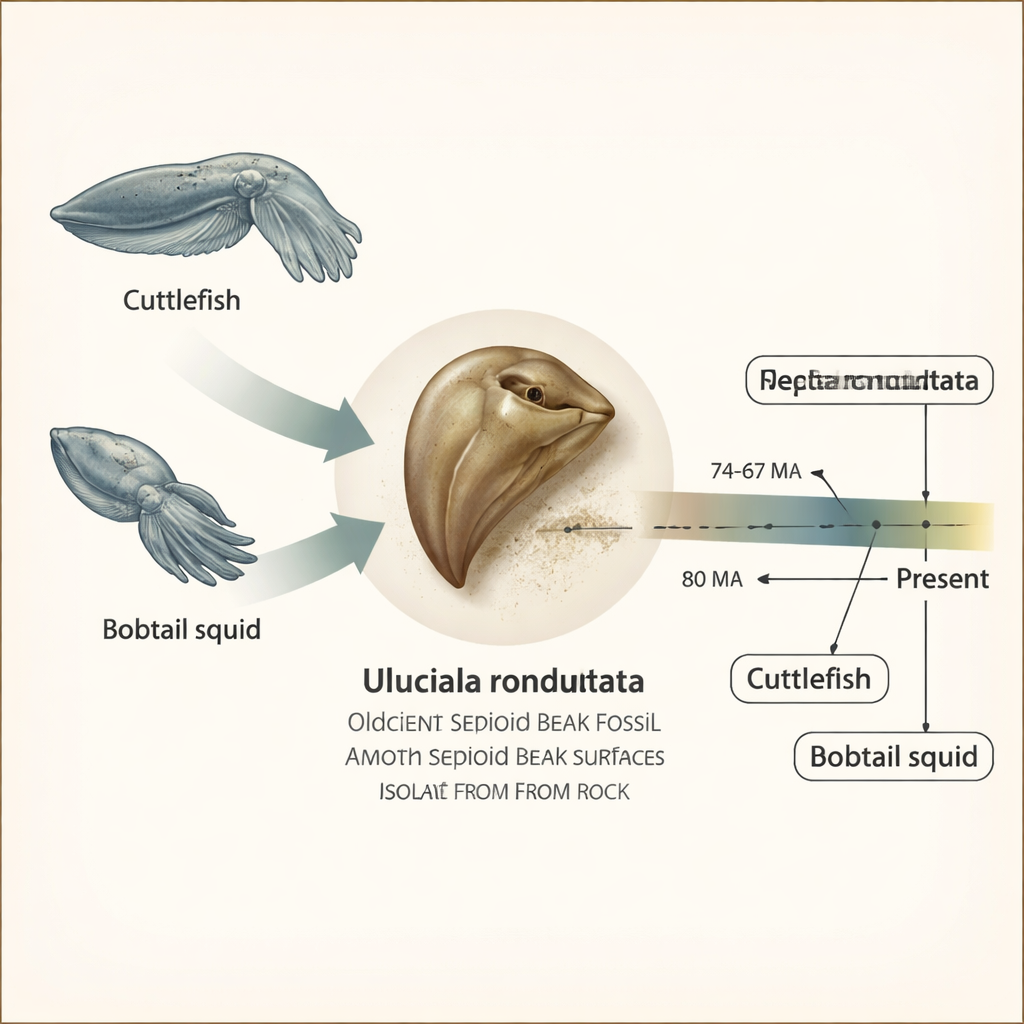
Among the AI‑highlighted objects, the team reconstructed two tiny three‑dimensional beaks only a few millimeters long. Careful comparison with beaks of living and fossil cephalopods revealed that these jaws came from a previously unknown animal, which they named Uluciala rotundata. Its lower beak carries a distinctive mix of features: a large rounded hook and forward‑sweeping jaw edge, reminiscent of modern cuttlefish, but also straight ventral margins and triangular depressions similar to bobtail squids. Statistical analyses of overall beak shape across more than 160 living species confirmed that Uluciala falls between the two groups in “morphospace,” a map of form differences, rather than clustering clearly with either one.
Rewriting the family story of cuttlefish and bobtail squid
These fossils are not only morphologically intermediate; they are also old. One specimen comes from rocks about 74 million years old (late Campanian), and the other from about 67 million years ago (late Maastrichtian), both within the Late Cretaceous. Before this discovery, the earliest known cuttlefish‑like fossil dated to roughly 70 million years ago, and bobtail squids lacked a trustworthy fossil record altogether. The presence of Uluciala in both time intervals shows that sepioids were already diversifying during the later Cretaceous, and that the split between the cuttlefish and bobtail lineages likely occurred soon after. In other words, the characteristic beak shapes of today’s groups are the endpoint of a longer, previously unseen evolutionary experiment.
What this means for life’s hidden record
To a non‑specialist, the main message is that even the smallest fossil pieces can transform our view of evolution when paired with advanced imaging and AI. Uluciala rotundata, known only from delicate beaks entombed in rock, links two successful modern cephalopod groups and pushes their shared history deeper into time. The digital fossil‑mining method that revealed it can, in principle, uncover many more “missing” species whose soft bodies left almost no trace. As these tools spread, countless other hidden fossils may emerge from long‑studied rocks, filling in gaps in the tree of life and showing how today’s marine ecosystems came to be.
Citation: Sugiura, K., Ikegami, S., Takeda, Y. et al. The oldest sepioid cephalopod from the Cretaceous discovered by Digital fossil-mining with zero-shot learning AI. Commun Biol 9, 301 (2026). https://doi.org/10.1038/s42003-026-09519-9
Keywords: cephalopod evolution, cuttlefish, fossil beaks, paleontology AI, Late Cretaceous