Clear Sky Science · en
Locomotion engages context-dependent motor strategies for head stabilization in primates
Why steady heads matter when we move
Every time you walk, your brain works behind the scenes to keep your head surprisingly steady. That stability is vital: a stable head helps your eyes and inner ears make sense of the world so you can see clearly and keep your balance. This study in rhesus monkeys asks a deceptively simple question with big implications for neuroscience, rehabilitation, and even robotics: does the brain always use the same "default" pattern of muscle activity to steady the head, or does it switch strategies depending on how and where we move?
Testing walking in different everyday situations
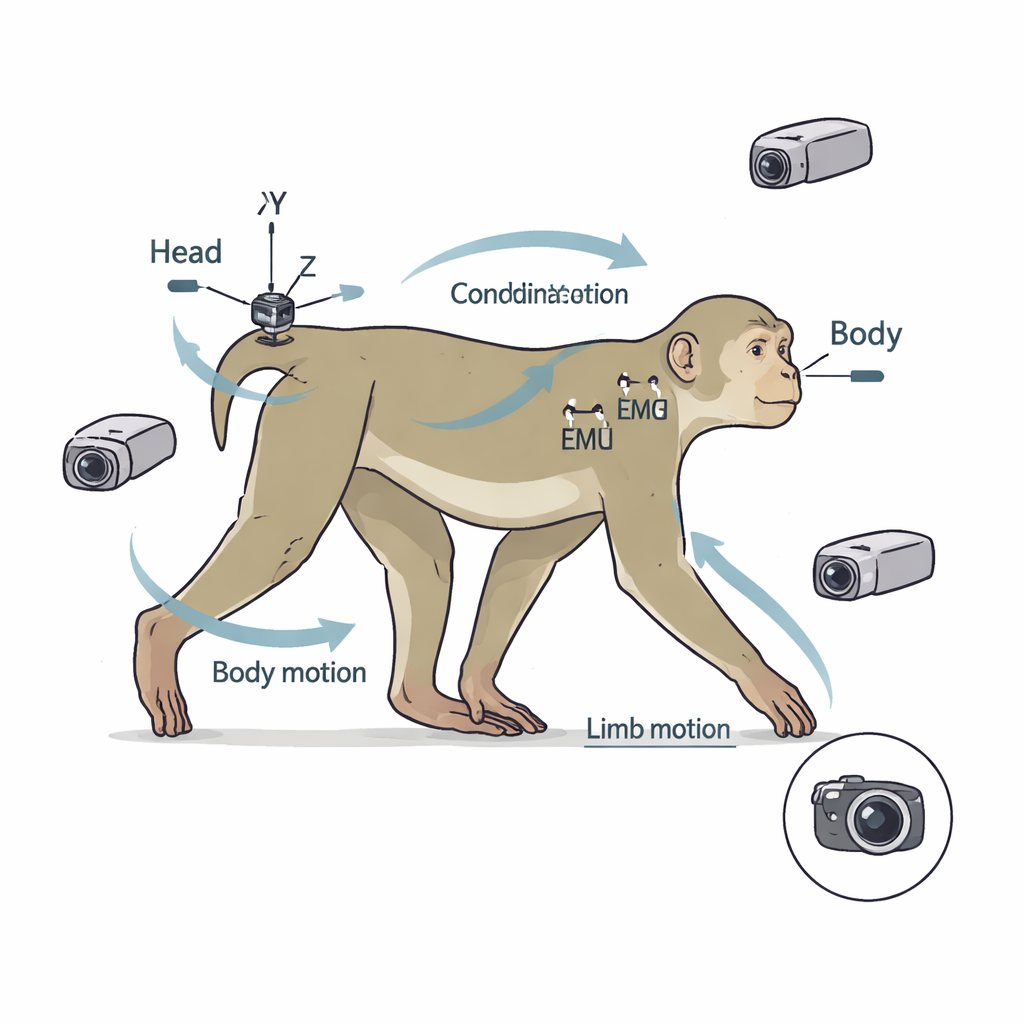
The researchers trained monkeys to walk in three main situations that mirror familiar human experiences. In one, the animals walked on a motorized treadmill, where the belt speed was precisely controlled across a range of speeds. In another, they walked overground along a straight track at their own, natural pace. In a third, a second, friendly monkey was nearby, creating a mildly exciting social setting that raised the walking animal’s arousal level, which the team tracked by measuring pupil size. While the monkeys walked, the scientists collected detailed measurements: three-dimensional motion of the limbs, body, and head; tiny electrical signals from neck muscles that move and steady the head; and the forces and accelerations acting on the head.
Keeping the head steady on moving bodies
Across all conditions, the monkeys managed to keep their heads surprisingly stable in space, even as the rest of the body moved rhythmically underneath. On the treadmill, faster belt speeds produced greater forces and larger head velocities and accelerations, yet the overall side-to-side and up‑and‑down head displacements stayed small and often changed little with speed. The neck, acting like a built‑in stabilizer, used head‑on‑body movements to counter body motion. In some directions, especially for rolling movements of the head, this compensation was nearly perfect: the head moved almost exactly opposite to the body, cancelling much of the motion. In others, such as pitching and vertical movement, compensation was only partial and sometimes overshot, reflecting limits of the neck’s mechanics.
Self‑paced walking calls for a different motor plan
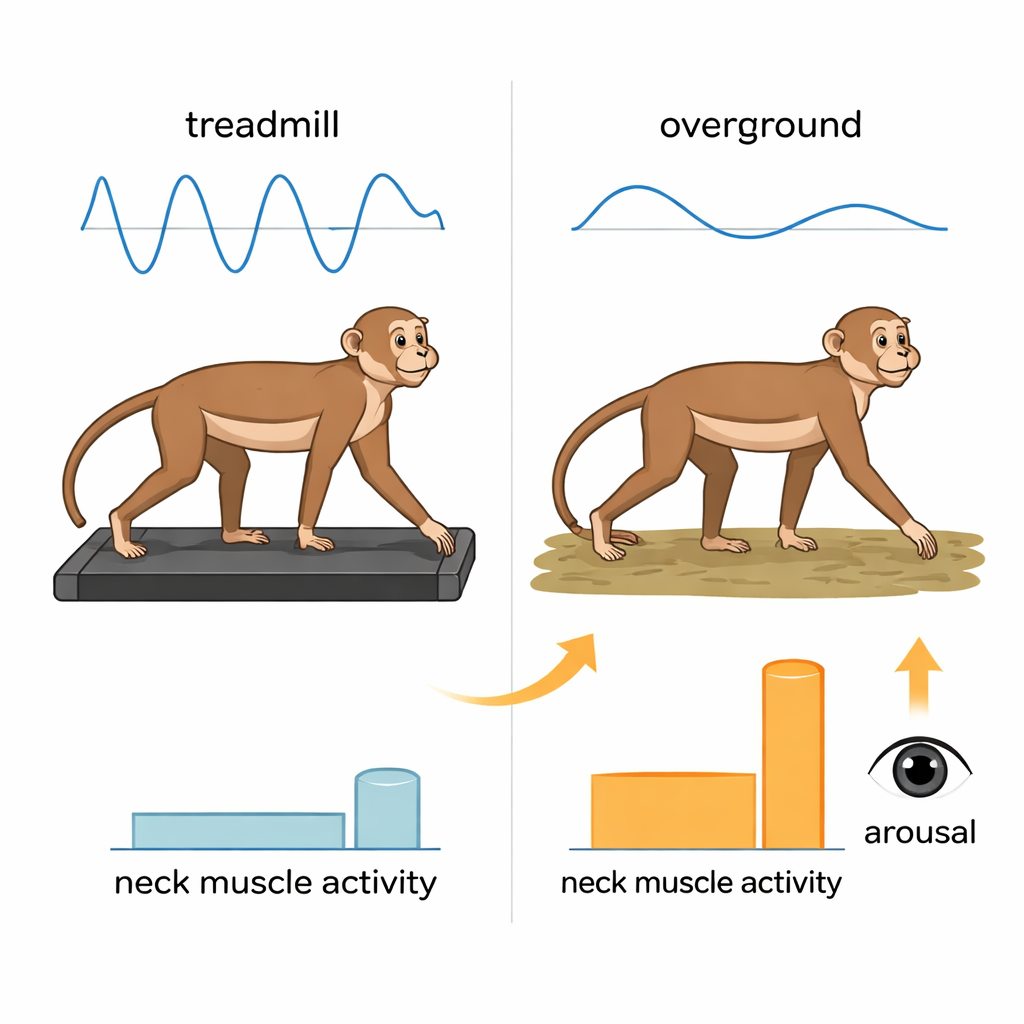
When the same monkeys walked overground at a speed matched to the treadmill, their head stabilization actually improved. Head rotations and accelerations were generally smaller, particularly in the up‑down and pitching directions. Yet this better performance did not come from simply “turning up” the same control strategy. Recordings from key neck muscles showed that muscle activity was stronger and began earlier in the step cycle during overground walking, even compared with the fastest treadmill speed. To dig deeper, the authors used mathematical tools that look at patterns across all recorded muscles at once. On the treadmill, these population patterns scaled smoothly with speed: faster walking stretched the same basic loop of activity in time and strength without changing its shape. Overground walking, in contrast, produced a clearly different pattern in this low‑dimensional space, indicating that the brain had reorganized how neck muscles worked together rather than just pushing the same pattern harder.
Excitement boosts effort, not the basic pattern
The social condition, in which a conspecific was present and the walking monkey’s pupils dilated, provided a test of internal state. Under heightened arousal, head motion became even more stable, and compensating head‑on‑body movements improved. Neck muscles fired more strongly, but their timing within the step and their overall coordination pattern in the population space remained largely unchanged compared with normal overground walking. In other words, being more alert amplified the output of the existing overground strategy without reshaping its underlying structure. This contrasted with the much larger shift seen between treadmill and overground walking, where the external mechanics and sensory cues differ more strongly.
What this means for brains, clinics, and machines
For a lay observer, the main message is that our brains do not rely on a single, fixed "program" to steady the head during walking. Instead, they select and tune different low‑complexity strategies depending on context—whether movement is driven by a belt, self‑paced across real space, or carried out in a more excited internal state. Treadmill walking is controlled by a stable pattern that simply scales with speed, while overground walking recruits a differently organized, and apparently more effective, plan that takes advantage of natural body mechanics and richer sensory feedback. Arousal then acts like a volume knob, boosting that plan without rewriting it. These insights help explain why treadmill and overground walking can feel and function differently, suggest new angles for designing rehabilitation programs that target head and neck control, and offer inspiration for robots that need to keep their "heads" steady while moving through an unpredictable world.
Citation: Wei, RH., Stanley, O.R., Charles, A.S. et al. Locomotion engages context-dependent motor strategies for head stabilization in primates. Commun Biol 9, 234 (2026). https://doi.org/10.1038/s42003-026-09512-2
Keywords: head stabilization, locomotion, neck muscles, treadmill vs overground, motor control strategies