Clear Sky Science · en
Exploring the genomic population structure and history of Austroasiatic speakers in Mainland Southeast Asia
Ancient roots beneath today’s Southeast Asia
Mainland Southeast Asia—home to Thailand, Laos, Vietnam, Cambodia, Myanmar, and parts of Malaysia—is one of the world’s great crossroads. Many of the region’s peoples speak Austroasiatic languages, an ancient family tied to early rice farming. This study asks a question that matters for anyone curious about human origins: how did waves of farmers, traders, and highland hunter‑gatherers mix over thousands of years to create the rich genetic and cultural patchwork we see today?
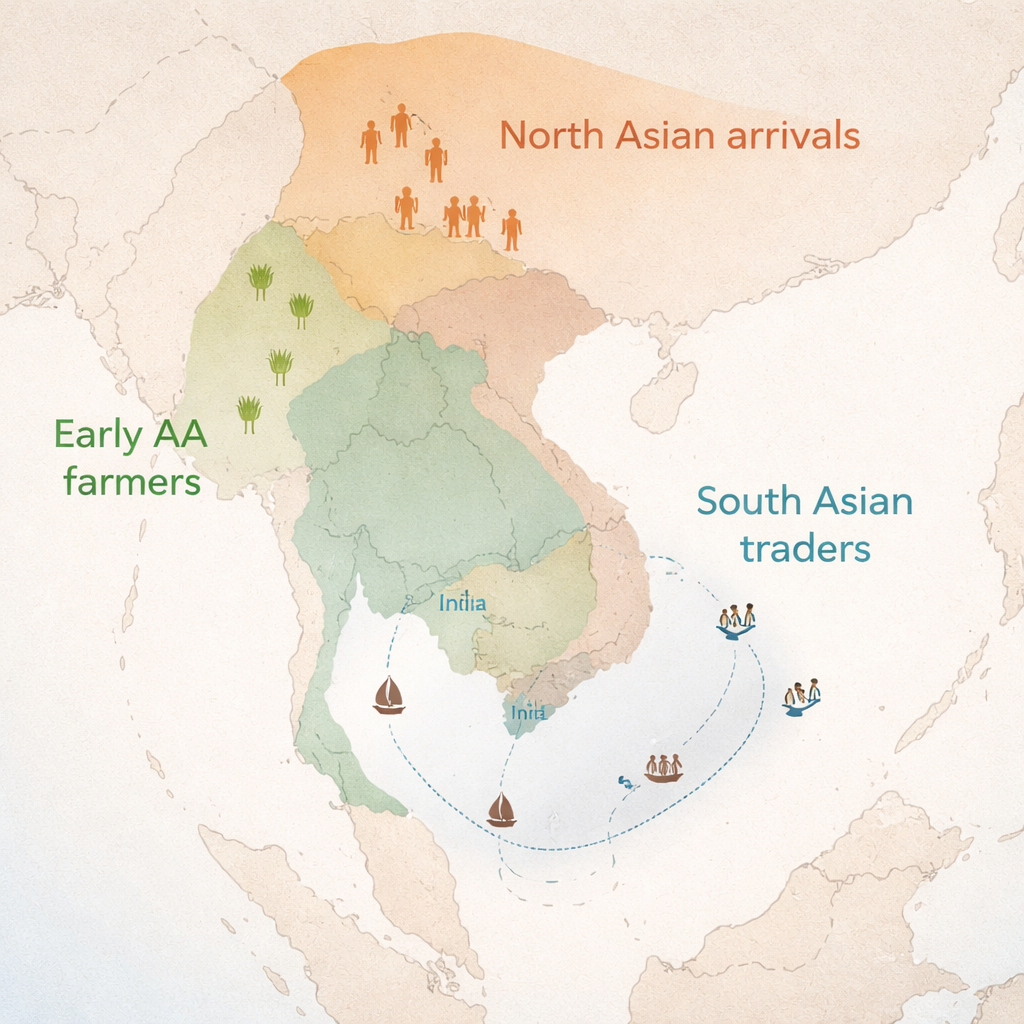
Many peoples, many histories
The researchers assembled the largest genomic dataset so far for Austroasiatic speakers, combining new genome‑wide data from 164 individuals in Thailand, Laos, and Myanmar with thousands of previously published genomes from across Asia, including ancient DNA. Using tools that map how people cluster genetically, they found that Austroasiatic speakers are far from uniform. Instead, groups that live in different landscapes or speak different branches of the language family form partially distinct genetic clusters. Highland Northern Mon‑Khmer groups, lowland Khmer speakers, Viet‑Muong speakers in Vietnam, and rainforest‑dwelling Maniq hunter‑gatherers all carry recognizable, but different, genetic signatures.
Old farmers and older foragers
Ancient DNA lets the team look back in time. Stone‑age hunter‑gatherers linked to the Hoabinhian culture once roamed the region. Later, Neolithic farmers—genetically closer to early East Asians—brought rice agriculture, probably speaking early Austroasiatic languages. By comparing ancient genomes with living people, the authors show that many modern Austroasiatic groups still carry a substantial share of this older Hoabinhian‑related ancestry, especially in lowland communities tied to Eastern Mon‑Khmer and Southern Monic languages. In contrast, Iron Age skeletons (about 2,000 years old) resemble today’s highland Northern Mon‑Khmer groups, hinting that mountain communities preserve a different slice of the past.
New neighbors from north and west
History did not stop with the first farmers. During the Bronze and Iron Ages, speakers of Tai‑Kadai and Sino‑Tibetan languages moved south from China, and seafaring traders connected India with Southeast Asia. Genetic analyses reveal that northern Austroasiatic groups, especially Viet‑Muong speakers and some highland communities, absorbed more ancestry from northern East Asians. Southern lowland groups, including Khmer and related peoples, show clear traces of South Asian ancestry. Dating methods suggest that much of this South Asian genetic input arrived roughly 800–1,200 years ago, around the time of powerful states such as Dvaravati and Angkor, which were deeply involved in trade and religious exchanges with India.
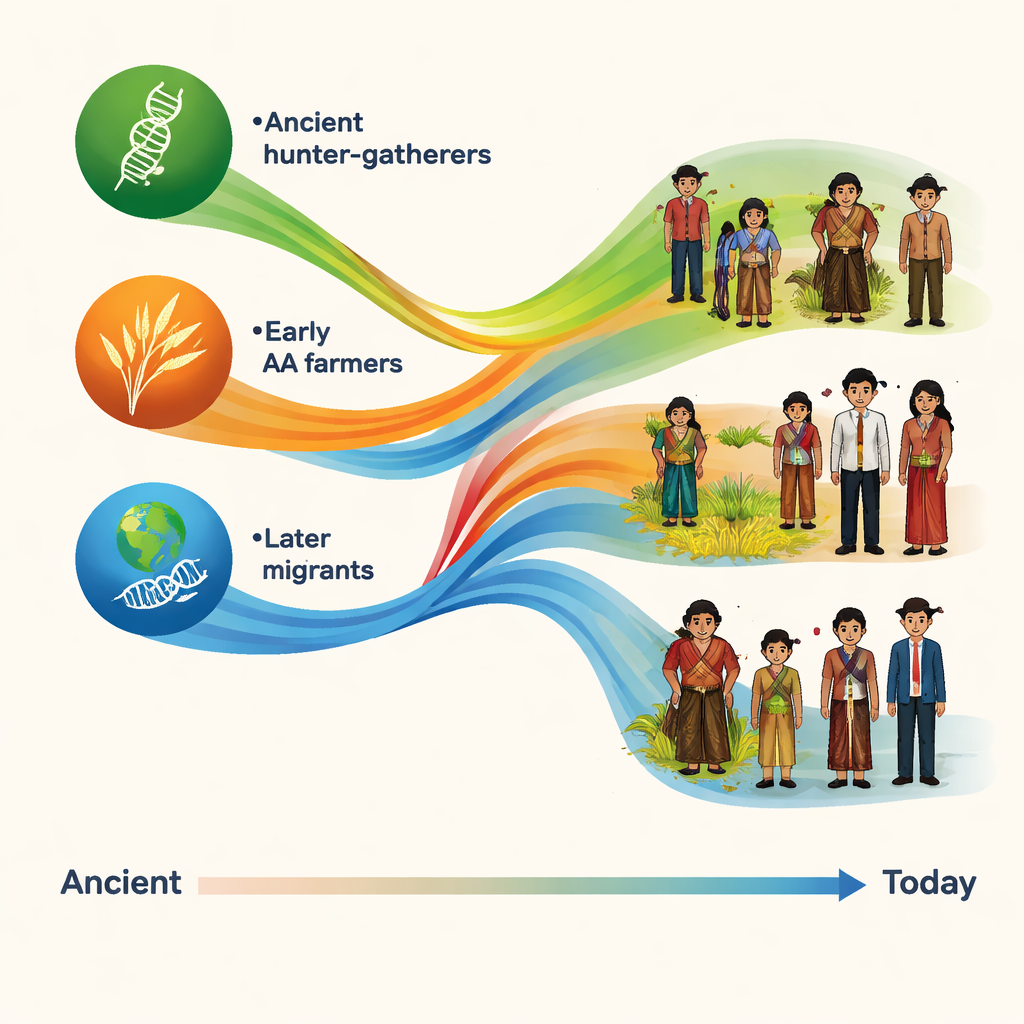
Layers of mixing and isolation
To capture more recent events, the team tracked long shared segments of DNA that point to common ancestors in the last few thousand years. These patterns reveal that Austroasiatic groups have exchanged genes frequently with nearby Tai‑Kadai, Sino‑Tibetan, and Austronesian neighbors—especially in lowland regions where travel and contact are easier. In contrast, some small highland and forest groups, such as the Mlabri and Maniq hunter‑gatherers, show signs of strong isolation and tiny population size, with very distinctive genetic profiles. Mapping these connections onto geography, the authors show that mountains tend to slow movement and preserve differences, while river valleys and coasts encourage mixing.
Surprising early ties to South Asia
One of the study’s most striking findings is that a South Asian‑related genetic signal is already present in some Neolithic skeletons from Southeast Asia, dating back 3,000–4,000 years—much earlier than the medieval kingdoms usually cited as the start of India–Southeast Asia contact. Rather than indicating direct migration from historical Indian civilizations, this faint but consistent signal likely reflects a very old, deeply diverging ancestry that connects early populations of South Asia, Southeast Asia, and East Asia. Later, more intense contacts—via trade, religion, and politics—added further South Asian ancestry to certain lowland Austroasiatic groups.
What this means for the story of the region
For a non‑specialist, the takeaway is that today’s peoples of Mainland Southeast Asia are the result of many overlapping layers of history. Austroasiatic speakers appear to form the oldest widespread language layer in the region and contribute a fundamental genetic base. On top of this, later movements from northern East Asia and repeated contacts with South Asia, combined with local isolation in mountains and forests, produced the pronounced genetic diversity we see today—even among neighbors who might seem culturally similar. The study shows how combining genomes from living people with ancient DNA can reveal a much richer, more complex story of human movement than language or archaeology alone could provide.
Citation: Yin, Z., Gupta, Y.M., Prakhun, N. et al. Exploring the genomic population structure and history of Austroasiatic speakers in Mainland Southeast Asia. Commun Biol 9, 300 (2026). https://doi.org/10.1038/s42003-025-09471-0
Keywords: Austroasiatic languages, Southeast Asia genetics, ancient DNA, human migration, population history