Clear Sky Science · en
Reappraisal of the extinct barbelthroat shark †Bavariscyllium and the nebulous origin of carcharhiniform galeomorphs
Ancient shark with a mysterious whisker
Long before great whites and hammerheads cruised the oceans, small sharks prowled the seafloor of a tropical archipelago that is now southern Germany. This study revisits one of those early sharks, the extinct “barbelthroat” shark Bavariscyllium, known from exquisitely preserved Jurassic fossils. By combining detailed anatomy, tooth analysis, and modern statistical tools, the authors show that this animal does not neatly fit into any living shark group, challenging current ideas about when modern shark lineages arose.
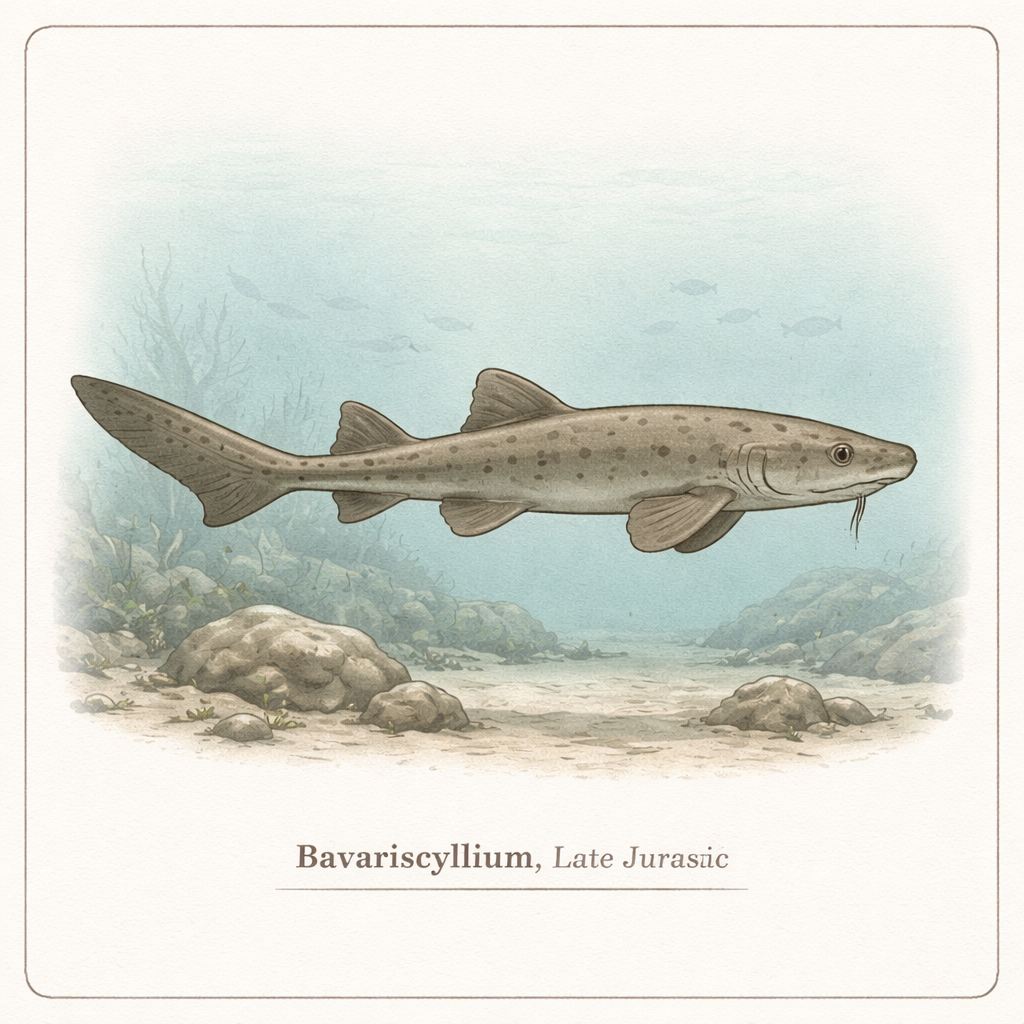
A tiny shark frozen in stone
The fossils of Bavariscyllium come from the famous Solnhofen limestones, rocks that also yielded Archaeopteryx and preserve organisms in remarkable detail. Bavariscyllium was a small shark only about 20–25 centimeters long, with a slender, elongated body and a long, low tail. Its fins were rounded and set far back on the body, and it likely lived close to the seafloor, moving with flexible, eel-like waves rather than powerful tail beats. Several almost complete skeletons show a dense covering of tiny skin denticles and a simple internal skeleton made of cartilage, typical of sharks.
The strange “beard” under its throat
What makes Bavariscyllium truly stand out is a whisker‑like barbel projecting from its throat. In most living sharks, barbels—when present—occur as a pair near the nostrils and help them sense their surroundings. Only one modern group, the collared carpet sharks (genus Cirrhoscyllium), carries a pair of long barbels under the throat that likely detect movement in the water. Bavariscyllium appears to have had at least one such barbel, and possibly a pair. This unusual feature suggests that it may have relied on touch or subtle water movements to locate prey along the seafloor, much like some modern bottom‑dwelling sharks.
Teeth that tell an incomplete story
Shark skeletons rarely fossilize, so most ancient species are known only from teeth. Bavariscyllium is a rare exception, preserving both skeletons and tiny, less‑than‑millimeter‑high teeth. These teeth are narrow and pointed, with small side cusps, suited for grasping soft‑bodied prey rather than crushing shells. Their overall form closely resembles teeth long thought to belong to the earliest members of a major modern shark group, the ground sharks (order Carcharhiniformes, which includes catsharks and many coastal species). The authors compare new Bavariscyllium teeth from Germany with similar fossils from France and England and conclude that some of these previously named species actually represent the same shark, extending Bavariscyllium’s history from the Late Jurassic into the Early Cretaceous.
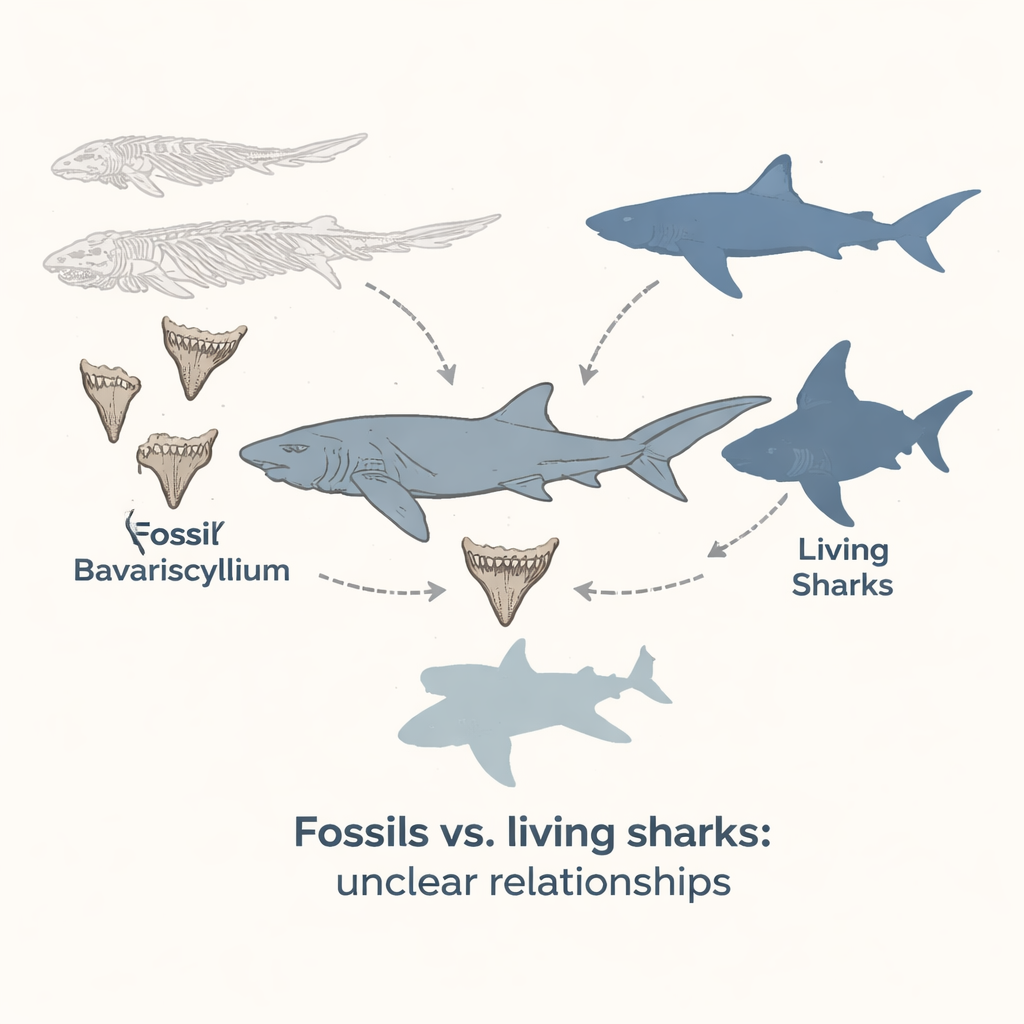
Body shape comparisons blur the family tree
To place Bavariscyllium on the shark family tree, the researchers did more than look at teeth. They took 16 body measurements from complete fossils and compared them with those of over 180 living bottom‑dwelling sharks, including catsharks and carpet sharks. Using statistical methods that map body shapes into a “morphospace,” they asked whether Bavariscyllium clustered with any modern family. It did not. Instead, it occupied its own region in this shape space, near—but not inside—the cloud of modern ground sharks. A similar analysis of another Jurassic shark, Palaeoscyllium, showed yet another distinct pattern. Together, these results indicate that early galeomorph sharks (the larger group that includes ground sharks, carpet sharks, and mackerel sharks) had already evolved a variety of body plans that do not match any single living lineage.
Rethinking when modern sharks emerged
Finally, the team used a broad set of anatomical traits to run computer‑based family‑tree analyses. These trees consistently placed Bavariscyllium within the galeomorph group but could not cleanly assign it to either ground sharks or carpet sharks. The combination of its unusual throat barbel, generalist teeth, and distinctive body shape suggests that Bavariscyllium represents an early side branch rather than a direct ancestor of any modern shark family. This matters because some similar fossils have been used to “start the clock” in DNA‑based studies that estimate when ground sharks evolved. If those fossils cannot be firmly tied to that group, the dates for the origin and diversification of many familiar sharks may need to be revisited.
What this means for our picture of shark evolution
To a non‑specialist, the key message is that early sharks were already experimenting with many different lifestyles and shapes, but their family ties are hazy. Bavariscyllium was a tiny, bottom‑dwelling shark with a sensory throat whisker and grasping teeth, living in warm, shallow seas around 150 million years ago. Yet, despite its familiar outline, it does not slot neatly into any modern shark order. By showing that these Jurassic sharks sit in a gray zone of relationships, this study cautions against using them as fixed markers for timing shark evolution and highlights just how much of shark history is still hidden in the rocks.
Citation: Stumpf, S., Türtscher, J., López-Romero, F.A. et al. Reappraisal of the extinct barbelthroat shark †Bavariscyllium and the nebulous origin of carcharhiniform galeomorphs. Commun Biol 9, 158 (2026). https://doi.org/10.1038/s42003-025-09272-5
Keywords: Jurassic sharks, fossil sharks, shark evolution, Bavariscyllium, Solnhofen fossils