Clear Sky Science · en
Effects of forestry decentralization on rural inequality in Nepal
Why forests and fairness matter
Who gains when local communities are put in charge of nearby forests: everyone equally, or mainly those already better off? This question matters because community-based conservation has become a go-to strategy for protecting nature while fighting poverty across the Global South. Nepal’s celebrated community forestry program is often held up as a success story. This study asks a tougher question: even if the program reduces overall poverty and protects trees, does it also narrow long-standing gaps between powerful social groups and historically marginalized communities in rural Nepal—or might it unintentionally widen them?
Sharing the forest, not always the benefits
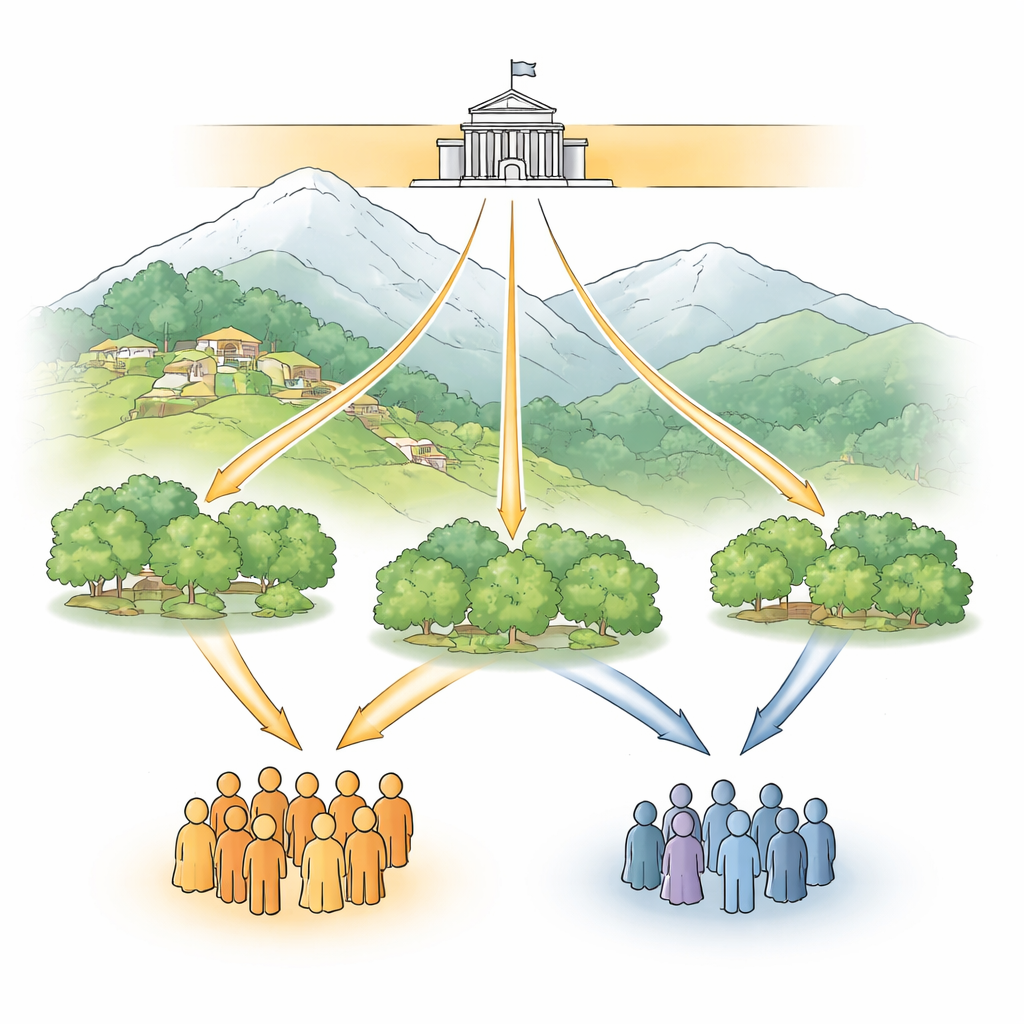
Since the early 1990s, Nepal has handed over large areas of public forest to village-level Community Forest User Groups. These groups can harvest wood and other products, hire local workers, and invest revenues in village projects or small cash benefits for households. On paper, the rules are unusually progressive: they call for seats for disadvantaged groups on forest committees, reduced fees, and targeted support for poorer families. Yet Nepal is also marked by deep social divisions. Households from Brahmin, Chhetri, and Newar backgrounds tend to be wealthier and more politically connected, while Dalit, Janajati, Muslim, and other minority groups have long faced discrimination, lower education, and fewer opportunities.
Testing who moves ahead
To see how this ambitious forestry reform affects inequality, the researchers combined two types of nationwide data. First, they used detailed samples from Nepal’s 2001 and 2011 population censuses, covering more than half a million rural households. From the census questions, they built a multi-dimensional poverty index that captures basic deprivations in health, schooling, electricity, clean water, sanitation, and cooking fuels. Second, they matched each household’s location to government records showing when its ward—the smallest local administrative unit—first formed a community forest group. Using a statistical approach that compares changes over time within the same wards, they estimated how poverty gaps between advantaged and marginalized caste and ethnic groups shifted when the forestry program arrived.
Small gains, uneven ground
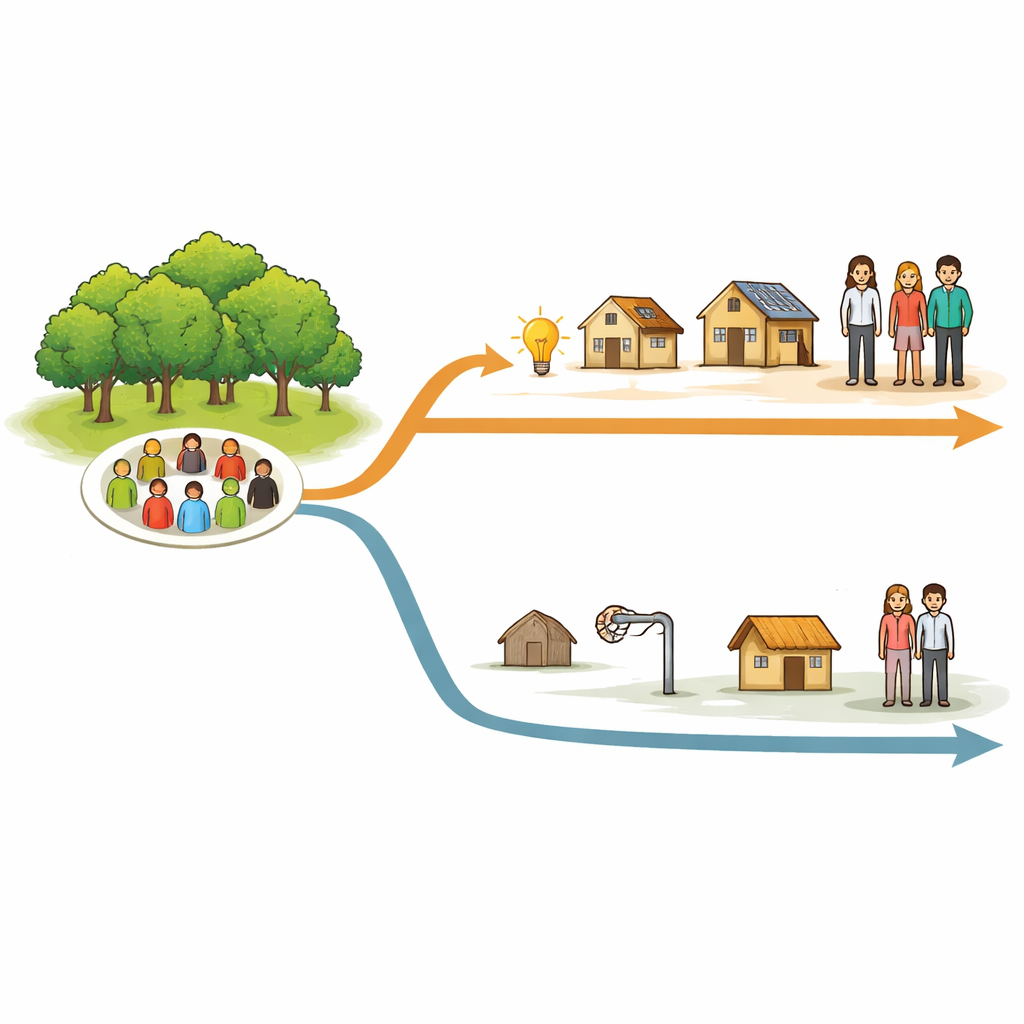
The analysis confirms that, even before considering forestry, marginalized groups were already worse off than Brahmin, Chhetri, and Newar households living in the same villages. Once community forestry was in place, those gaps grew rather than shrank. Households from the dominant groups saw a clear reduction in poverty on the index: their housing conditions, access to services, and other basic indicators improved more noticeably. Janajati households gained some ground, but less. For Dalit and other minority households, the study finds no convincing evidence of improvement linked to the program. In other words, community forestry appears to help many rural people, but it helps the already advantaged most, leaving entrenched inequalities largely intact and, in statistical terms, slightly wider.
Why the playing field stays tilted
The findings fit with earlier, smaller-scale studies of who actually participates and who holds power inside community forest groups. Members of dominant social groups are more likely to be literate, connected to officials, and seen as local leaders. They are better positioned to navigate rules, sit on committees, and steer decisions about forest use and spending. They also tend to have more capital and market access, which makes it easier to turn new forest rights into jobs, businesses, and home improvements. By contrast, marginalized households often have less voice in meetings and face subtle or overt barriers to claiming program benefits, even when formal guidelines say they should be included.
What this means for people and the planet
The study does not conclude that community forestry is harmful overall; previous work shows it can lower deforestation and reduce average rural poverty. But it does highlight a key trade-off: a conservation and development tool widely praised as a win–win may still leave deep social divides untouched—or even deepen them slightly—if powerful groups capture most of the gains. For policymakers, the message is that good intentions and progressive rules are not enough. Stronger enforcement of equity provisions, targeted support for marginalized communities, and new ways to share commercial forest benefits will be needed if future programs are to protect forests, cut poverty, and close inequality gaps at the same time.
Citation: Cook, N.J., Andersson, K.P., Benedum, M.E. et al. Effects of forestry decentralization on rural inequality in Nepal. Nat Sustain 9, 385–394 (2026). https://doi.org/10.1038/s41893-025-01729-z
Keywords: community forestry, rural inequality, Nepal, decentralized governance, poverty reduction