Clear Sky Science · en
Halving global ammonia emissions with cost-effective measures
Invisible Gas, Visible Problems
Most of us never think about ammonia, a sharp-smelling gas best known from household cleaners. Yet vast amounts of ammonia are quietly escaping from farms, landfills and chimneys around the world, damaging our lungs, shortening lives and degrading rivers, lakes and wildlife habitats. This study asks a deceptively simple question with big implications: could we realistically cut human-made ammonia emissions in half, and would it be worth the money? Using global data and economic models, the authors find that the answer is yes—and that the health and environmental payoffs would far exceed the costs.
Where All This Ammonia Comes From
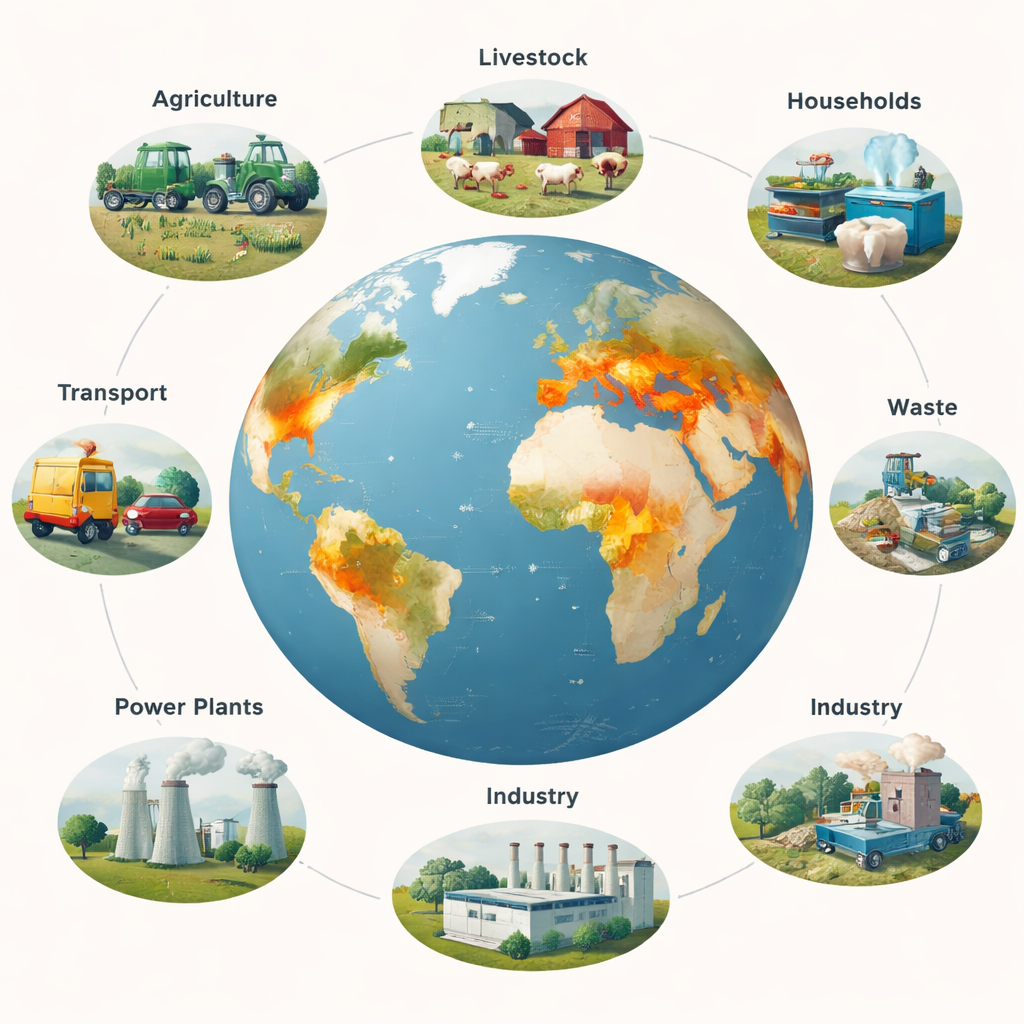
Ammonia is a natural part of the nitrogen cycle, but human activity has pushed it far beyond background levels. Since 1980, global ammonia emissions from people and their activities have risen by almost 50 percent, largely to feed a growing and more meat-hungry population. Modern agriculture is the main culprit: nitrogen-rich fertilizers spread on fields and manure from cattle, pigs and poultry release large plumes of gas. Smaller but still important contributions come from household activities, waste handling, industry, power generation and transport. China and India together account for more than a third of global emissions, with other Asian countries, Europe, North America and a rapidly developing Sub-Saharan Africa also playing major roles.
Testing Dozens of Possible Fixes
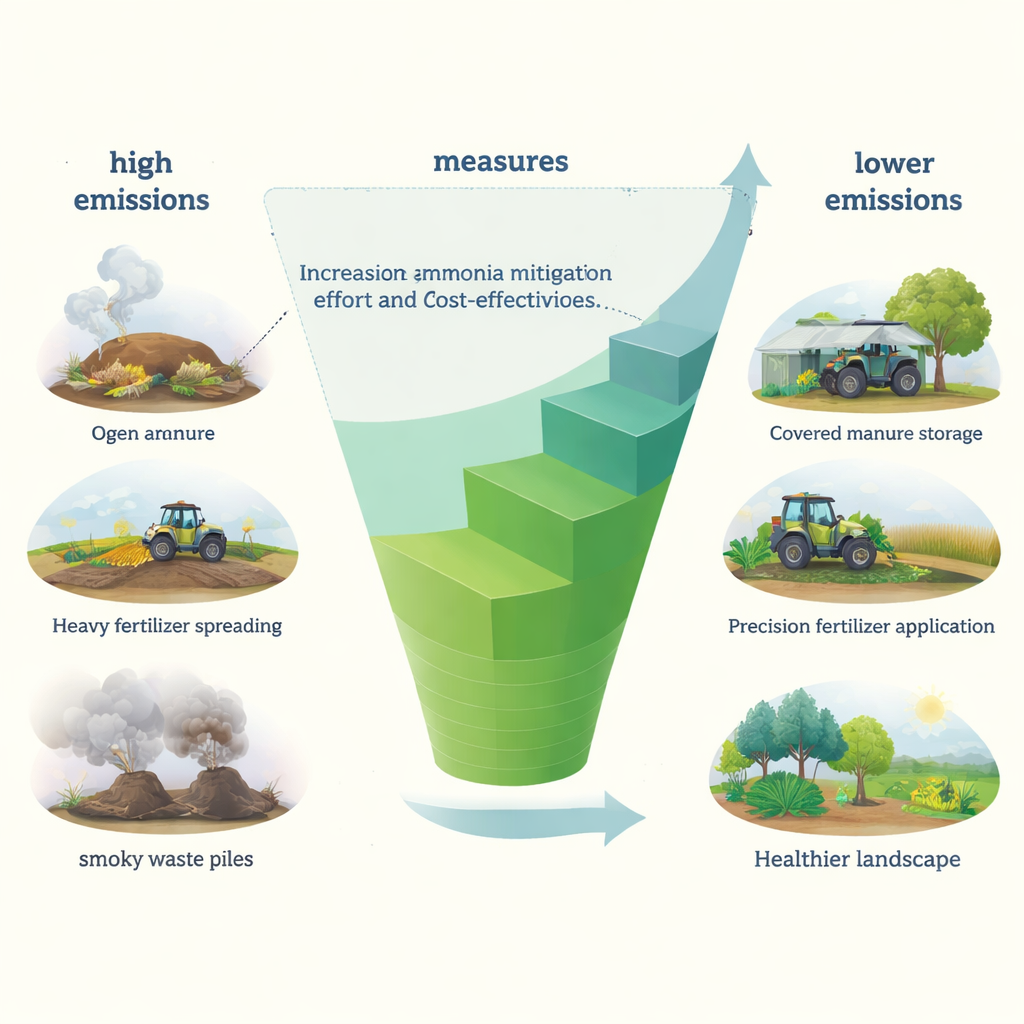
Despite the scale of the problem, detailed, global comparisons of different ammonia-control strategies have been scarce. To close this gap, the authors combined multiple models and datasets covering 185 countries and seven emitting sectors. They evaluated 32 practical measures, from better timing and placement of fertilizer, to covering manure storage, to upgrading waste and industrial treatment systems, to changing diets and cutting food waste. For each option they estimated how much ammonia it could avoid, what it would cost to roll out and what it would save in avoided deaths, cleaner ecosystems and climate effects. They then built “marginal abatement cost curves,” which rank measures from cheapest to most expensive, to see how far the world could go using the most economical tools first.
Big Cuts at Modest Cost
The analysis shows that existing technology and behavior changes could cut human-made ammonia emissions by about 60 percent compared with current levels. On average, each kilogram of avoided ammonia would cost around US$7.4 to prevent, and the total global bill would be roughly US$274 billion. That is a large sum, but the benefits—fewer heart and lung diseases from fine air particles, less damage to forests and lakes from excess nitrogen, and related resource savings—are estimated at about US$722 billion. Agriculture offers the best bang for the buck: smarter fertilizer use and cleaner manure handling alone provide over 60 percent of the total benefit at relatively low cost. Household actions like shifting toward diets with less animal protein and wasting less food, as well as improved waste and sanitation systems, add further, cost-effective reductions. By contrast, cutting ammonia from power plants, industry and transport is much pricier per unit of pollution removed, unless those measures are justified primarily for climate and broader air-quality reasons.
Winners, Strugglers and Future Pathways
The gains and challenges are not evenly spread. China and India emerge as priority countries where large, low-cost cuts could deliver outsized health and environmental payoffs. Europe and North America also reap strong net benefits thanks to dense populations and established farm regulations that can be strengthened. Sub-Saharan Africa is a special case: present emissions are lower, but infrastructure is weak and farming is fragmented, pushing up the cost of advanced controls. There, improving basic waste and agricultural systems may be a more realistic first step than aggressive ammonia targets. Looking ahead to 2050, the authors explore future scenarios. In a “sustainability” world with greener diets, less food waste and efficient production, global ammonia emissions fall by more than half, and net economic benefits soar. In pathways with weak cooperation or fossil-fuel-heavy growth, emissions keep rising, driving mounting health damage and ecosystem loss.
A Roadmap for Cleaner Air and Safer Food
For non-specialists, the core message is straightforward: cutting ammonia is both doable and worthwhile. Practical steps on farms, in waste systems and in our kitchens can dramatically shrink emissions without starving the world, and in many cases they save money or boost yields. The study argues that ammonia control should be woven into broader policies for clean air, climate, food security and the United Nations Sustainable Development Goals. If countries act ambitiously—particularly major agricultural producers—the world can halve ammonia emissions by mid-century, prevent large numbers of premature deaths and protect sensitive ecosystems, all at a cost far lower than the damage we would otherwise pay.
Citation: Zhang, X., Sun, Y., Gao, Y. et al. Halving global ammonia emissions with cost-effective measures. Nat Sustain 9, 247–259 (2026). https://doi.org/10.1038/s41893-025-01723-5
Keywords: ammonia pollution, agricultural emissions, air quality, nitrogen management, sustainable farming