Clear Sky Science · en
Effectiveness, acceptability, adherence, and safety of exergaming for depressive symptoms: a systematic review and meta-analysis
Why Moving With Games Matters
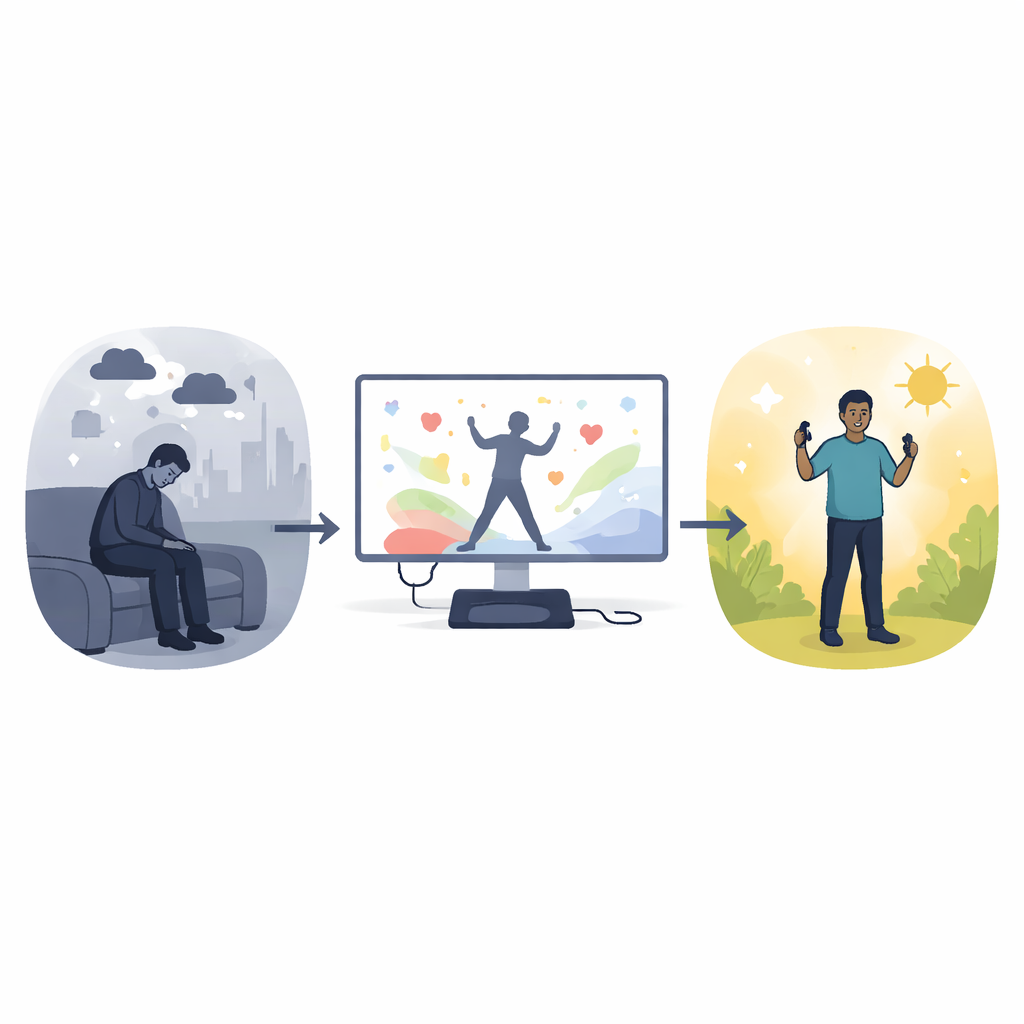
Depression affects hundreds of millions of people worldwide, yet many never receive treatment or find that therapy or medication alone does not fully meet their needs. At the same time, video games that require players to move their bodies—often called exergames—have quietly become part of daily life, from living rooms to rehabilitation clinics. This study asks a simple but important question: can these movement-based games meaningfully lift low mood and offer a practical, enjoyable complement to standard care?
Blending Play and Exercise
Exergames turn physical movement into the way you control a game. Instead of pressing buttons, people step, stretch, or balance in front of a motion sensor or hold controllers that track their actions. This approach removes some of the usual barriers to exercise: it can be done indoors, in small spaces, with built-in guidance and instant feedback. The researchers note that exergames have become especially popular since the COVID-19 pandemic, when many people lost access to gyms and group classes but still needed ways to stay active and protect their mental health.
Taking a Fresh Look at the Evidence
Earlier reviews of exergames and depression gave mixed answers—some found strong benefits, others found little or none. To clarify the picture, the authors pooled data from 58 controlled studies conducted between 2011 and 2025, involving 3614 participants aged 9 to 85. These studies covered a wide range of people: healthy volunteers, individuals with long-term physical illnesses such as heart disease or chronic pain, and those with neurological or mental health conditions, including dementia and Parkinson’s disease. Exergames used popular consumer systems like Microsoft’s Kinect and Nintendo’s consoles, as well as specialized rehabilitation platforms.
How Much Do Exergames Help?
Across all studies, exergaming produced a moderate and statistically reliable reduction in depressive symptoms. In plain terms, people who used these games tended to feel noticeably less depressed than those who received no extra activity or only standard care. When exergames were compared directly with traditional forms of exercise such as walking, balance training, or cycling, their impact on mood was similar. This suggests that moving with a game can be as emotionally helpful as more conventional workouts, without necessarily being better or worse. The benefits were strongest when people played more than three times per week and for at least 30 minutes per session.

Who Benefits Most, and Is It Safe?
The analysis hints that older adults may gain slightly more from exergaming than younger people, though this trend did not reach strict statistical certainty. One reason may be that in later life, mood is closely tied to physical function and social contact—two areas that exergames can improve by encouraging movement and providing a playful, sometimes social, setting. Importantly, reports from the studies showed high completion rates: on average, nearly nine out of ten participants stuck with their programs. Most trials reported no adverse events, and the few serious problems were rare and not always clearly linked to the games. Cost analyses from a handful of projects suggested that, for certain groups, exergaming can be reasonably cost-effective when judged against standard health economic benchmarks.
What This Means for Everyday Life
For people living with depression, and for clinicians searching for flexible options, this review offers cautious but encouraging news. Exergaming is not a cure-all, nor does it replace the need for professional care when depression is severe. However, the findings indicate that regular, game-based movement can meaningfully reduce low mood, with good safety, strong user enthusiasm, and practical costs. A routine of playing these games for at least half an hour, more than three times a week, appears especially helpful. The authors argue that larger, longer-term studies are still needed, particularly those tailored to older adults, but the message is clear: turning exercise into play may be a realistic way to help more people move their bodies—and their mood—in the right direction.
Citation: Tang, D., Liu, C., Liu, J. et al. Effectiveness, acceptability, adherence, and safety of exergaming for depressive symptoms: a systematic review and meta-analysis. npj Digit. Med. 9, 279 (2026). https://doi.org/10.1038/s41746-026-02479-8
Keywords: exergaming, depression, digital mental health, physical activity, virtual reality exercise