Clear Sky Science · en
Multi night digital assessment of sleep disordered breathing is associated with accelerated vascular aging
Why your snoring may matter more than you think
Most people think of snoring and sleep apnea as nighttime nuisances, embarrassing at worst. This study shows they can quietly speed up aging of the arteries that feed your heart and brain—and that the pattern of your breathing from night to night matters almost as much as how severe your sleep problem looks on any single night. Using everyday smart devices in people’s homes worldwide, the researchers found that disturbed breathing and loud snoring over many nights are linked to stiffer, “older” blood vessels, even after accounting for age, sex, and body weight.
How blood vessels age and why stiffness is risky
Our arteries are meant to be springy tubes that expand with each heartbeat and cushion pressure waves traveling through the body. As we age, they naturally become thicker and less elastic, a process known as vascular aging. One of the best ways to capture this change is by measuring how fast the pulse wave travels along the aorta—the main artery leaving the heart. Faster waves mean stiffer arteries and a higher risk of high blood pressure, strokes, and heart attacks. Until recently, measuring this required specialized equipment in clinics. Now, new bathroom scales can estimate pulse wave speed at home, making it possible to track vascular aging across thousands of people over time.
Tracking sleep and blood vessels in real life
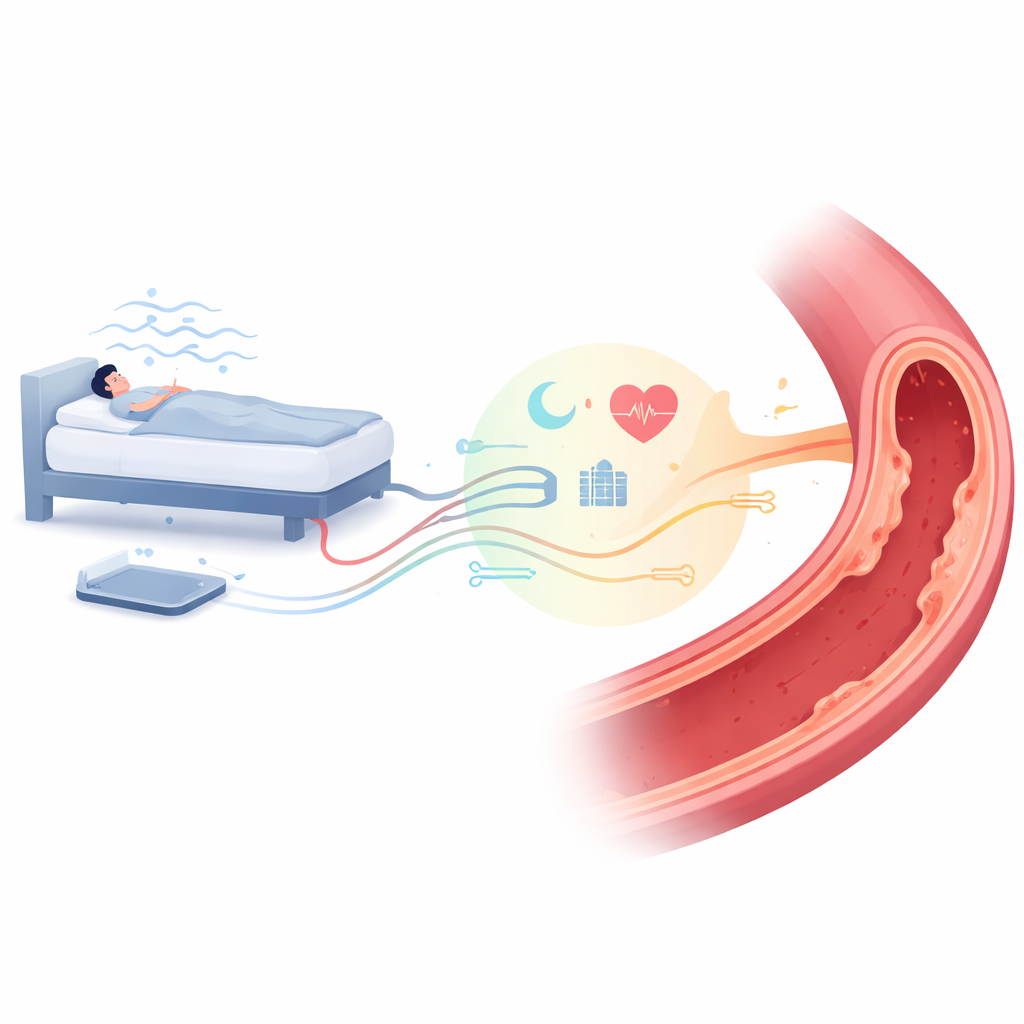
The team analyzed data from nearly 30,000 adults in 19 countries who used two consumer devices for about four years: an under-mattress sleep sensor and a smart scale. The sleep sensor used pressure and sound to estimate how often breathing paused or became shallow (a measure of sleep apnea) and how much of the night was spent snoring. The scale estimated pulse wave speed as people stood on it. On average, each person had around 250 nights of sleep data and about 40 vascular measurements per year, creating a uniquely detailed picture of how nightly breathing patterns and artery stiffness evolved together in everyday life.
More apnea, more snoring, stiffer arteries
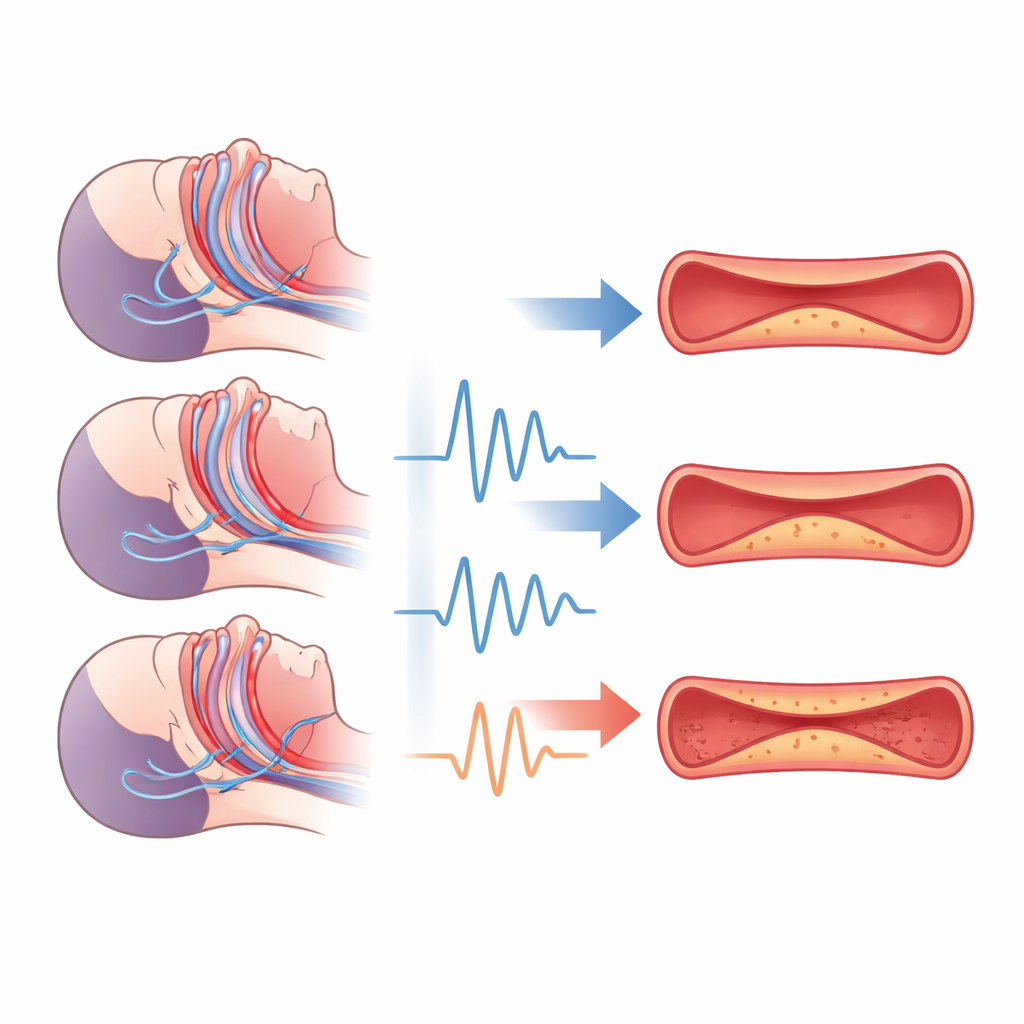
When the researchers grouped people by their average level of sleep apnea over many nights, they saw a clear stepwise pattern: those with mild, moderate, and severe apnea all had progressively higher pulse wave speeds than people without apnea. This pattern held even after accounting for age, sex, and body mass index. The link was particularly strong in younger and leaner participants, suggesting that disturbed sleep may speed up vascular aging most in people who would otherwise be considered relatively low risk.
Night-to-night ups and downs are a hidden danger
Beyond the average severity, how much apnea varied from night to night emerged as an important warning sign. People whose apnea swung widely between better and worse nights had stiffer arteries than those with more stable patterns, even when their overall average was similar. Strikingly, individuals with only mild apnea on average but very high nightly variability showed pulse wave speeds comparable to people with consistently severe apnea. Snoring told a similar story: spending a larger fraction of the night snoring was linked to stiffer arteries across all apnea categories. In fact, heavy snorers without apnea had vascular stiffness similar to people with severe apnea who barely snored.
What this means for everyday health
Taken together, the findings suggest that disturbed breathing during sleep—its severity, its nightly swings, and the burden of snoring—can all accelerate the aging of our arteries. Because these changes are thought to be at least partly reversible with treatments like continuous positive airway pressure, lifestyle improvements, and weight loss, identifying people at risk is crucial. This work shows that multi-night, at-home monitoring can reveal hidden patterns that a single sleep study might miss, opening the door to more personalized decisions about who should be evaluated, treated, and followed closely for cardiovascular risk.
Citation: Pinilla, L., Sansom, K., Letzelter, P. et al. Multi night digital assessment of sleep disordered breathing is associated with accelerated vascular aging. npj Digit. Med. 9, 286 (2026). https://doi.org/10.1038/s41746-026-02469-w
Keywords: sleep apnea, snoring, arterial stiffness, digital health, cardiovascular risk