Clear Sky Science · en
Derivation and validation of a machine learning-driven score to predict the diagnostic yield of endomyocardial biopsy
Why this matters for people with heart failure
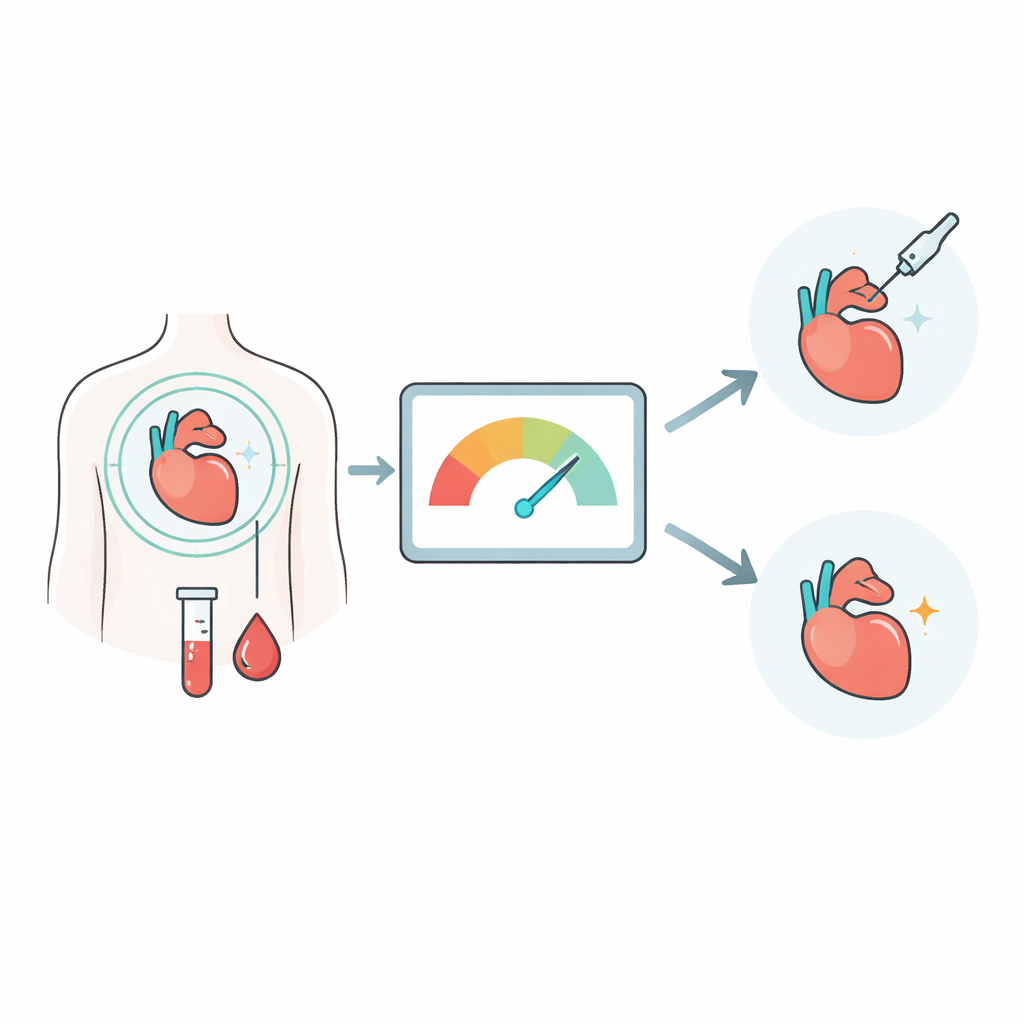
When doctors cannot figure out why someone has heart failure, they sometimes take tiny pieces of heart tissue with a procedure called a biopsy. This test can reveal hidden diseases that need special treatment, but it is invasive, carries some risk, and often fails to give a clear answer. This study asked a simple, patient-centered question: can information from scans and blood tests be combined into a smart score that tells doctors in advance whether a heart biopsy is likely to be truly helpful?
A closer look at a risky heart test
Endomyocardial biopsy, in which a small tool is threaded through a vein into the heart to pinch off tissue samples, has long been the final step when the cause of heart failure remains a mystery. Yet in everyday practice, most of these biopsies do not uncover a specific disease. In this study, researchers examined 775 people with heart failure of unknown cause treated at a Swedish hospital. All had undergone a biopsy as part of their work-up. Only about one in five biopsies (19.9%) delivered a definite diagnosis, most often a protein deposition disease called cardiac amyloidosis. A second, independent group of 171 patients from an Italian hospital was later used to test the reliability of the findings.
Turning scans and blood tests into a prediction score
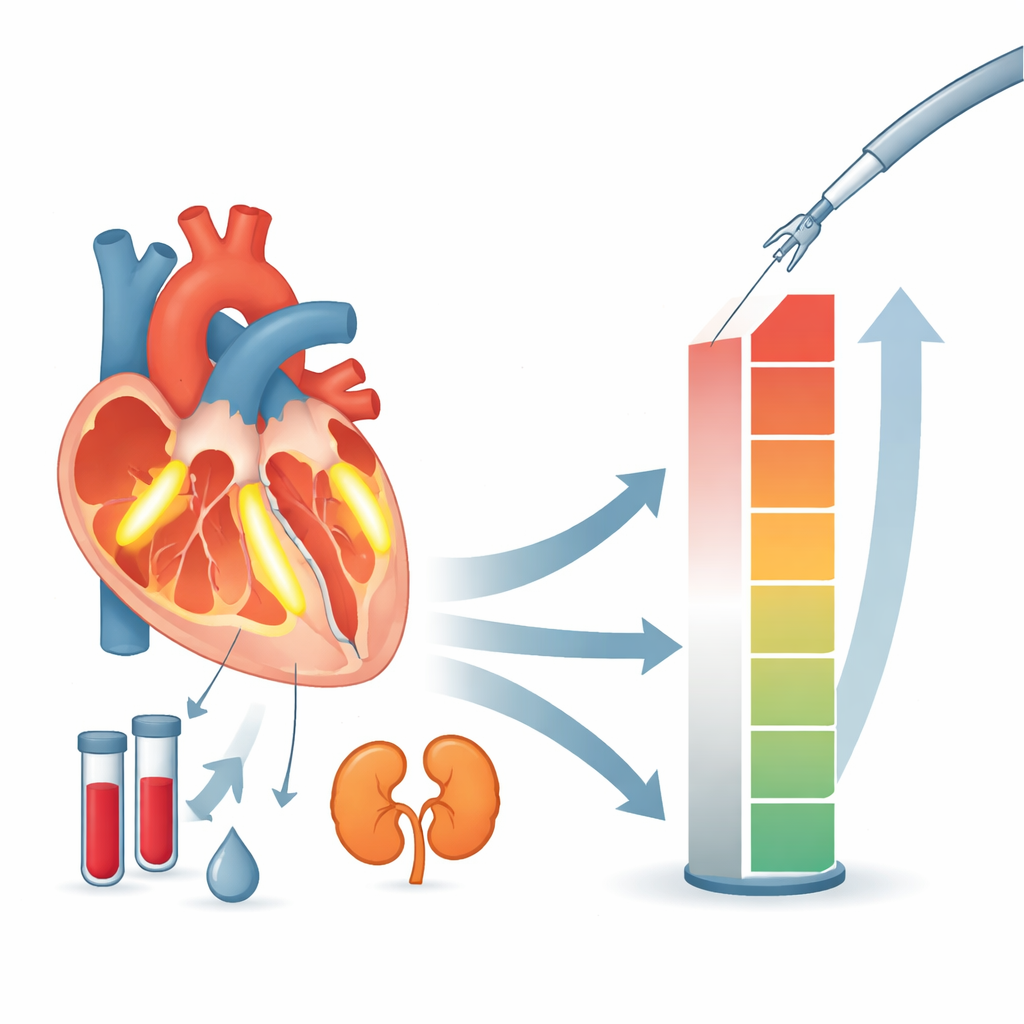
The team gathered a wide range of information routinely collected before biopsy: heart ultrasound, heart MRI scans, blood pressure, kidney function, heart rhythm strips, and blood markers of heart strain. They then compared several computer-learning methods to see which could best tell apart patients whose biopsy would be diagnostic from those whose biopsy would be inconclusive. A method called random forests performed best. From this, the researchers distilled a simple 0–100 score based on just nine factors, with particular weight given to scar-like patterns on heart MRI and two blood measures: a heart failure hormone (NT-proBNP) and kidney filtration rate.
What the heart scan reveals
The MRI feature that mattered most was "late gadolinium enhancement"—bright areas that mark diseased heart tissue—especially when seen in the right side of the heart, the lower and side walls of the main pumping chamber, and the upper heart chambers. People with these patterns, together with high NT-proBNP levels and poorer kidney function, were far more likely to have a biopsy that uncovered a specific disease. In contrast, bright areas limited to the front wall of the heart were linked to a lower chance of a meaningful biopsy. When the score was tested, it separated high-yield from low-yield biopsies very well: the measure of accuracy, called the area under the curve, was about 0.9 in both the original and external patient groups, which is considered excellent.
Helping decide who really needs a biopsy
To make the score useful at the bedside, the authors examined how different cut-off values would perform. A score of 60 or higher identified a smaller group of patients in whom the chance of a diagnostic biopsy was very high, with almost no false alarms in both hospitals. This threshold favors "ruling in" people for biopsy when the payoff is greatest, which is important because biopsies are invasive procedures. The score was especially strong in spotting cardiac amyloidosis, a condition that often shows widespread MRI changes and strikingly abnormal blood tests. Even when amyloidosis cases were removed, the score still provided a net benefit over simply biopsying everyone or no one, particularly for people with other suspected infiltrative or inflammatory heart diseases.
What this means for patients and doctors
For people living with puzzling heart failure, this work offers a way to make tough decisions about biopsy more evidence-based and less dependent on individual guesswork. By combining patterns from MRI scans and common blood tests into a clear 0–100 scale, the score helps identify who is most likely to benefit from having heart tissue sampled and who can probably be spared the risks and stress. The authors stress that the score should not replace clinical judgment or newer non-invasive tests, but rather act as a decision aid in borderline cases. In everyday practice, such a tool could reduce unnecessary procedures, focus biopsies where they are most informative, and ultimately speed up the path to the right diagnosis and treatment for patients with unexplained heart failure.
Citation: Basile, C., Polte, C.L., Gentile, P. et al. Derivation and validation of a machine learning-driven score to predict the diagnostic yield of endomyocardial biopsy. npj Digit. Med. 9, 228 (2026). https://doi.org/10.1038/s41746-026-02421-y
Keywords: heart failure, cardiac biopsy, cardiac MRI, machine learning, cardiac amyloidosis