Clear Sky Science · en
Ten-year population-based assessment of multimorbidity burden progression in a regional cohort of 5.5 million adults
Why many illnesses like to travel together
As people live longer, more of us are managing several long‑lasting illnesses at the same time—such as high blood pressure, diabetes, joint pain, and anxiety. Doctors call this multimorbidity. It strains patients, families, and health systems, yet care is still often organized one disease at a time. This study followed nearly all adults in Catalonia, Spain, for ten years to see how these combined health problems build up, who is most likely to move into a high‑risk group, and how we might act earlier to prevent worsening health.

A decade‑long look at real‑world health
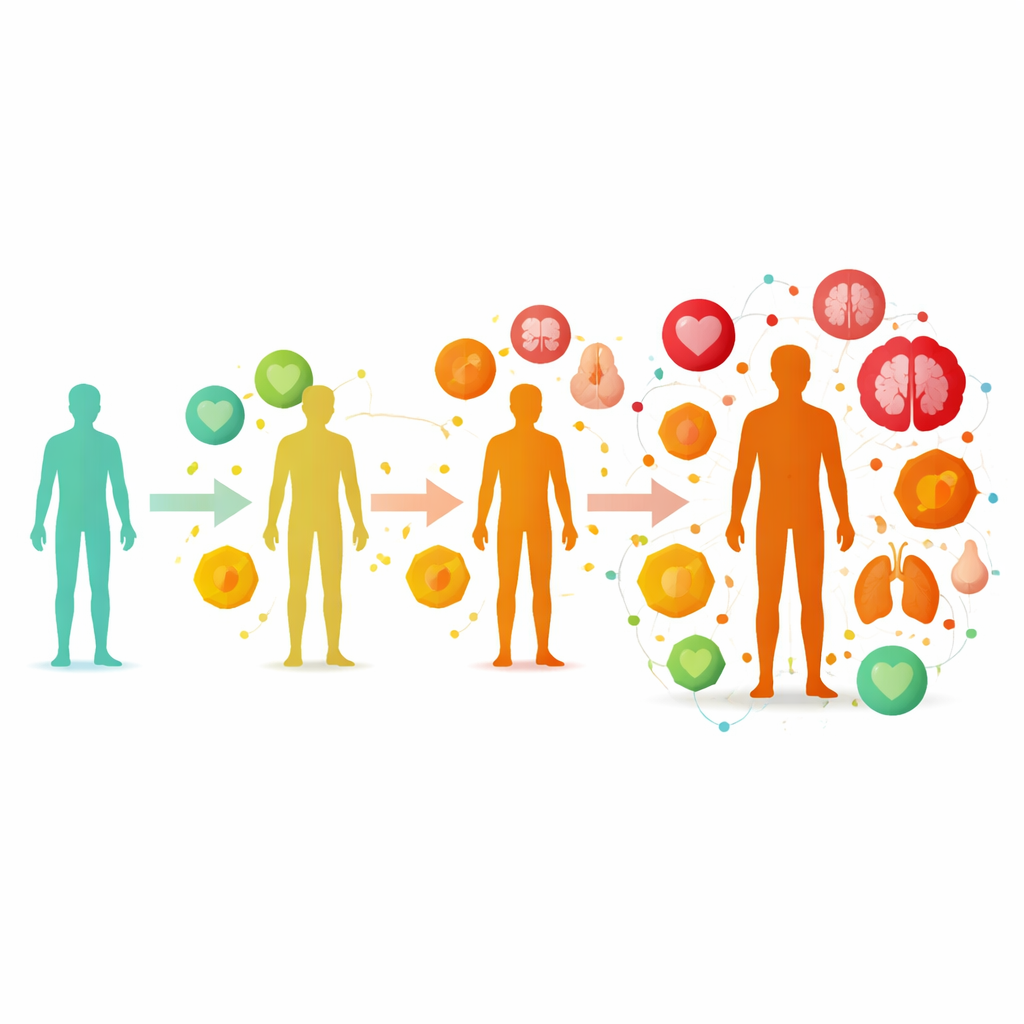
The researchers used electronic health records from 5.5 million adults who were alive at the end of a ten‑year period starting in 2013. Every hospital stay, clinic visit, and diagnosis fed into a tool called the Adjusted Morbidity Groups (AMG) index, which summarizes a person’s overall illness burden rather than focusing on single diseases. People were sorted into four risk levels, from low to very high. Over the decade, the typical number of chronic conditions per person rose from one to three, and almost 40% of adults moved into a higher‑risk group, with about 16% crossing into the high or very‑high risk range.
Which problems show up first
By the end of the study, the most common conditions were nutritional and hormone‑related problems such as obesity and high blood lipids, anxiety disorders, and high blood pressure. New mental health problems appeared most often in young adults and tapered off with age, while heart and blood vessel diseases grew more frequent later in life, especially in men. Women had more joint and muscle problems and genitourinary issues across the life span. Among the conditions that most often accompanied a jump into the high‑risk group were chronic kidney disease, high blood pressure, and osteoarthritis, suggesting these are key warning signs of mounting complexity.
Predicting who is likely to get worse
The team tested several machine‑learning models to predict who would move from low or moderate risk into high risk over ten years. They compared simple models using only age and sex with richer models that also included the AMG score over time, how many chronic diseases a person had, and when those diseases were first diagnosed. Models that used this fuller picture clearly outperformed those based only on basic demographics. In every approach, the single strongest predictor of future deterioration was not any particular disease but the overall illness burden measured by the AMG index. Adding long lists of individual diagnoses provided little extra benefit beyond this summary measure.
How illnesses cluster and build on each other
To understand how conditions tend to appear together, the researchers built networks that tracked which diagnoses usually followed others, and whether they tended to arise before or after a person entered the high‑risk group. They found over 16,000 possible pairs of conditions, but only a small fraction were common. Obesity and related metabolic problems frequently came before high blood pressure, type 2 diabetes, joint disease, and several mental health disorders. Anxiety disorders, often preceded by tobacco and other substance use, linked to a wide range of physical and brain‑related problems and typically appeared before people became high‑risk, marking them as early alarms. In contrast, high blood pressure was more often tied to conditions that emerged after someone was already high‑risk, such as chronic kidney disease and further heart and circulatory problems.
What this means for patients and health systems
Altogether, the study shows that the total weight of a person’s health problems—and the way new conditions accumulate over time—is more important than any single diagnosis in predicting serious future illness. Because the AMG score and disease histories can be calculated automatically from routine records, health systems can use them to spot people whose health is likely to worsen years in advance, without extra tests or paperwork. This opens the door to earlier, more coordinated care that tackles clusters of conditions together, especially mental health, obesity, and blood‑pressure‑related problems, instead of treating each disease in isolation. For patients, it suggests that managing seemingly “mild” issues like anxiety or weight gain today may help prevent a cascade of serious, interconnected illnesses tomorrow.
Citation: Valero-Bover, D., Monterde, D., Carot-Sans, G. et al. Ten-year population-based assessment of multimorbidity burden progression in a regional cohort of 5.5 million adults. npj Digit. Med. 9, 200 (2026). https://doi.org/10.1038/s41746-026-02395-x
Keywords: multimorbidity, chronic disease, risk prediction, population health, electronic health records