Clear Sky Science · en
Adaptive physiology-informed correction for reliable remote photoplethysmography heart-rate monitoring
Checking Your Pulse Without Touch
Imagine your phone quietly tracking your pulse while you chat on a video call or sit in a waiting room—no wires, no chest straps, no finger clips. That vision is close to reality thanks to cameras that can read tiny color changes in your face linked to blood flow. But these contactless heart-rate readings are still easily thrown off by movement and bad lighting. This study introduces a clever, low-cost software add-on that makes camera-based heart-rate monitoring far more reliable, even on simple devices like wearables or home health gadgets.
Why Watching the Face Can Reveal the Heart
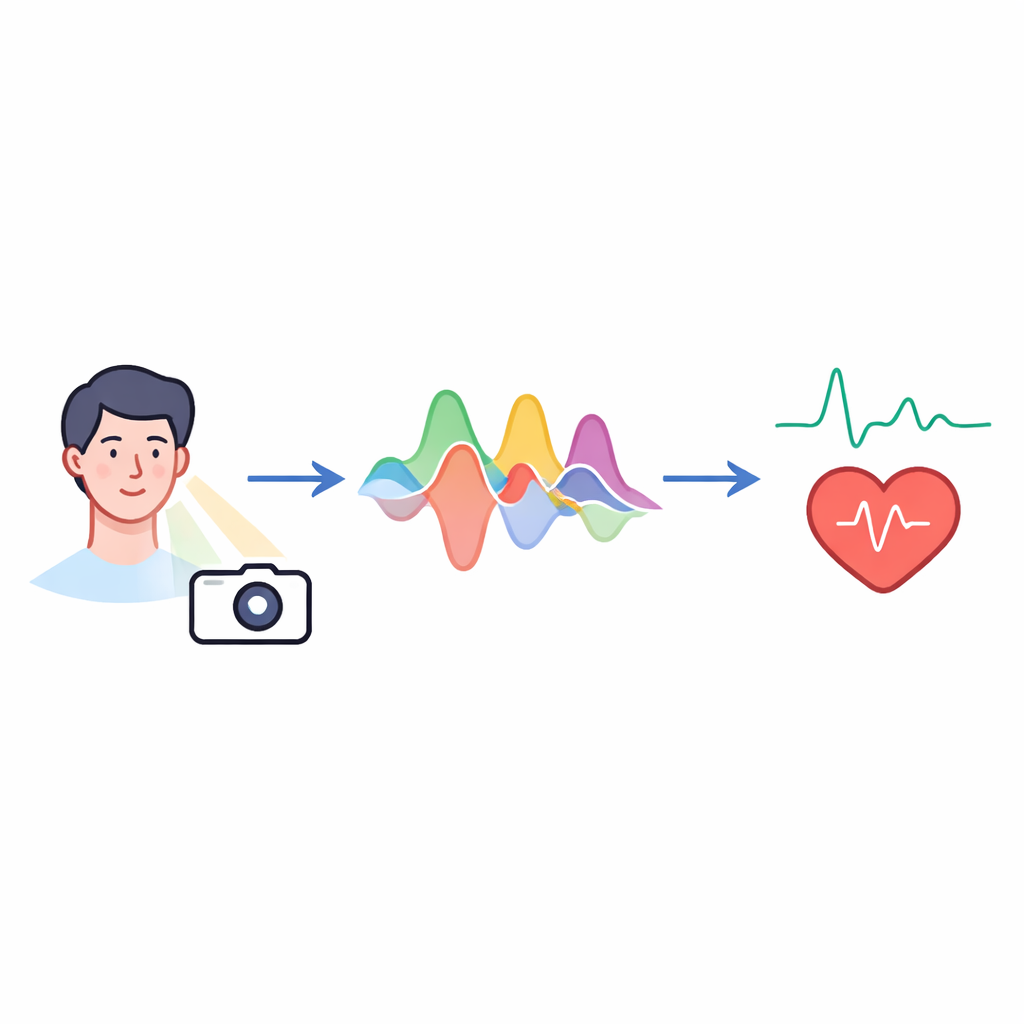
Heart rate is a key vital sign that reflects not only heart and blood vessel health, but also fitness level and mental stress. Traditionally, doctors rely on electrocardiograms and fingertip or wrist sensors that shine light into the skin to measure blood pulses. These contact devices work well but can be uncomfortable, hard to use during sleep or surgery, and inconvenient for continuous monitoring. Remote photoplethysmography, or rPPG, takes a different approach: it uses an ordinary camera to film the face and then software teases out the subtle color shifts caused by each heartbeat. Because most people already have cameras in phones, laptops, and hospital rooms, rPPG could make heart-rate tracking much more accessible.
The Trouble With Motion and Shadows
In practice, rPPG signals are messy. Turning your head, talking, or exercising adds motion; dim or changing lighting alters what the camera sees. These factors create false peaks in the frequency patterns that algorithms use to estimate heart rate, leading to jumps or drops that do not match the real pulse. Past research has focused on cleaning up the raw signal or using heavy machine-learning models, sometimes requiring extra sensors like accelerometers. These methods can be accurate in the lab but often demand powerful processors, careful tuning, or cloud processing—barriers for small, privacy-sensitive devices working at the edge.
Using How the Heart Behaves as a Guide
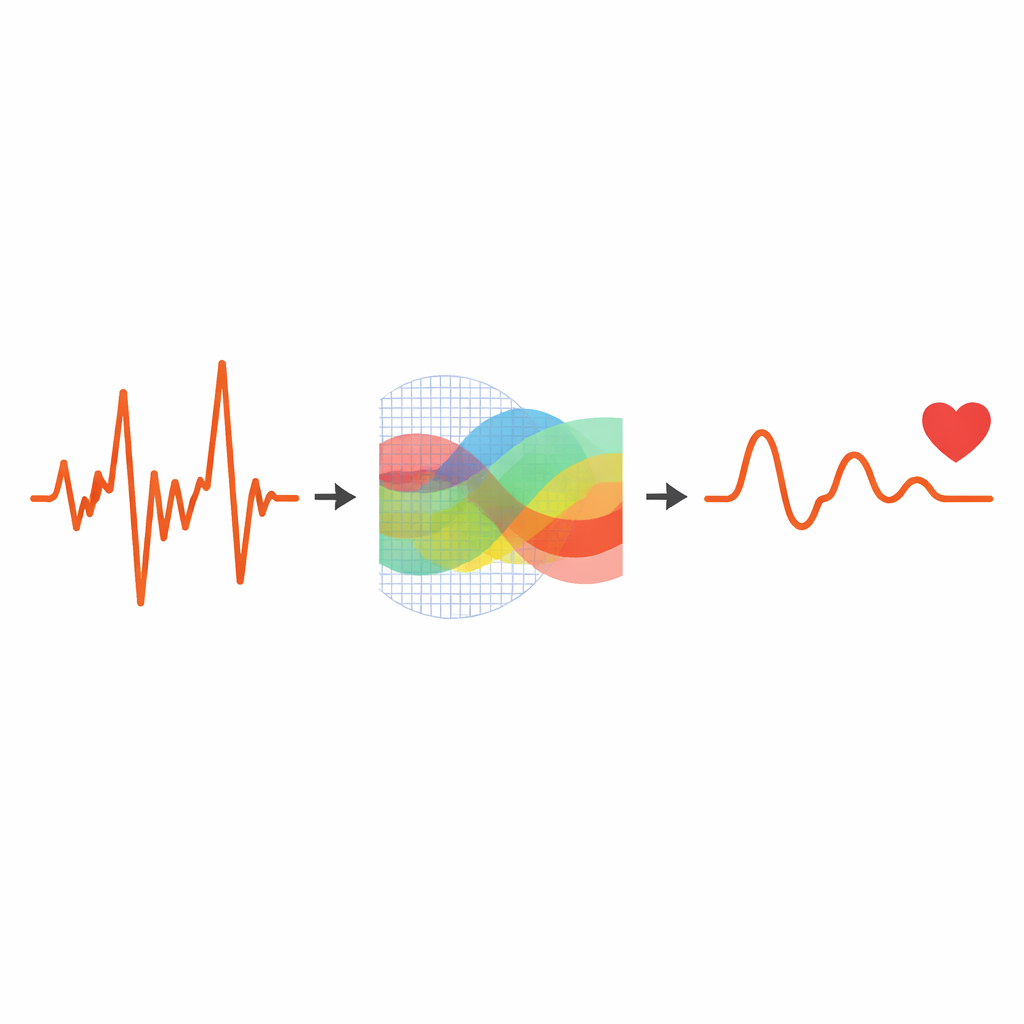
The authors take a different tack: instead of only polishing the camera signal, they correct the heart-rate estimates after the fact using simple rules based on how real hearts change over time. Medical and sports studies show that a healthy heart does not jump dozens of beats per minute from one second to the next. When people speed up or slow down, heart rate tends to rise and fall within known limits. The new algorithm watches the sequence of estimated heart rates and compares each new value to recent ones. If a sudden spike or plunge would require the heart to change faster than physiology allows, the software temporarily rejects that value and keeps the last trustworthy estimate, only accepting new values once a consistent trend appears.
Putting the Algorithm to the Test
To see how well this idea works, the team tested it on three public datasets that represent tough real-world conditions. One set involved people moving, rotating their heads, talking, or exercising. Another was recorded in very low light, and a third captured nearly ideal, steady indoor scenes. In each case, heart rate was first estimated using several common rPPG methods, then refined with different correction techniques. Across all datasets, the physiology-informed algorithm sharply increased the share of measurements meeting consumer device standards. For a challenging movement dataset, accurate readings (within 10 beats per minute of the true value) jumped from about 46% to over 84%; in low light, they rose from roughly 48% to 69%. Even in easier conditions, the method nudged performance upward. At the same time, the algorithm ran extremely fast and fit on a tiny Arduino microcontroller, while some competing methods were too heavy to deploy.
What This Means for Everyday Health Tech
By teaching software to respect how the human heart naturally speeds up and slows down, this work shows that simple rules can rescue many bad camera-based readings without extra sensors or powerful chips. The algorithm slots in as a plug-and-play step after existing rPPG methods, filtering out obviously implausible values and stabilizing the heart-rate trace. While the authors note limits—such as a brief warm-up period and potential issues for people with irregular heart rhythms—the approach points to more trustworthy, low-cost, and privacy-friendly heart monitoring from a distance. In the near future, such correction tools could help bring reliable contactless pulse checks to cars, hospital beds, fitness gear, and telemedicine platforms.
Citation: Tian, Y., Li, S., Zhu, Y. et al. Adaptive physiology-informed correction for reliable remote photoplethysmography heart-rate monitoring. npj Digit. Med. 9, 233 (2026). https://doi.org/10.1038/s41746-026-02386-y
Keywords: remote photoplethysmography, contactless heart rate, digital health, wearable sensing, telemedicine