Clear Sky Science · en
AI-driven low-cost rehabilitation exergame as a lightweight framework for stroke assessment
Turning Play into Everyday Recovery
Stroke often steals the easy, automatic movements we rely on to eat, dress, or hug someone. Regaining those skills usually means years of repetitive therapy and regular checkups with specialists—time and money many people simply do not have. This study explores a different route: a simple video game that lets stroke survivors exercise their arms at home while an ordinary camera quietly measures how well they are moving, estimating the same clinical scores therapists use in the clinic.
A Game that Doubles as a Checkup
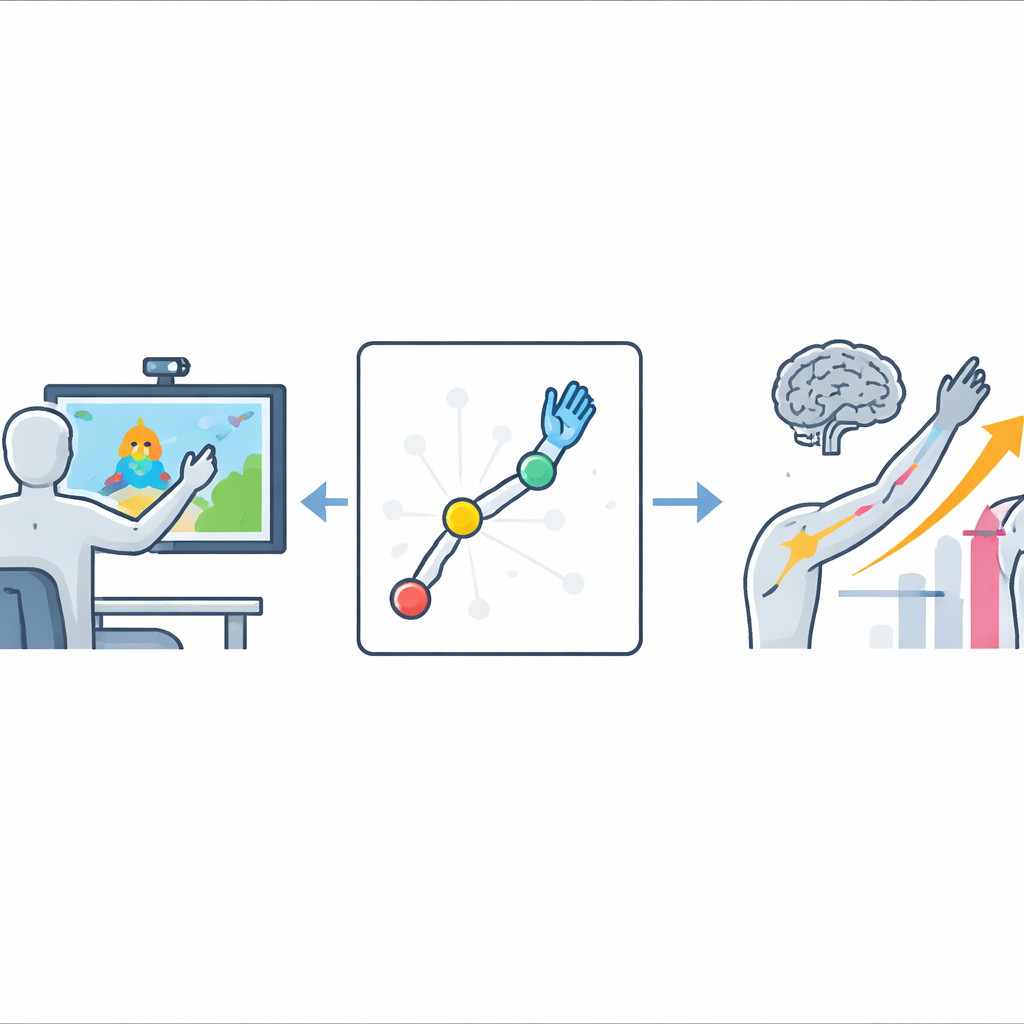
The researchers built an "exergame"—a video game designed for exercise—where players guide a bird across a colorful landscape to collect fruit. The player moves only their arm and hand; a standard camera tracks those movements and steers the bird in real time. Behind the scenes, artificial intelligence software from Google’s MediaPipe toolkit follows the position of the wrist, elbow, shoulder, and fingers frame by frame, without any special sensors or wearable devices. The same session that entertains and motivates the player also becomes a detailed record of how far the arm reaches, how smoothly it moves, and how much the hand can open.
Simple Motion Clues that Reveal Ability
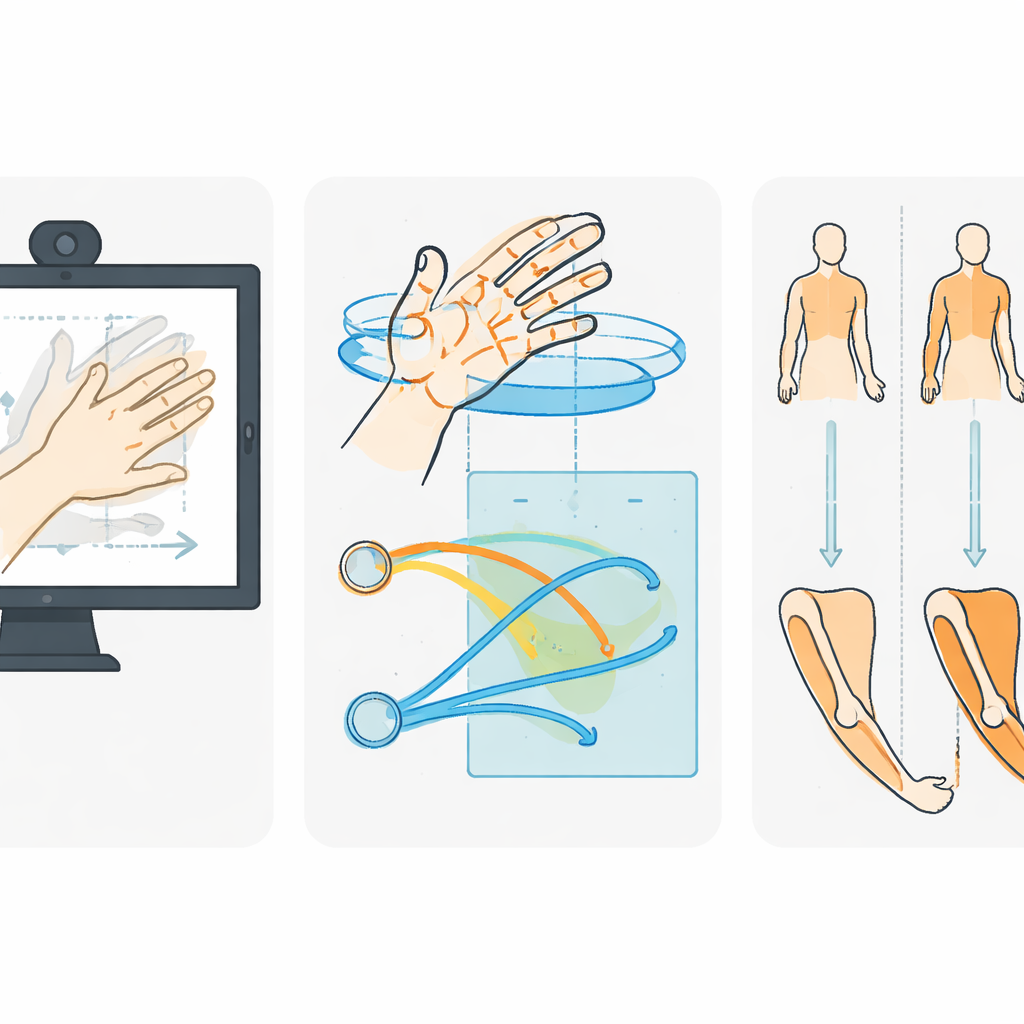
Twelve adults living with long-term effects of stroke played the game with both arms, giving the team 24 sets of arm data. Each arm was also examined using the Fugl–Meyer Assessment, a widely used but time-consuming clinical scale of upper-limb function. From the game recordings, the researchers pulled out sixteen straightforward measurements, such as the area covered by the wrist on the screen, the total distance the hand traveled, how widely the fingers could open, and how well the shoulder and elbow moved together. When they grouped the arms into severe, moderate, mild, and nearly normal function, several of these game-based measures lined up neatly with the clinical categories: people with better arm use explored a larger area, coordinated their joints more fluidly, and showed greater ability to open the hand.
From Movements to a Meaningful Score
Next, the team asked whether these motion clues could stand in for a formal exam score. Using linear regression—a transparent kind of statistical equation—they combined a small set of features, including hand opening, the space explored on the screen, overall path length, and joint coordination. The resulting formula predicted each arm’s clinical score with high accuracy, closely matching therapists’ ratings (a rank correlation of 0.92 and an error of about 4 points on a 66-point scale). When the researchers translated the predicted scores into the familiar categories of mild, moderate, and severe impairment, the system correctly classified arms 86–93% of the time, and any mistakes occurred only between neighboring categories, not between extremes.
Why Light-Touch AI Can Be Better
To test whether heavier technology would help, the authors also tried more complex machine-learning models, including random forests and deep neural networks that learn directly from raw motion data. Despite their sophistication, these approaches did not beat the simple regression formula and were harder to interpret and run in real time on a typical mobile device. In contrast, the lightweight model uses just a handful of clearly understandable motion features, can work on the same device that runs the game, and requires nothing more than a built-in camera. That makes it well suited for home use, remote monitoring, and busy clinics where therapists cannot spend half an hour on formal testing every visit.
What This Could Mean for Life After Stroke
For stroke survivors, this framework hints at a future where everyday rehab sessions double as checkups, turning enjoyable play into continuous, low-effort tracking of recovery. The study is still a proof of concept, built on a small group of volunteers, and the authors plan larger trials to confirm and refine their approach. Yet the message is clear: by combining an engaging game with affordable camera-based tracking and a clear, modest AI model, it may be possible to deliver frequent, objective assessments at home—supporting more personalized therapy while easing the workload on already stretched rehabilitation services.
Citation: Tannús, J., Valentini, C. & Naves, E. AI-driven low-cost rehabilitation exergame as a lightweight framework for stroke assessment. npj Digit. Med. 9, 196 (2026). https://doi.org/10.1038/s41746-026-02383-1
Keywords: stroke rehabilitation, exergames, digital biomarkers, telerehabilitation, AI motion tracking