Clear Sky Science · en
Validating an adaptive digital assessment of youth mental health needs: a cross-sectional study
Why faster mental health checks matter
For many young people, reaching out for mental health help is hard enough without being handed a long, repetitive survey. Yet these questionnaires are often the main way services decide who needs urgent help, ongoing therapy, or support with work, study, or substance use. This study asks a simple question with big consequences: can a smart, digital assessment quickly capture the full picture of a young person’s mental health needs without exhausting them in the process?
A smarter way to ask questions
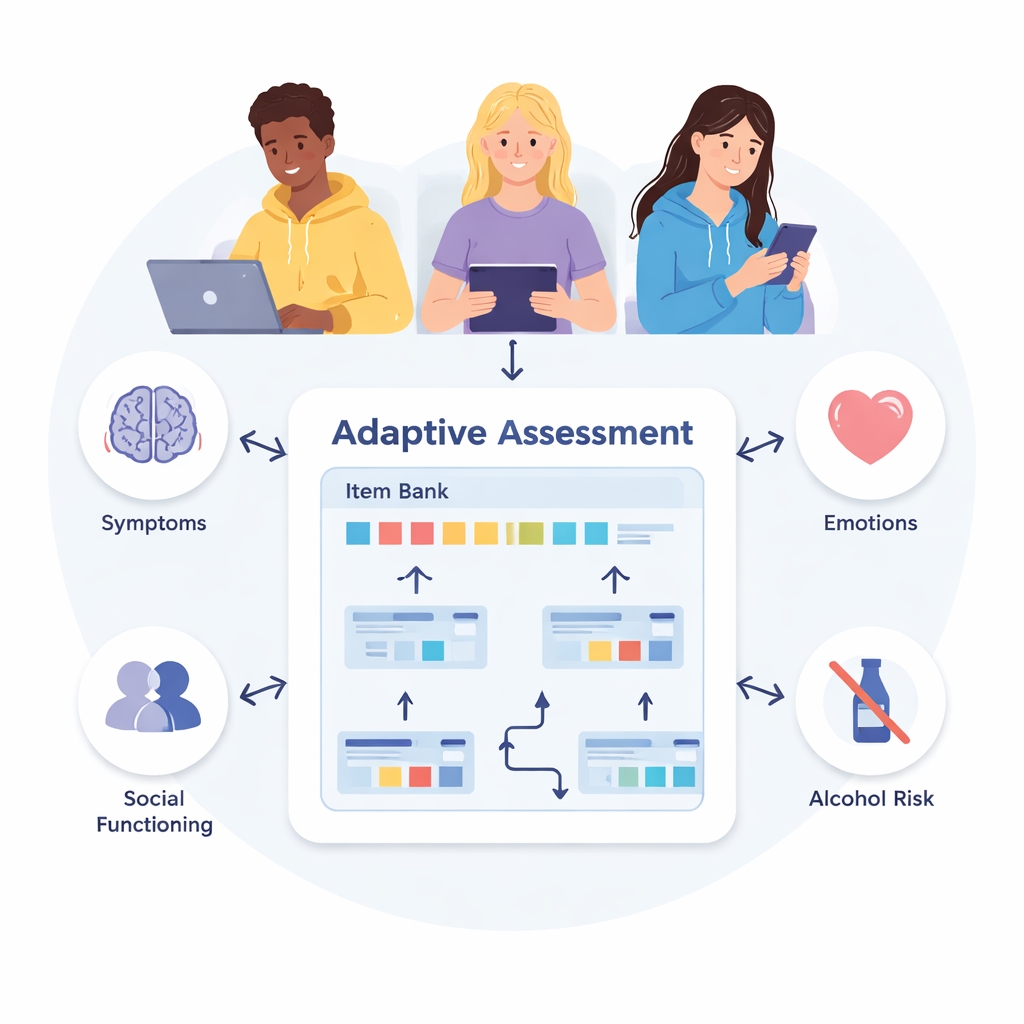
The researchers worked with 1,734 young people aged 12 to 25 who were already receiving care at Australian mental health services. Instead of inventing new tests, they started from seven widely used questionnaires that cover psychological distress, anxiety, unusual experiences like hallucinations, mood swings, suicidal thoughts, alcohol use, and day-to-day functioning. Together, these add up to 49 questions—enough to feel long and repetitive for someone already under stress. The team built a digital system that could predict each person’s full scores on all seven questionnaires by asking only a tailored subset of the original items.
How an adaptive test learns from your answers
The heart of the system is a multidimensional computerized adaptive test, or MCAT. Instead of giving everyone the same fixed battery, the MCAT starts with a highly informative question, such as whether the person has had suicidal thoughts. Based on the answer, the program updates its estimate of that person’s overall mental health profile and chooses the next question that will add the most useful information. This process repeats, with each response shaping the next question. The test stops when the system has become confident enough about the young person’s likely scores across all seven domains, or when it reaches an upper limit on the number of questions.
Big cuts in time, small loss in precision
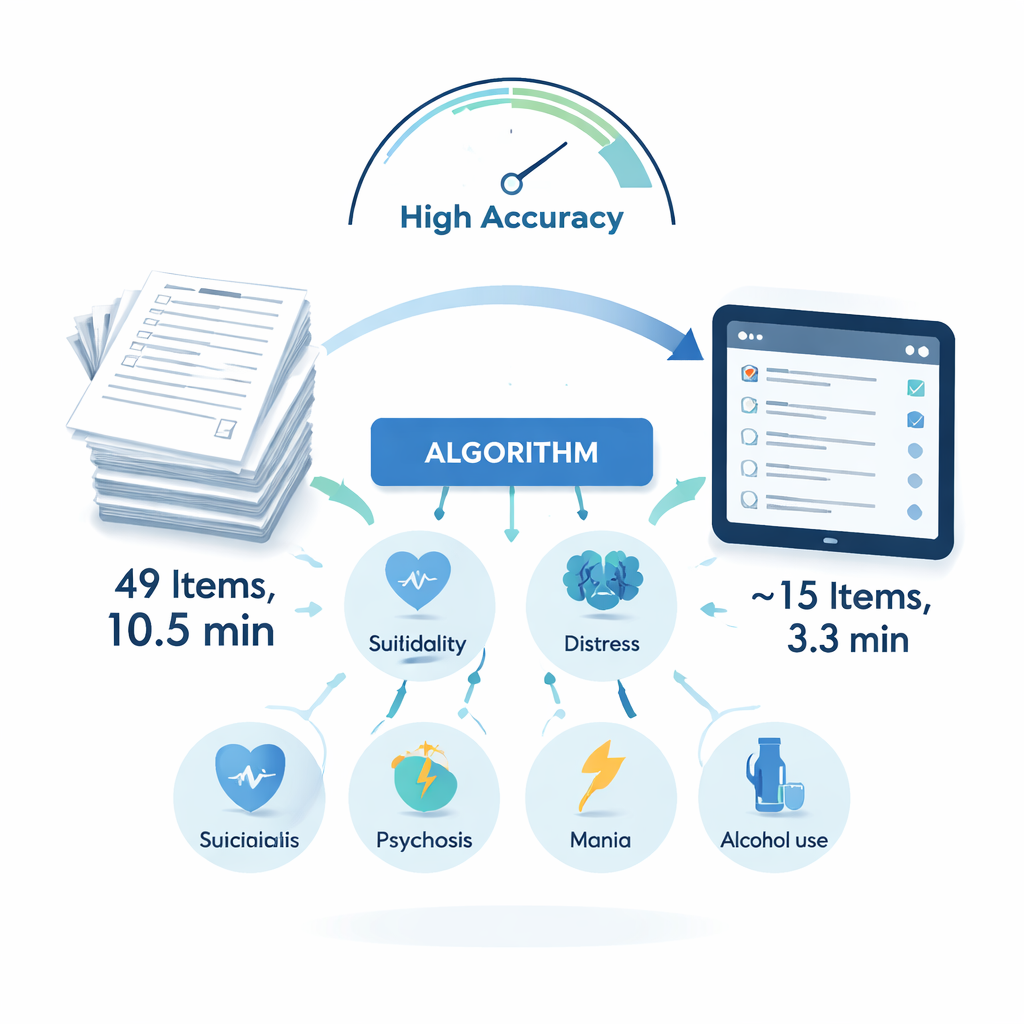
To see how well this approach works, the authors ran extensive computer simulations, repeatedly training the model on part of the sample and testing it on the rest. Using what they judged to be the best balance of speed and accuracy, the adaptive test needed on average just over 15 questions instead of 49—a 69% reduction. Estimated completion time fell from about 10 and a half minutes to just over 3 minutes. Despite using far fewer questions, the short test’s predicted scores closely matched the original full-length scores, especially for suicidal thoughts, anxiety, and alcohol use, where agreement was rated as excellent. Distress, everyday functioning, and unusual experiences like psychosis and mania were slightly less precise, but still in the “good” range for clinical decision-making.
Spotting complex or atypical cases
Interestingly, around one in ten young people hit the maximum of 25 questions before the test was confident in its estimates. Rather than seeing this as a failure, the researchers argue these cases may flag more complex or unusual patterns of symptoms that deserve extra attention. In practice, services could use this signal to direct those young people to a full clinical interview, longer questionnaires, or more specialized assessment. The adaptive system, in other words, would not replace human judgment but help identify who needs it most urgently.
Building better digital front doors
The study suggests that adaptive digital assessments could become powerful “front doors” to youth mental health care. A short, personalized questionnaire that still reproduces the information from standard tools could be used online before appointments, in clinics, or as part of ongoing monitoring to track how someone is responding to treatment. The authors also point to future possibilities, such as combining this kind of testing with artificial intelligence methods or large language models that can ask follow-up questions in natural language. For young people and services alike, the conclusion is straightforward: it is possible to get a rich, multi-layered view of mental health needs in just a few minutes, lowering the burden of assessment while improving the chances of being matched to the right kind of help.
Citation: Capon, W., Hickie, I.B., Varidel, M. et al. Validating an adaptive digital assessment of youth mental health needs: a cross-sectional study. npj Digit. Med. 9, 173 (2026). https://doi.org/10.1038/s41746-026-02374-2
Keywords: youth mental health, digital assessment, computerized adaptive testing, suicide risk screening, measurement-based care