Clear Sky Science · en
Context-dependent placebo hypoalgesia through observational learning: the role of empathy in immersive and non-immersive environments
Why watching pain in VR might change how we feel
People increasingly use virtual reality (VR) not just for games, but also to manage pain and support mental health. This study asks a deceptively simple question with big implications: if you watch someone else experience relief from pain—either in immersive VR or on a regular screen—does that change how much pain you later feel yourself? And does it matter whether you are watching a real person or a computer-generated avatar?
Learning from others’ pain and relief
Humans constantly learn from watching each other. This includes how we respond to pain and to treatments. When we see someone benefit from a cream or pill, our own expectations can make the same treatment feel more effective—a placebo response learned socially rather than through our own past experience. The researchers built on this idea by testing whether such “observed” pain relief works differently in immersive VR versus standard 2D video, and whether viewers respond more strongly to a real human demonstrator than to a lifelike avatar showing the same scene.
Inside the two-step experiment
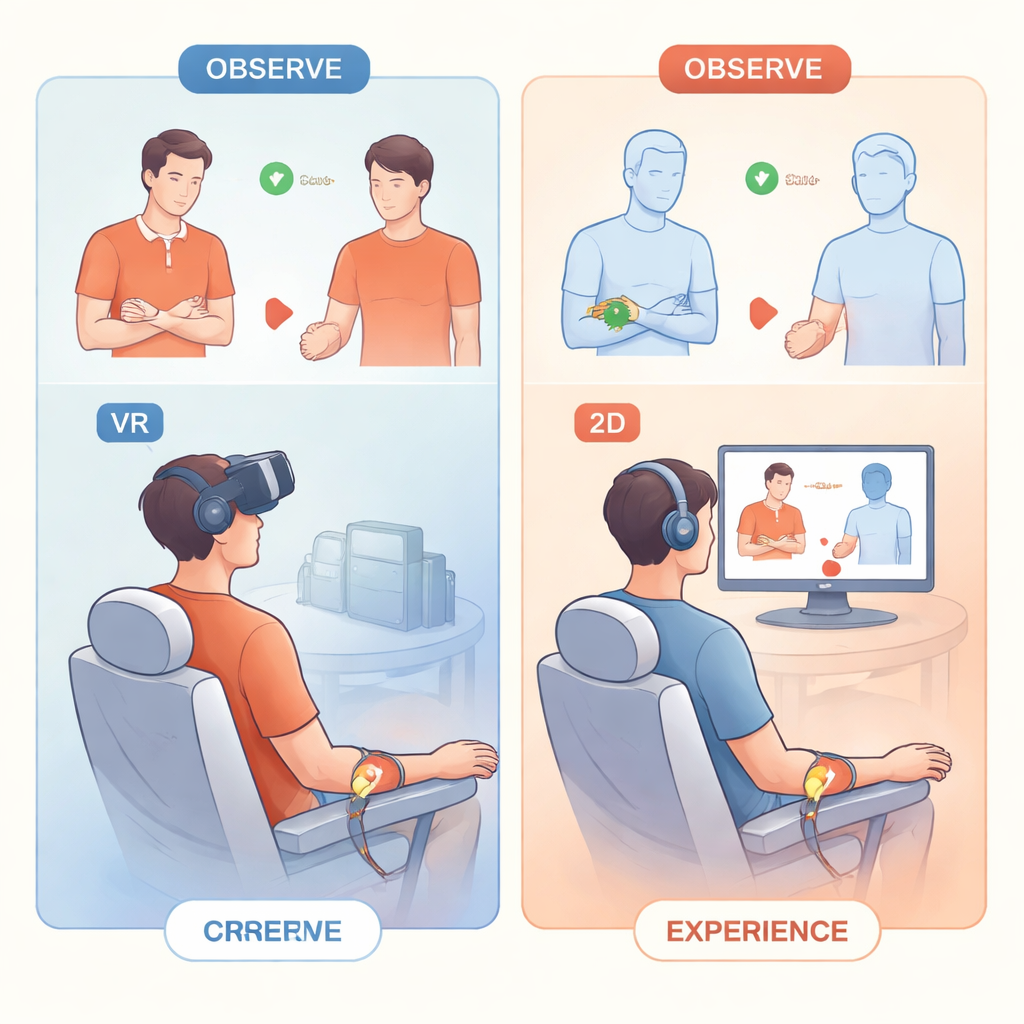
Forty-seven healthy adults took part in a two-phase experiment, repeated under four conditions: VR with a human demonstrator, VR with an avatar, 2D video with a human, and 2D video with an avatar. In the first phase, participants watched a demonstrator receive heat pain on the forearm after two different colored creams were applied. One color was paired with higher pain ratings on a visual scale (the “no treatment” cue), and the other with lower ratings (the “pain relief” cue)—even though both creams were actually the same. After each observation block, participants rated how much they thought the demonstrator hurt (a thinking, or "cognitive," empathy measure) and how much they themselves felt bothered when imagining being in that situation (a feeling, or "affective," empathy measure).
Feeling your own pain after watching others
In the second phase, the volunteers received the same kind of heat stimulation on their own forearms, again paired with the two colored creams. This time, their pain intensity and unpleasantness were measured directly. Across conditions, people reported less pain when the stimulus was paired with the color they had seen as “pain relieving” during the observation phase. This confirmed that simply watching someone else appear to get relief can produce real, if modest, reductions in pain—an observationally learned placebo effect.
Human faces, digital worlds, and empathy
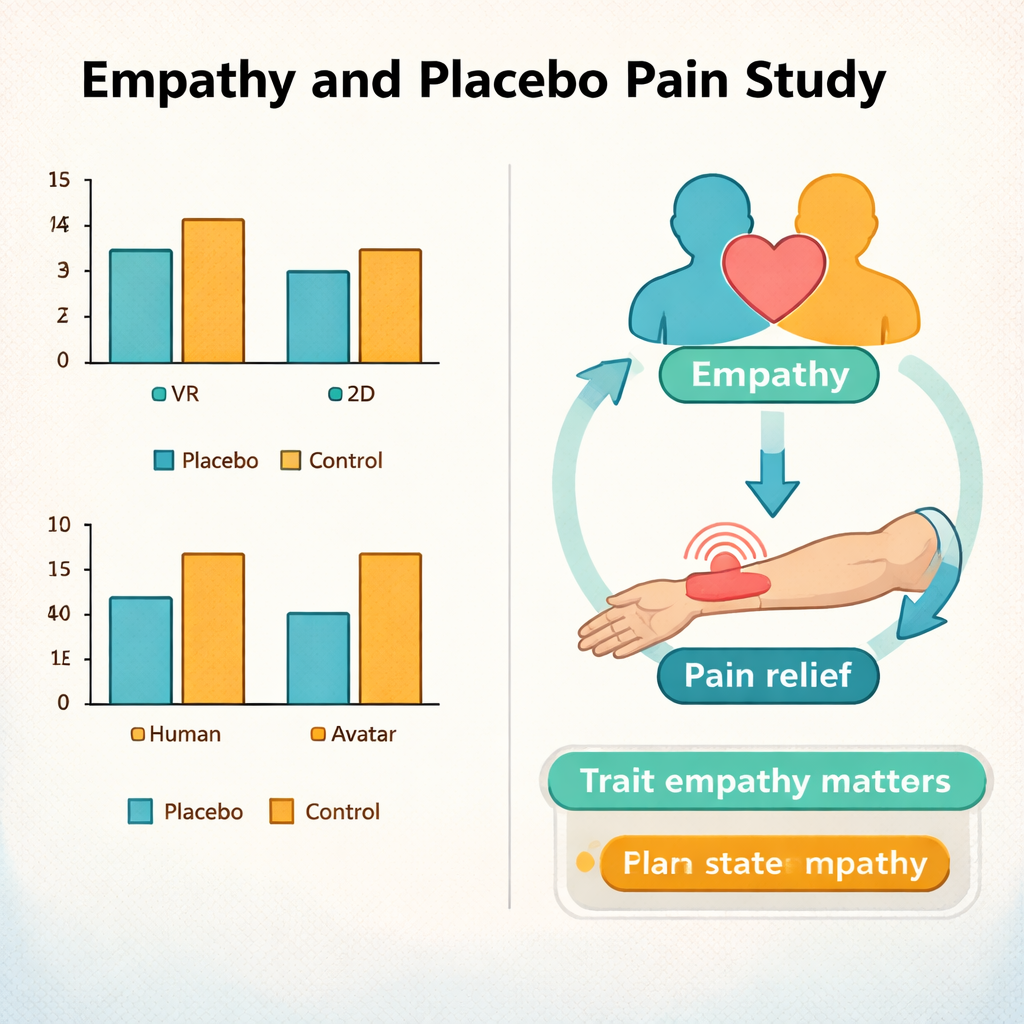
The study revealed a more nuanced story when teasing apart empathy, technology, and who was being watched. Overall, observers showed more “thinking” empathy for a real human than for an avatar, regardless of whether the scene appeared in VR or on a flat screen. Interestingly, whenever the demonstrator seemed to benefit from a treatment, viewers’ empathy—both thinking and feeling—actually went down, perhaps because the person appeared to suffer less. Contrary to expectations, immersive VR did not increase state empathy compared with 2D video. Yet the combination of context and demonstrator mattered for pain relief: in 2D, watching a human produced stronger placebo effects than watching an avatar, whereas in VR, the avatar led to greater pain reduction than the human. In addition, people with higher stable, long-term empathy traits showed larger placebo effects in the VR–human condition, even though brief, moment-to-moment empathy during the task did not explain these effects.
What this means for future digital pain tools
For non-specialists, the takeaway is that seeing others respond well to a treatment can genuinely shape how our own body feels pain, and this social learning also works in digital environments. But the details matter: an avatar might be more effective in a fully virtual world, while a real person works better on a standard screen. Surprisingly, the study suggests that deep-seated, trait-like empathy may matter more than immediate emotional reactions in the moment. These findings can guide designers of future VR and digital health tools: by matching the type of demonstrator to the viewing context, they may harness modest but meaningful placebo pain relief without relying on drugs.
Citation: White, J.N., Watson, L., Wang, Y. et al. Context-dependent placebo hypoalgesia through observational learning: the role of empathy in immersive and non-immersive environments. npj Digit. Med. 9, 192 (2026). https://doi.org/10.1038/s41746-026-02373-3
Keywords: virtual reality pain, placebo effect, empathy, observational learning, digital therapeutics