Clear Sky Science · en
Predicting individual differences in digital alcohol intervention effectiveness through multimodal data
Why Your Friends’ Drinking Habits Matter
Many young adults want to cut back on drinking but may not have the time or money for in‑person counseling. Smartphone programs that send short, psychology-based reminders offer a convenient alternative. Yet these digital tools don’t work equally well for everyone. This study asked a timely question: can we predict, in advance, who is most likely to benefit from a digital alcohol intervention, using information about people’s feelings, brains, friendships, and—most importantly—their perceptions of how much their friends drink?
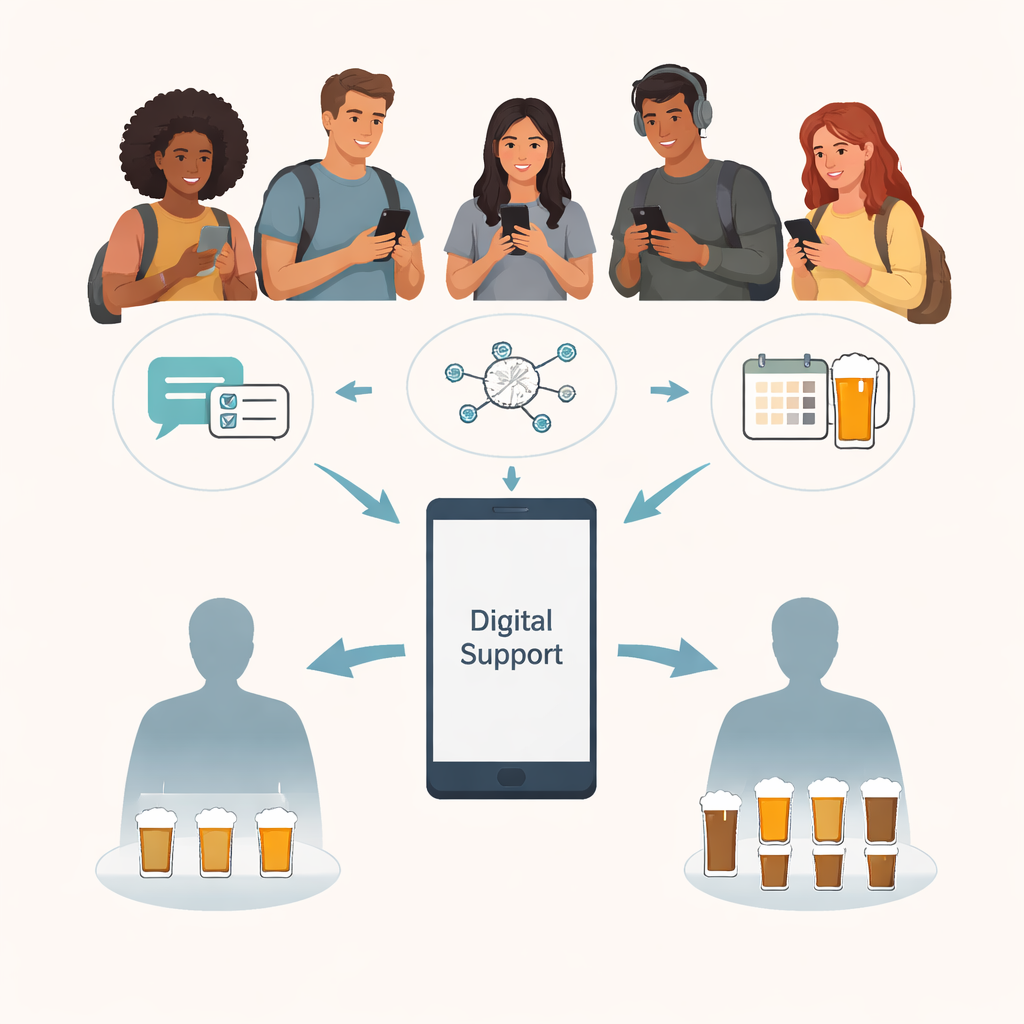
Smartphones as Pocket Coaches
The researchers worked with college students who were social drinkers at two U.S. universities. For 28 days, students received text messages twice a day teaching “psychological distancing.” Some messages coached mindfulness—notice your thoughts and cravings without acting on them. Others prompted perspective‑taking—imagine how a friend who drinks very little would think and feel in this situation. During “active” weeks, students got these distancing reminders; during “inactive” weeks, they only reported their drinking and were told to react naturally. This on‑off design let researchers see whether people actually drank less when the digital coaching was turned on.
Many Kinds of Data, One Key Question
Before the intervention started, students completed extensive assessments. They answered questions about their own drinking habits and motives, their moods and personality, and how strongly they felt pressured by peers. They mapped their social networks, indicating who in their campus group drank the most or had high social influence. Some also had brain scans while viewing alcohol-related and social images. The team fed all of these “multimodal” data—psychological, social, neural, and demographic—into several machine‑learning models. The goal was to see whether a computer could learn to sort students into “responders,” who reduced weekly drinking occasions by more than one, and “non‑responders,” who did not.
What You Think Your Friends Drink Predicts Change
Surprisingly, the most powerful predictors were not brain scans or detailed personality tests, but just five questions about perceived peer drinking. Students rated how often and how much the heaviest drinkers in their group consumed alcohol, and how approving their group seemed of drinking and binge drinking. Using this small set of answers alone, a random forest model correctly distinguished responders from non‑responders about 71% of the time in the first student sample—meeting or exceeding thresholds that previous digital health studies consider useful for guiding care. When the same model was tested on a second, independent sample, it still performed at a similar level, suggesting the results were not a fluke of one group or time period.
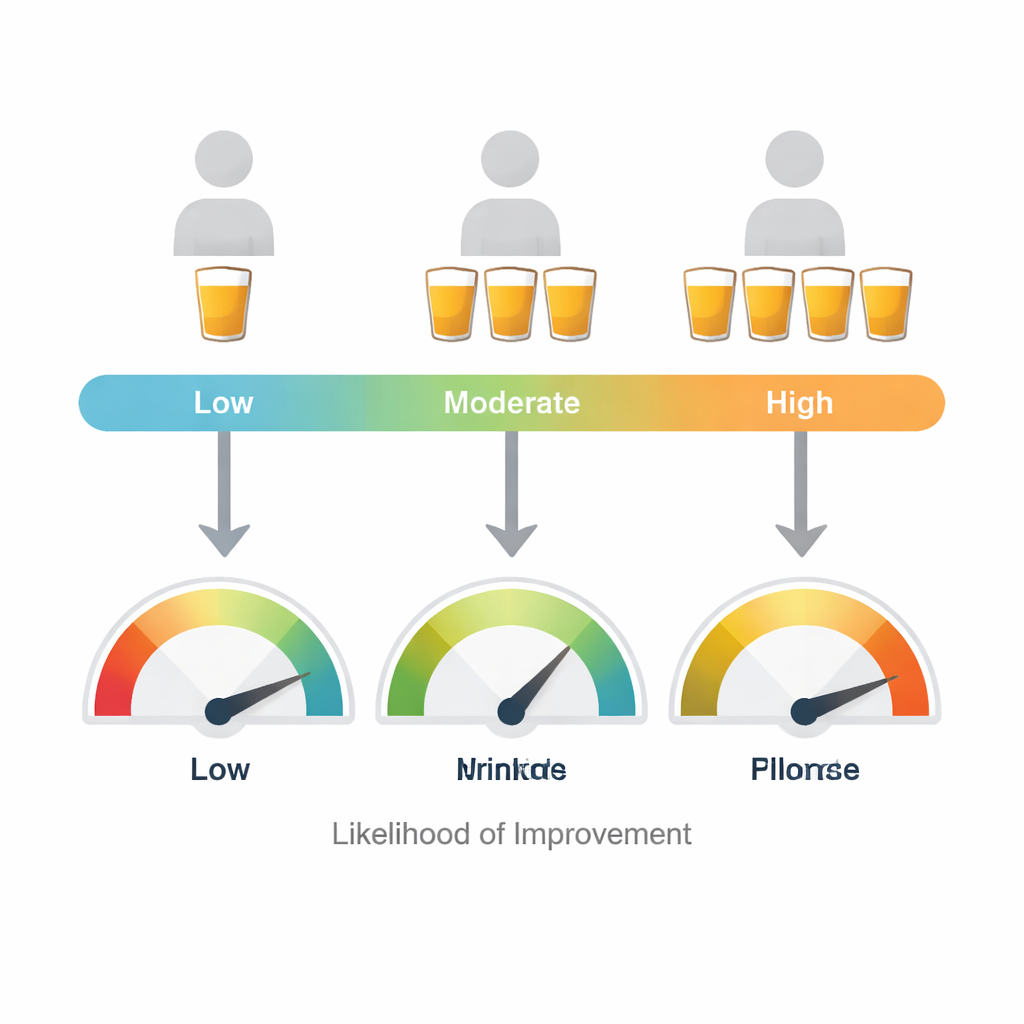
Moderate, Frequent Drinkers Are the Sweet Spot
Looking more closely, the intervention worked best for students who saw their heaviest‑drinking peers as regular but not extreme drinkers—roughly one to two drinking occasions per week and a couple of drinks each time. Those who viewed their peers as very infrequent drinkers were less likely to change, perhaps because drinking was already rare in their circles. Those who believed their peers drank very heavily also did not benefit as much, possibly because social pressure to drink was too strong for brief text reminders to counter. Strikingly, it was these perceptions that mattered, not the peers’ actual self‑reported drinking. Students tended to underestimate how much their heaviest‑drinking friends truly drank, yet their beliefs still shaped who responded.
What This Means for Everyday Life
For non‑specialists, the takeaway is that our beliefs about what friends do can strongly influence how well simple digital tools help us cut back on alcohol. A short questionnaire about perceived peer drinking—a low‑cost, easy‑to‑deliver measure—was enough for algorithms to make reasonably accurate predictions about who would benefit from a text‑based distancing program. In future, apps could use just a handful of questions about your social circle to decide whether to offer a standard program, a more intensive version, or a different type of support. While more work is needed in larger and more diverse groups, this research shows that smarter, more personalized digital help for alcohol use may be only a few well‑chosen questions away.
Citation: Fuchs, M., Boyd, Z.M., Schwarze, A. et al. Predicting individual differences in digital alcohol intervention effectiveness through multimodal data. npj Digit. Med. 9, 170 (2026). https://doi.org/10.1038/s41746-026-02356-4
Keywords: digital alcohol intervention, peer drinking perceptions, psychological distancing, machine learning in health, college drinking