Clear Sky Science · en
Remote digital cognitive assessment for aging and dementia using the Oxford Cognitive Testing Portal OCTAL
Why testing your memory from home matters
As we live longer, many people worry about their memory and risk of dementia—but getting a proper check-up often means long waits, travel to a clinic, and pen-and-paper tests that haven’t changed in decades. This study introduces a new way to measure thinking skills entirely through an ordinary web browser, so people can be assessed at home, in just a few minutes, with accuracy comparable to specialist clinic tests.
A web portal for everyday brain checks
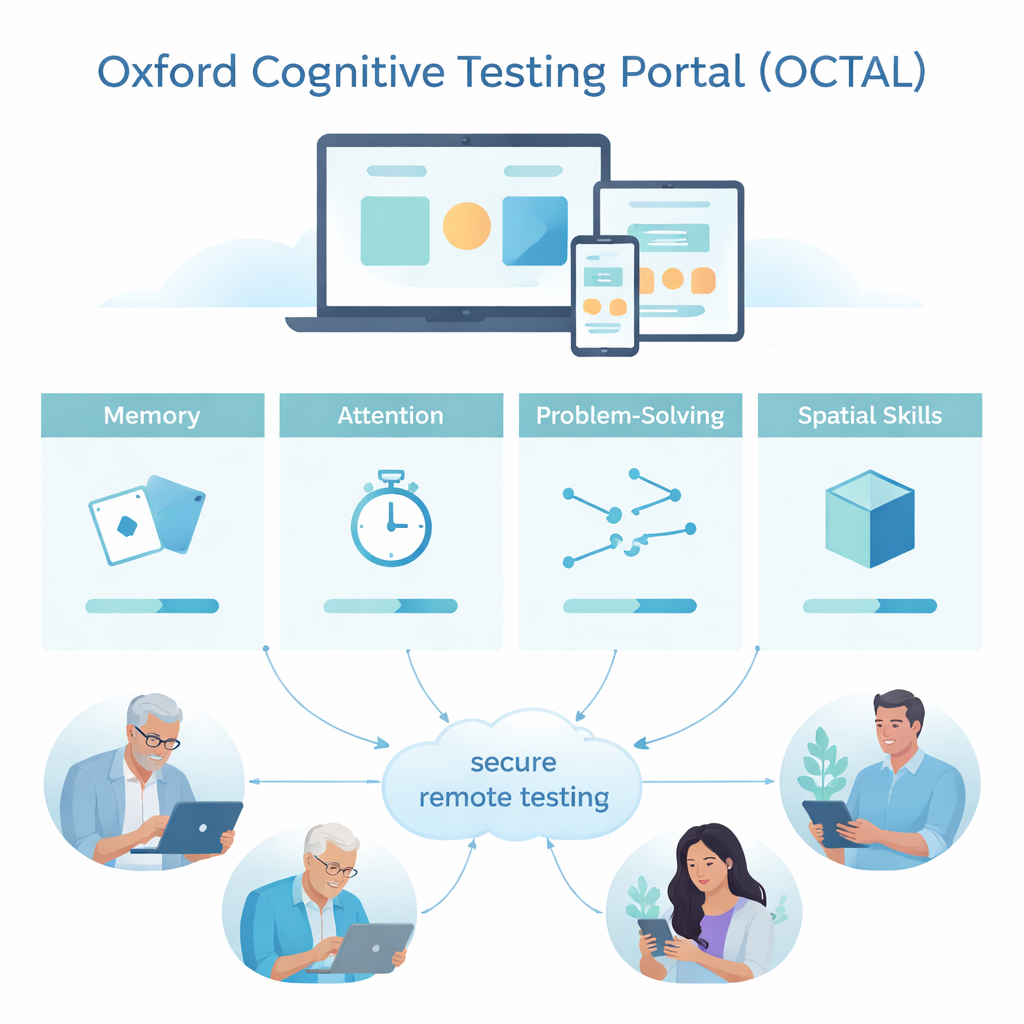
The Oxford Cognitive Testing Portal, or OCTAL, is an online collection of short games that probe different aspects of thinking. Using a laptop or tablet, people complete tasks that test how quickly they match symbols, how well they follow trails of numbers and letters, how accurately they copy and recall a complex picture, and how well they remember objects, scenes, and word lists. Unlike traditional tests that simply give a total score, OCTAL records reaction times and precise mistakes, creating a rich fingerprint of a person’s memory, attention, and problem-solving abilities. The system runs in an ordinary web browser, needs no special hardware, and is designed so researchers can plug it into common survey and experiment platforms.
Works across languages and across the lifespan
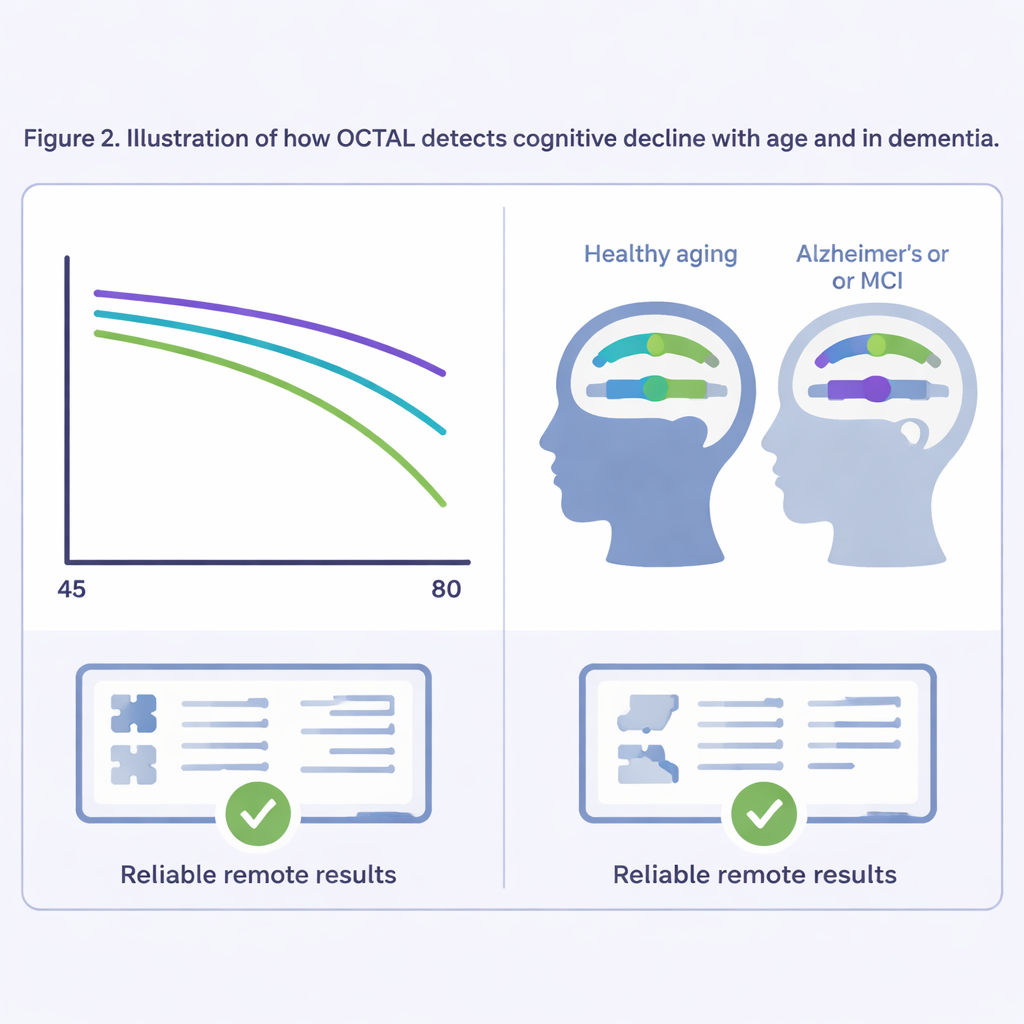
The researchers first asked whether OCTAL would work similarly in people from different cultures. They tested 361 young adults in the United Kingdom and mainland China, each using a version of the tasks in their native language. For almost all key measures, Chinese and English speakers performed within the same normal range, suggesting the tasks travel well across languages. A second, much larger study of more than a thousand UK adults aged 18 to 85 mapped how thinking skills change with age. It showed that abilities linked to speed and flexible thinking—like quickly matching symbols or switching between numbers and letters—start to decline from the mid‑40s. In contrast, many forms of memory, such as recalling pictures or word lists, stay in the youthful range until people reach their 70s. These patterns match what decades of aging research have found, but OCTAL captures them with far more detail.
Spotting dementia as well as a clinic visit
Next, the team tested OCTAL in 194 people seen in a memory clinic, including healthy volunteers, individuals with mild memory complaints, people with mild cognitive impairment, and patients with early Alzheimer’s disease. Everyone completed both the online OCTAL tasks and a widely used face‑to‑face paper test called the Addenbrooke’s Cognitive Examination (ACE‑III). OCTAL scores strongly mirrored the clinic test: people who scored poorly on ACE‑III also showed clear problems on specific OCTAL tasks. A 20‑minute subset of three tasks—copying and recalling a complex figure, remembering objects in scenes after a delay, and a timed trail‑making test—distinguished those with Alzheimer’s or mild cognitive impairment from those with only subjective worries even better than ACE‑III. A stripped‑down 5‑minute combination of tasks matched the clinic test’s ability to separate impaired from unimpaired individuals.
Reliable results over time from your own device
For any tool meant to track brain health, stability over time is crucial. In a follow‑up with 118 participants, including patients with dementia, the researchers repeated both OCTAL and ACE‑III three times over six months. Almost all OCTAL measures showed “good” to “excellent” reliability by standard statistical criteria, comparable to or approaching that of the clinic test. Importantly, the scores did not depend strongly on screen size or type of computer, and built‑in checks could flag participants who were not fully engaged. Some small differences emerged in reaction times between countries, likely reflecting differences in internet infrastructure or language demands, but the core memory and accuracy measures remained robust.
What this means for people worried about their memory
In plain terms, this work shows that carefully designed online tasks can match, and in some cases outperform, traditional clinic‑based paper tests for detecting early dementia—while taking less time and no travel. OCTAL’s fine‑grained digital measures can reveal which specific thinking abilities are changing and can be repeated safely over months or years. That makes it a promising tool for large research studies, future blood‑test–based screening programs, and routine check‑ups for people concerned about their memory, all delivered through a simple, secure browser session at home.
Citation: Zhao, S., Toniolo, S., Tang, QY. et al. Remote digital cognitive assessment for aging and dementia using the Oxford Cognitive Testing Portal OCTAL. npj Digit. Med. 9, 162 (2026). https://doi.org/10.1038/s41746-026-02346-6
Keywords: digital cognitive testing, remote dementia screening, online memory assessment, Alzheimer’s early detection, aging and cognition