Clear Sky Science · en
Economic evaluation of a digital symptom checker for endometriosis using a Markov decision process model
Why this matters for everyday health
Many people live for years with severe period pain, exhaustion, and fertility problems without knowing the cause is endometriosis, a common but often overlooked condition. This study asks a simple question with big real‑world consequences: can a smart, app‑based symptom checker help people recognize possible endometriosis earlier, reach doctors sooner, and actually save money for both families and the health system?
A hidden condition with a heavy price
Endometriosis affects an estimated 6–10% of women of reproductive age and can cause chronic pelvic pain, painful periods, and difficulties getting pregnant. Because symptoms can look like many other problems and there is no easy, routine test, diagnosis is often delayed by seven years or more. During this long wait, people may cycle through repeated doctor visits, emergency appointments, and trial‑and‑error treatments, all while struggling at work and at home. In the U.S., the total yearly cost of endometriosis, including lost productivity, is believed to reach tens of billions of dollars.
How a digital symptom checker could help
The researchers evaluated “Flo SC,” a chat‑style tool within a popular women’s health app that asks structured questions about pain, bleeding patterns, and other clues, then tells users whether their symptoms might fit endometriosis and suggests when to see a doctor. Instead of replacing doctors, the tool is meant to nudge users toward appropriate care earlier. To test its potential impact, the team built a long‑term computer model following 10,000 hypothetical 20‑year‑old women in the United States over 40 years. One group used standard care alone—seeking help only when they chose to—while the other could also use the symptom checker, which influenced how quickly they recognized a problem and booked appointments. 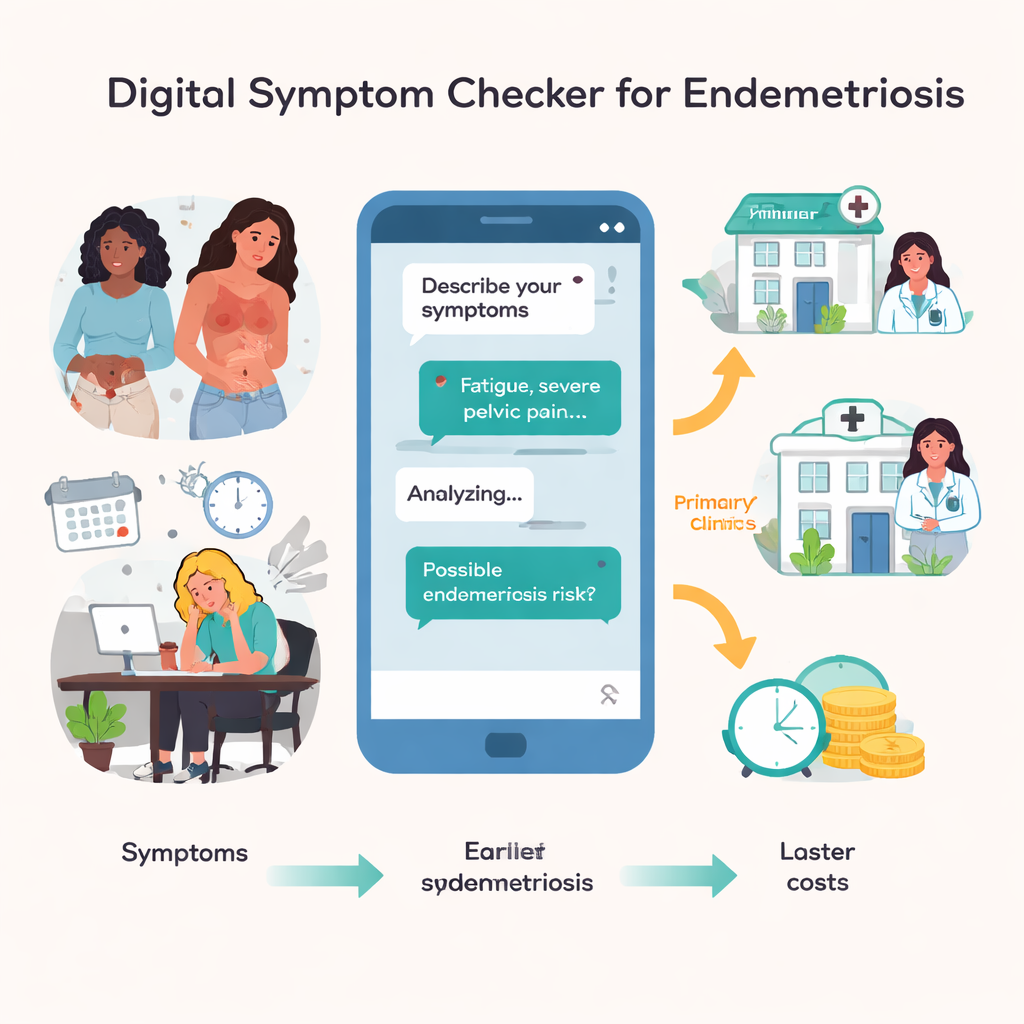
Following patients and costs over a lifetime
The model traced each woman’s journey through stages such as symptom onset, first doctor visit, correct or incorrect diagnosis, treatment, relapse, menopause, and death. For each pathway, the researchers added up medical spending (visits, tests, treatments and surgery) and indirect costs like missed work, as well as quality‑of‑life scores reflecting pain and day‑to‑day functioning. They then compared overall health and costs between the two groups using a standard measure called the quality‑adjusted life year, which bundles how long and how well people live into a single number. To reflect real uncertainty, the team repeatedly re‑ran the model while randomly varying key inputs such as the app’s accuracy, how many people use it, how many follow its advice, and how expensive care is.
Earlier answers, lower spending
The results suggest the symptom checker could be both health‑improving and money‑saving. On average, using the tool shortened the delay to diagnosis by about 4.4 years, shifting the typical wait from roughly seven years down to under three. Over a lifetime, this earlier recognition brought a small but real gain in quality‑adjusted life (about 0.05 extra quality‑adjusted years per person) and cut total costs by around $5,200 per person, mainly by reducing repeated doctor visits and unnecessary tests before diagnosis. When the researchers attached a dollar value to better health, the symptom checker delivered a large positive “net benefit,” and in nearly 94% of the simulated scenarios it was both more effective and cheaper than standard care alone. The tool performed best when it was reasonably accurate (correctly flagging and ruling out endometriosis at least 70% of the time) and when users actually acted on its advice to seek care. 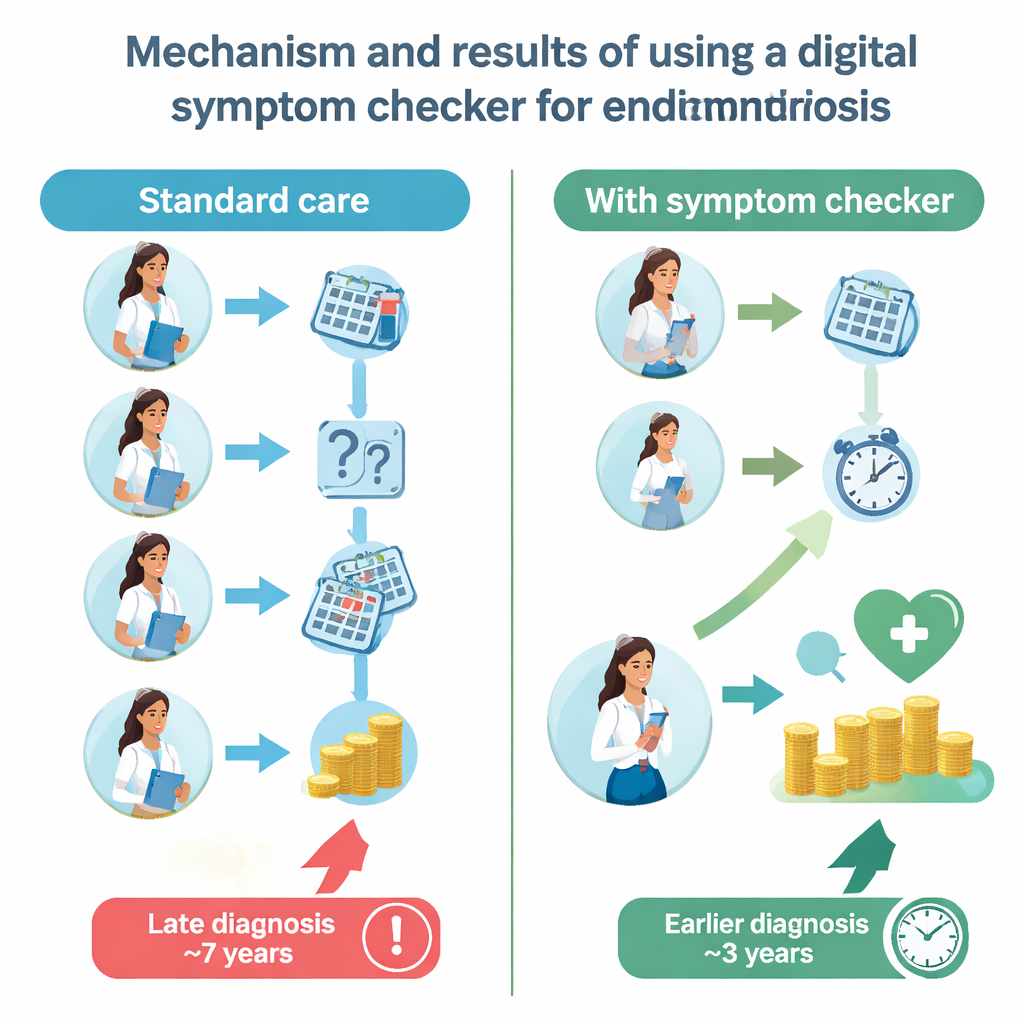
When digital tools add the most value
The study highlights that the greatest payoff comes in settings where people are slow to seek help on their own and where delays are especially costly. If users rarely follow the app’s recommendation—such as ignoring advice to see a doctor—the benefits mostly disappear, and the tool can even increase spending. However, across a wide range of assumptions about subscription price, usage rates, and how often women check symptoms, the symptom checker remained cost‑saving and helpful as long as a reasonable share of users trusted and followed its guidance. The authors note that the health gains are modest because endometriosis rarely shortens life; the main advantage is years of reduced pain and fewer disruptions to work and home life.
What this means for patients and health systems
For someone wondering whether their painful periods are “just normal,” this research suggests that a well‑designed symptom‑checking app could be a useful extra ally, not a replacement for medical care. By prompting earlier conversations with doctors and helping focus attention on possible endometriosis, such tools may shorten years of uncertainty and repeated appointments, while also lowering overall costs. For health systems facing tight budgets, the study offers early evidence that investing in digital triage tools for underdiagnosed, high‑burden conditions can pay off—provided the tools are accurate enough and people feel able and willing to use and trust them.
Citation: Xu, Y., Prentice, C., Torres-Rueda, S. et al. Economic evaluation of a digital symptom checker for endometriosis using a Markov decision process model. npj Digit. Med. 9, 128 (2026). https://doi.org/10.1038/s41746-025-02332-4
Keywords: endometriosis, digital symptom checker, women's health, health economics, diagnostic delay