Clear Sky Science · en
High UV sensitivity in graphene-silicon Schottky photodiodes in industry standard packaging
Why Better UV Sensors Matter
From tracking ozone holes to monitoring industrial flames and sterilizing medical tools, ultraviolet (UV) light sensors quietly underpin a wide range of modern technologies. Today, most of these sensors are made from traditional silicon or more costly materials like silicon carbide and gallium nitride. This article explores a new kind of UV photodiode that combines graphene—a single-atom-thick form of carbon—with silicon, and then packages it using the same hardware and stress tests used in commercial electronics. The work shows that these tiny devices can detect UV light more efficiently than many existing products while surviving harsh industrial conditions, hinting at more capable and affordable UV detectors in the near future. 
A New Twist on a Familiar Chip
The core idea is to build a light sensor by stacking graphene directly onto a silicon chip. Graphene is unusually transparent and allows electrical charges to move with very little resistance. When a thin sheet of graphene is laid on top of n‑type silicon, it does not form the usual deep junction inside the crystal; instead, it creates a so‑called Schottky contact right at the surface. The researchers further pattern the surface into two interlocking regions: exposed silicon areas where the graphene forms the light‑sensitive contact, and neighboring areas where a thin silicon dioxide layer sits between graphene and silicon, acting as a capacitor. This interdigitated layout helps sweep up the charges created when light enters the silicon, turning incoming UV photons into a stronger electrical signal.
Putting the New Sensors Up Against Today’s Best
To judge whether these graphene–silicon photodiodes are practical, the team compared them against off‑the‑shelf silicon UV detectors built into the same metal can package. They tested two versions of their device—one using commercially sourced graphene and another using graphene grown in their own lab—and measured how much current each produced when illuminated with UV light at 277 nanometers and violet light at 405 nanometers. Before packaging, the home‑grown graphene devices delivered about twice the responsivity of the commercial silicon diodes at 277 nanometers, while the other graphene devices still did about twice as well. Even at 405 nanometers, where conventional silicon performs better, the graphene designs maintained a clear edge. After packaging in metal cans with UV‑transparent windows, all sensors lost some efficiency because of extra glass and metal in the light path, but the graphene–silicon devices still outperformed their silicon counterparts.
Why Graphene Helps at Ultraviolet Wavelengths
The superior UV performance arises from where light is absorbed inside silicon. Short‑wavelength UV photons are stopped very close to the surface, while longer‑wavelength visible and infrared photons can travel deeper. In standard silicon photodiodes, the key junction that separates charges is buried below the surface. That works well for visible light that reaches the junction, but many UV photons are absorbed before they get that far, and their charges are mostly lost as heat. In the graphene–silicon design, the sensitive junction sits right at the surface where those UV photons are absorbed. As a result, more of the newly created electrons and holes are immediately pulled apart by the built‑in electric field and collected as useful current. Measurements confirm that these devices not only beat commercial silicon and gallium nitride photodiodes in the UV range, but also come close to the performance of specialized silicon carbide detectors, which are known for their strong UV response but are harder and more expensive to manufacture.
Surviving Heat, Cold, and Humidity
Impressive performance alone is not enough; industrial components must also last for years in demanding environments. To test this, the authors packaged their best graphene–silicon devices in two ways: a simple polymer‑filled frame that lets air and moisture seep in, and a fully sealed metal can with a glass window. They then subjected the sensors to standard industry stress tests that cycle between very low and very high temperatures, bake the devices at high heat, and expose them to hot, humid air for hundreds of hours. Under dry heat and rapid temperature swings, both the light‑generated current and the background dark current remained remarkably stable, drifting by amounts comparable to experimental uncertainty. Under prolonged humidity in the non‑sealed package, however, water molecules soaked into the device, stuck to the graphene, and altered its electrical properties, causing noticeable shifts in the sensor response. When the same humidity test was repeated with hermetically sealed packages, these drifts were kept to a modest level, and the dark current barely changed. 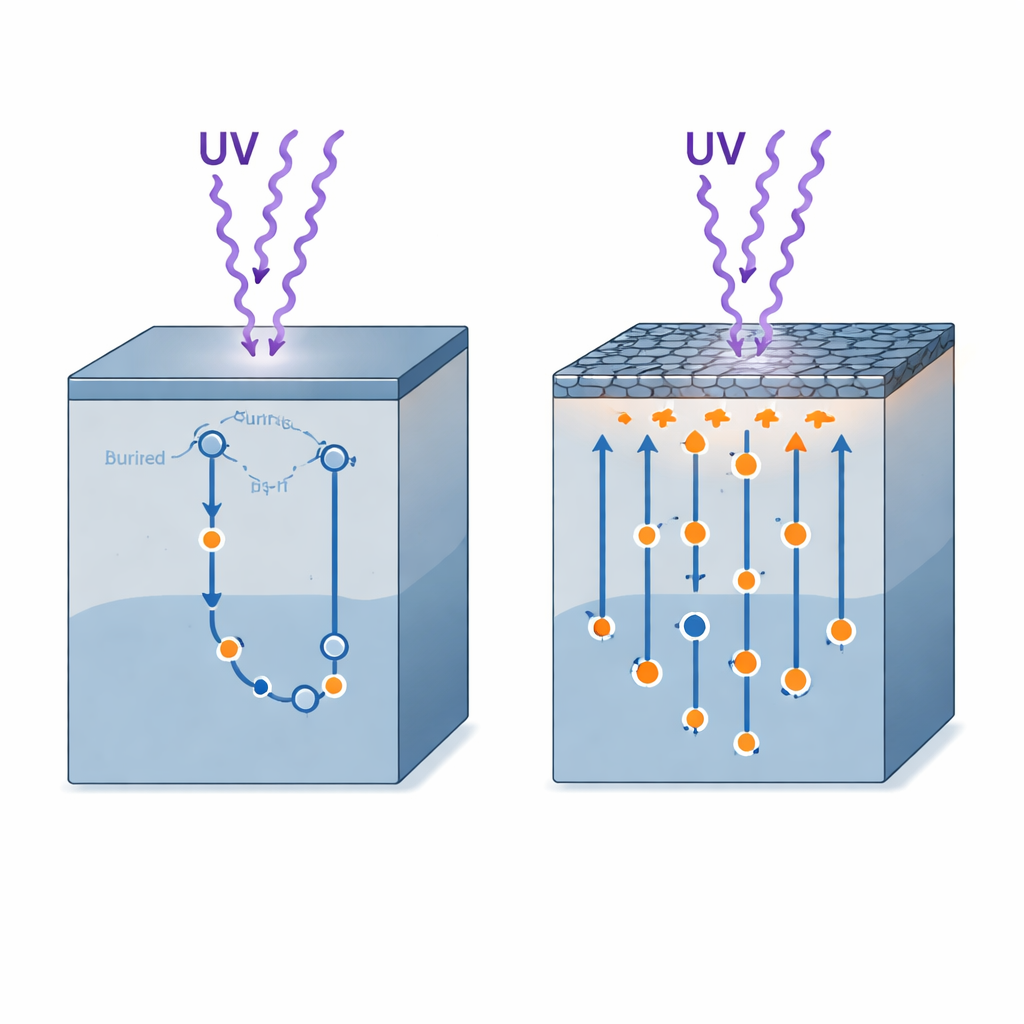
What This Means for Future UV Detectors
Overall, the study shows that by carefully arranging a single layer of graphene on top of silicon and using industry‑standard packaging, it is possible to create UV photodiodes that rival or surpass many current commercial options while remaining compatible with existing chip factories. The devices are especially sensitive to UV light because they place the active junction exactly where those photons are absorbed, and they can survive the same rigorous thermal and aging tests used to qualify everyday semiconductor components—provided they are packaged against moisture. This combination of high performance, robustness, and manufacturing friendliness suggests that graphene–silicon photodiodes could soon become practical building blocks for more compact, efficient, and affordable UV sensing systems.
Citation: Esteki, A., Gebauer, C.P., Avci, J. et al. High UV sensitivity in graphene-silicon Schottky photodiodes in industry standard packaging. npj 2D Mater Appl 10, 34 (2026). https://doi.org/10.1038/s41699-026-00678-1
Keywords: graphene photodiode, ultraviolet sensor, silicon electronics, Schottky junction, device reliability