Clear Sky Science · en
Active dual-gated graphene transistors for low-noise, drift-stable, and tunable chemical sensing
Listening to Molecules with Tiny Carbon Wires
Imagine a medical patch that continuously tracks stress hormones, air quality, or signs of infection from a single tiny chip. Today’s chemical and biological sensors are edging toward that vision, but they often struggle with unstable signals and electrical noise. This paper describes a new kind of graphene-based transistor that acts like an ultra-sensitive, yet remarkably steady, electronic nose and tongue, designed for real-time monitoring in everyday environments.
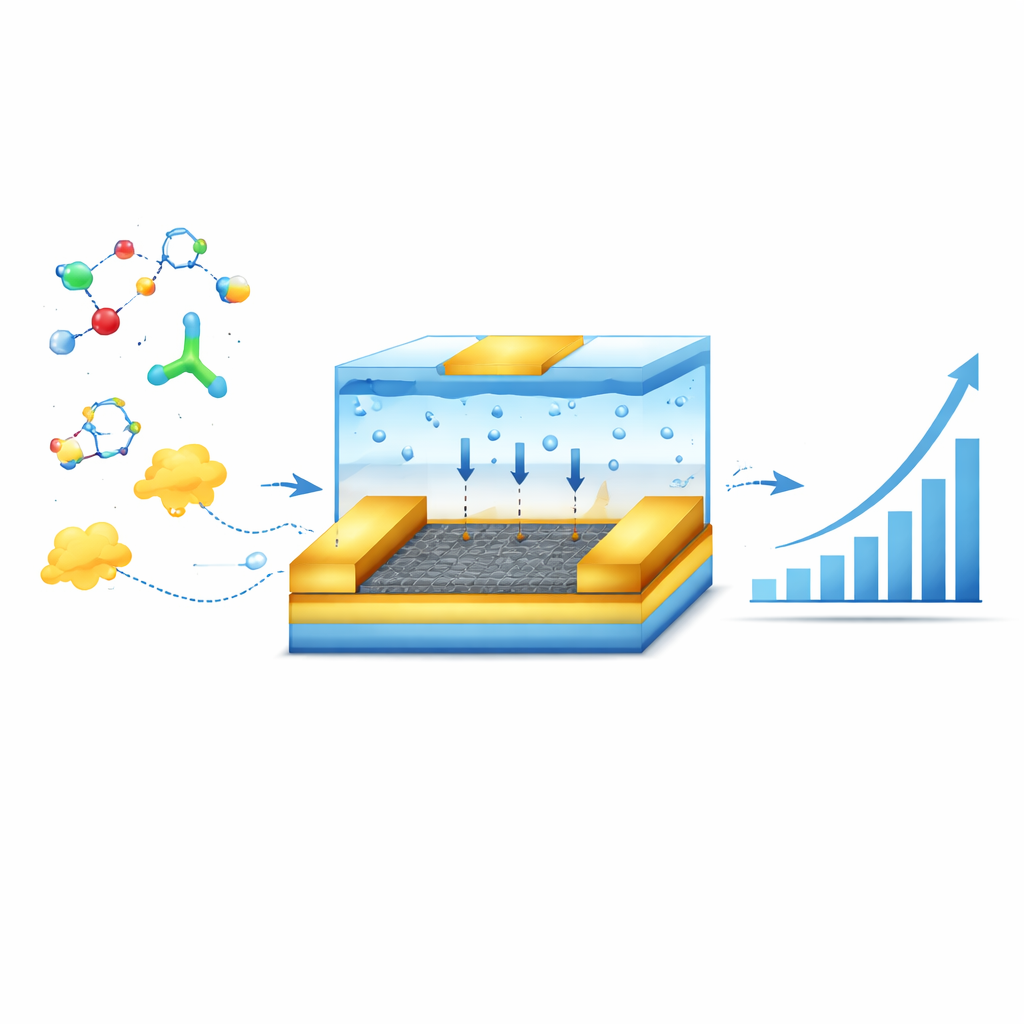
Why Graphene Is a Powerful Sensing Material
Graphene is a one-atom-thick sheet of carbon that conducts electricity extremely well and exposes every atom directly to its surroundings. When molecules land on graphene or nearby surfaces, they subtly change how charge flows through it, and that change can be read out electrically. Conventional graphene sensors typically use a single “gate” electrode to control this flow, especially in liquids. But in such set‑ups, the signal can drift over time, and repeated voltage sweeps used to boost sensitivity actually make things worse, causing trapped charges, hysteresis, and noisy, wandering baselines. These problems have limited the reliability of graphene sensors outside carefully controlled laboratory conditions.
Adding a Second Handle for Better Control
The authors introduce a dual-gated design that gives the transistor two independent “handles” instead of one. Above the graphene channel, a liquid forms a very thin charged layer that acts as a top gate, highly sensitive to ions and molecules in the solution. Beneath the graphene, they build a compact local back gate insulated by a thin layer of high‑dielectric hafnium dioxide. Because the liquid gate and solid gate have very different electrical capacitances, a small disturbance at the liquid side—caused by a change in pH or molecule binding—can be translated into a much larger voltage shift at the back gate. In effect, the device behaves like a built‑in electronic amplifier that magnifies chemical events occurring at its surface.
Using Smart Feedback to Tame Drift and Noise
Beyond the physical design, the key advance is an operating scheme called Differential Mode Fixed. In this mode, the liquid gate voltage is held steady while the back gate is continuously adjusted by simple electronics so that the current through graphene stays constant. When molecules alter the surface potential at the liquid interface, they try to change the current; the feedback loop immediately counters by nudging the back‑gate voltage. The size of that voltage adjustment becomes the sensor’s output signal. Because the liquid gate is not swept back and forth, slow drifts and hysteresis are largely suppressed. At the same time, the capacitive imbalance between the two gates amplifies the response, turning tiny molecular effects into easily measurable voltage shifts, while pushing much of the electrical noise out of the current channel.
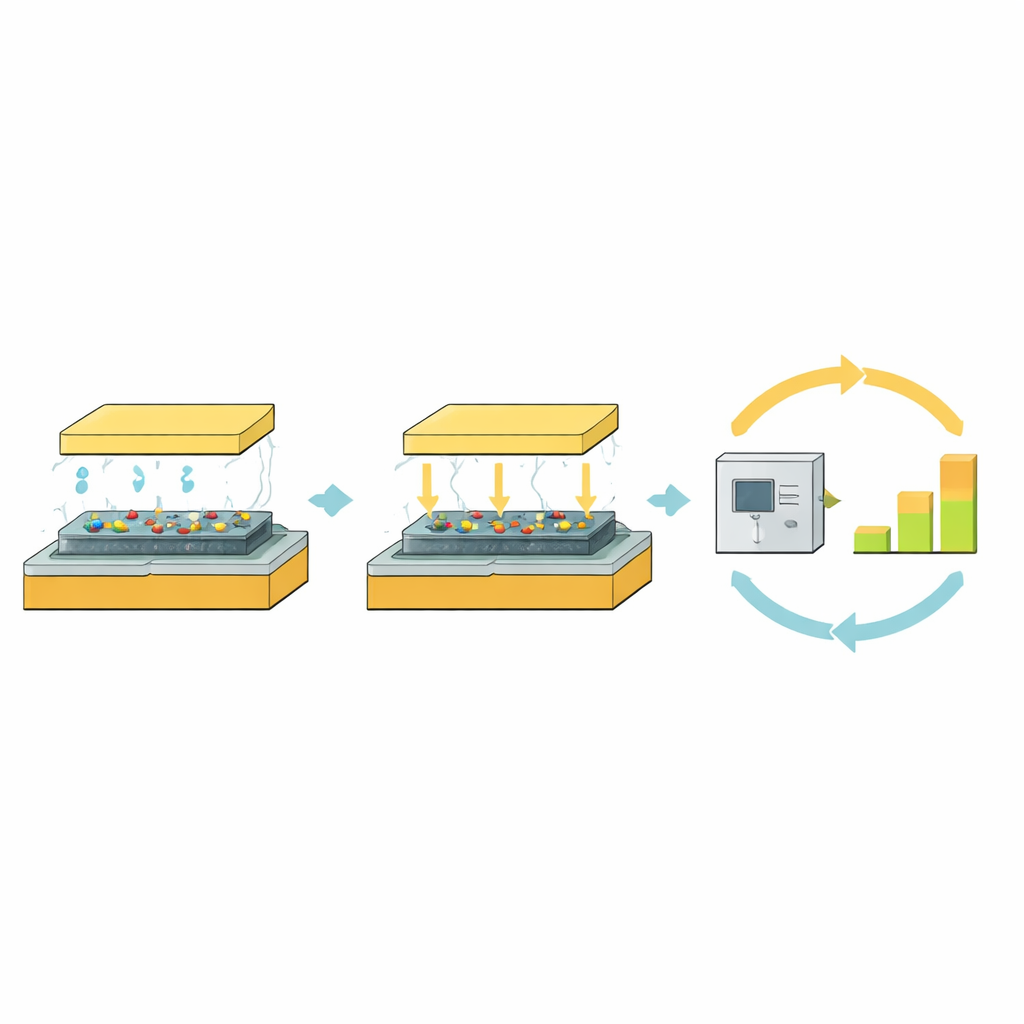
Testing with Real-World Chemical Targets
To show that this approach is broadly useful, the researchers tested the device on a diverse set of targets. It accurately tracked changes in acidity (pH), a classic benchmark for liquid sensors, but with an effective response more than six times larger than standard modes, even though the fundamental chemical limit is unchanged. It detected redox-active neurotransmitters—small brain-related molecules like dopamine—with about 20‑fold higher sensitivity than a simple single‑gate setup. With the graphene surface coated in antibodies, it picked up a protein signal linked to inflammation (the cytokine IL‑6) at roughly ten times lower concentration than before. The same platform also sensed persistent water pollutants such as perfluorooctanoic acid at parts‑per‑billion levels, and vapors of a common solvent, isopropyl alcohol, with enhanced response and far less signal drift over time.
Toward Practical, Portable Chemical Monitors
Crucially, this dual-gated, feedback‑controlled design does not rely on exotic readout hardware. The authors implemented it using off‑the‑shelf amplifiers, digital converters, and relay switches on a compact circuit board that can address many graphene channels at once. Across these channels, they achieved more than 20× higher sensitivity, up to 7× better signal‑to‑noise ratio, and over 15× lower drift compared with traditional single‑gate, sweep‑based measurements. While the exact amplification depends on the liquid environment and must be calibrated, the concept is flexible and can be adapted to other two‑dimensional materials and sensing chemistries. For a non‑specialist, the takeaway is that this work turns graphene transistors from delicate lab instruments into robust, tunable “electronic senses” that can maintain clear, stable readings over long periods—an important step toward wearable health monitors, smart food and water testing, and compact environmental surveillance tools.
Citation: Kammarchedu, V., Asgharian, H., Chenani, H. et al. Active dual-gated graphene transistors for low-noise, drift-stable, and tunable chemical sensing. npj 2D Mater Appl 10, 37 (2026). https://doi.org/10.1038/s41699-026-00674-5
Keywords: graphene sensors, chemical sensing, biosensors, dual-gate transistors, environmental monitoring