Clear Sky Science · en
MXene-MoS2 engineered heterostructured vertical memristors array: high-performance non-volatile memory with scalable integration
Smarter Memory for the Age of Artificial Intelligence
As our phones, cars, and online services become more intelligent, they need tiny devices that can store and process information the way our brains do—quickly, efficiently, and in huge numbers. This paper presents a new kind of electronic building block, a "memristor," built entirely from ultrathin sheet-like materials. The device not only remembers past electrical signals but can also mimic basic learning and forgetting behaviors, making it a promising element for future brain-inspired computers.

Why New Memory Devices Are Needed
Conventional computer chips shuttle data back and forth between separate logic and memory units, which wastes time and energy. For truly efficient artificial intelligence and neuromorphic hardware—circuits that function more like networks of brain cells—researchers are turning to memristors. These components switch between high and low resistance states when voltage is applied, thereby storing information directly where it is processed. Two-dimensional materials only a few atoms thick are especially attractive here because they can be packed densely, operate at low voltages, and be integrated over large areas.
Layering Ultra-Thin Materials Like a Nano Sandwich
The team demonstrates a new vertical memristor that combines two classes of atomically thin materials. At the bottom is MXene, a highly conductive sheet made of metal carbides that forms a smooth, solution-processed electrode. On top of this they place few-layer molybdenum disulfide (MoS₂), a well-studied semiconductor whose thickness is just a few atomic layers yet still electrically robust. Finally, a silver layer serves as the top electrode. This vertical stack—MXene/MoS₂/silver—is repeated in an array of 5 by 5 devices on a single glass substrate, showing that the approach can be scaled rather than being limited to one-off laboratory structures.
Checking the Structure at the Atomic Scale
To make sure the stack is well formed and stable, the researchers use a suite of structural probes. Optical and atomic force microscopy confirm that the MoS₂ flakes cover the MXene evenly and that the active area of each device is well controlled. X-ray diffraction reveals that the crystalline arrangement of both MXene and MoS₂ remains intact before and after extensive electrical testing, suggesting that switching does not damage the lattice. Raman spectroscopy, which measures characteristic vibrational "fingerprints" of the atoms, shows signatures consistent with few-layer MoS₂ and provides evidence for a clean interface between the materials. High-resolution electron microscopy and nanoscale current mapping further uncover grain boundaries and tiny defects in the MoS₂ where silver can later migrate.
How the Device Remembers and Learns
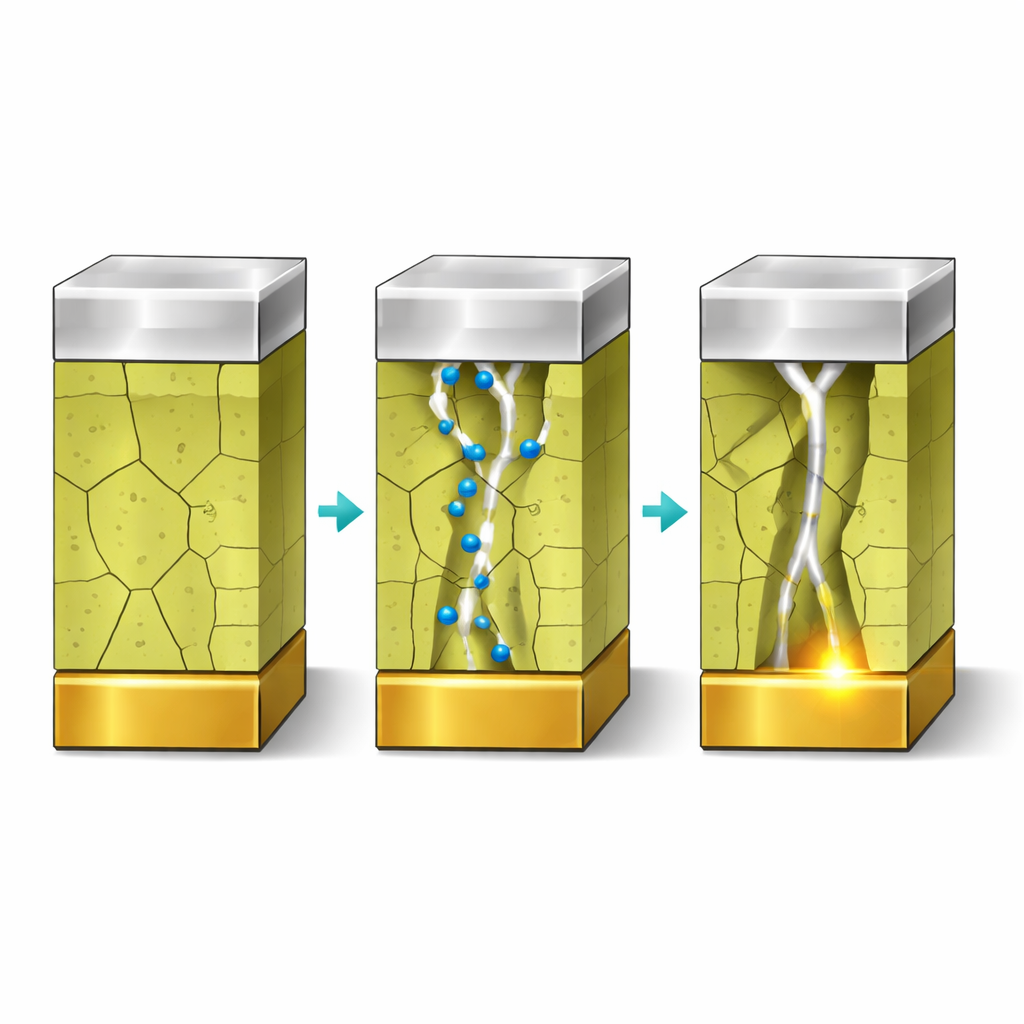
Electrically, the best-performing structure uses a double MXene bottom electrode made of titanium carbide and vanadium carbide beneath the MoS₂. When a small positive voltage is applied, silver from the top electrode drifts into the MoS₂ layer along grain boundaries and vacant atomic sites, forming narrow, metallic paths that connect the top and bottom electrodes. The device then jumps from a high-resistance to a low-resistance state at about 0.6 volts and stays there even when power is removed, behaving as non-volatile memory. A negative voltage breaks or thins these paths, resetting the device. Temperature-dependent tests confirm that the low-resistance state is carried by metallic filaments, while modeling shows that both filament formation and a more localized "conductive point" at a single vacancy contribute to switching.
Reliability, Endurance, and Brain-Like Behavior
Beyond single devices, the authors analyze 18 memristors in the array to assess how reproducible the switching is from cell to cell and over many cycles. Most of the devices switch on and off near the same voltages, with modest variation, and can endure about 3,000 cycles while maintaining a consistent contrast between the high and low resistance states. Retention tests indicate that the memory states can last for at least thousands of seconds and, when extrapolated, up to around a million seconds (on the order of weeks). Importantly, when the team applies sequences of positive and negative pulses, the device conductance gradually increases (potentiation) or decreases (depression), closely resembling how biological synapses strengthen or weaken with repeated activity.
What This Means for Future Electronics
In plain terms, this work shows that carefully stacking ultra-thin MXene and MoS₂ sheets can yield tiny, energy-efficient memory elements that not only store data reliably but also exhibit simple learning-like behaviors. The combination of low operating voltage, decent endurance, scalable fabrication, and synaptic-like response suggests that such all-2D-material memristors could form dense networks for future artificial intelligence hardware, bridging the gap between today’s rigid digital chips and brain-inspired computing systems.
Citation: Sattar, K., Babichuk, I.S., Khan, S.A. et al. MXene-MoS2 engineered heterostructured vertical memristors array: high-performance non-volatile memory with scalable integration. npj 2D Mater Appl 10, 36 (2026). https://doi.org/10.1038/s41699-026-00673-6
Keywords: memristor, two-dimensional materials, MXene, MoS2, neuromorphic computing